Get Full Government Meeting Transcripts, Videos, & Alerts Forever!
Get email alerts on the Housing Legislation topic
No spam. Unsubscribe anytime.
Oregon City staff brief commissioners on new state housing laws; planning code changes expected
Summary
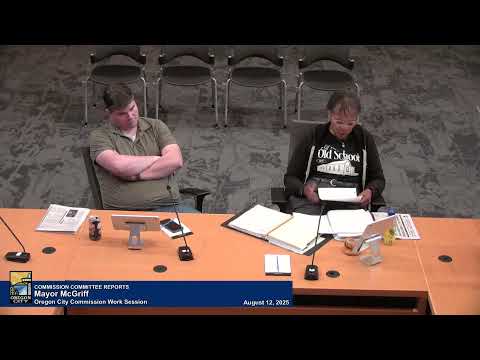
City Attorney Carrie Richter briefed the Oregon City Commission on Aug. 12 about 2024 and 2025 state housing legislation that will require local code changes, including limits on design standards for certain housing, new post‑entitlement review timelines and expanded middle‑housing rules.
City Attorney Carrie Richter briefed the Oregon City Commission on Aug. 12 about major housing bills from the 2024 and 2025 Oregon Legislature and what the city will need to change in local code and procedures.
"The purpose of this quick presentation is to share with you some of the more important bills that came out of the 2025 legislature regarding ... housing," Richter said. She told commissioners the briefing was intended to highlight measures "that Salem says we must do" and to give staff time to prepare code amendments and process changes.
Why it matters: Richter said several measures narrow local discretion and create new state timelines that will affect development review, historic-district design review and what kinds of local requirements the city may apply to middle housing, single-room-occupancy (SRO) projects and greenfield subdivisions. Staff flagged several items that will require code work, new internal procedures and outreach to applicants and the public.
Key points Richter highlighted: - Senate Bill 1537 (2024) adjustment/exemption process: Oregon City applied for an exemption from the statute's mandatory adjustment requirement; that application is in the Housing Accountability and Production Office (HAPO) notice period. "We expect a decision in the fall," Richter said. HAPO reviews adjustment applications and can grant full approval (broad exemption), a limited approval covering some adjustments, or a denial. - Senate Bill 974 (referred to in the presentation as "9 74"): includes a design-standard preemption for certain housing projects (for example, greenfield subdivisions of 20 or more single-family or middle-housing lots and some small multi‑unit projects). Richter warned this provision can waive many facade, roof and porch design controls even inside historic districts for qualifying projects; it does not waive height or setback limits. The bill also imposes an expedited "shot clock" for post-entitlement reviews: a 14-day completeness period followed by a 120‑day decision deadline (with specified extensions) for building, public-works and engineering reviews, operable one year from enactment. - Public notice and limited land-use decisions: Richter said SB 974 expands which matters can be processed as "type 2" (limited land-use) decisions with notice only to addresses within 100 feet and review by the planning director, with a de novo appeal to the city commission. As she put it, "You cannot give more notice than 100 feet" under the statute; the commission will still hold de novo hearings on appeal but the planning commission will no longer be the intermediate hearing body for those items. - House Bill 2138 (described in the briefing as the governor's middle‑housing bill): creates several provisions affecting middle housing. Richter summarized the highlights: no required traffic study or off‑site exactions for middle‑housing developments of 12 or fewer units (or on lots created within five years); added density incentives for units recorded as affordable or accessible (a covenant is required to document affordability/accessibility); and new rules expanding density and lowering parking for single‑room‑occupancy units in multifamily zones. She said parts of the bill apply retroactively in some cases and that enforcement of private covenants (CC&Rs) will remain a civil matter. - Department and agency rulemaking and templates: Richter said the Department of Administrative Services (DAS) and the Land Conservation and Development Commission (LCDC) will undertake rulemaking and may publish building-plan templates that local governments "must approve" on residentially zoned lots; she warned the templates discussed by staff have limited exemptions (for example, steep slopes) and no explicit exemptions for historic districts in some provisions. Richter also said LCDC/DAS will pursue definitions of "unreasonable cost or delay," and could narrow the permissible criteria in the discretionary "master plan" track for certain developments. - Infrastructure financing: the Legislature authorized a new infrastructure fund for housing with an initial appropriation Richter described as approximately $10 million; she said qualifying projects generally would need to meet density thresholds and that forgivable loans/grants would prioritize very-low, low- or moderate‑income housing.
What staff will do next: Richter and planning staff said the Planning Department will return with draft code amendments to implement procedural changes (shot clocks, post-entitlement timelines, notice provisions and adjustments to design-review procedures) and to propose local definitions and processes where the state left open rulemaking. Richter urged commissioners to expect follow-up code amendments and recommended the commission coordinate with the Planning Department and the city attorney's office for public outreach and internal implementation.
Commissioners asked technical questions about how the bills interact with historic-district review, how the shot-clock will operate when applicants submit incomplete follow-up materials, and whether city code menus of alternatives (the city's existing "menu" approach to certain design standards) will conflict with narrow lists the state requires to be waived. Richter answered those questions and said the city will need to reconcile its menu-style design standards with state limitations.
Richter also cautioned commissioners about new ethics and public‑meeting enforcement guidance from the Oregon Government Ethics Commission (OGEC) discussed during the same briefing: she summarized OGEC staff guidance on serial communications and public-records risks for social-media posts or messages arising during public meetings and said staff could help cure inadvertent violations to reduce penalties.
Ending: Richter closed by saying she will work with planning staff to prepare necessary code amendments and asked commissioners to expect additional briefings and red-line proposals in the months ahead.
Speakers quoted in this article are identified from the work session record and include Carrie Richter (City Attorney) and multiple commissioners and staff who asked or answered technical questions during the presentation.