Get Full Government Meeting Transcripts, Videos, & Alerts Forever!
Get email alerts on the Affordable Housing topic
No spam. Unsubscribe anytime.
Finance committee approves $3.5 million loan to finish financing for Jacaranda Court
Summary
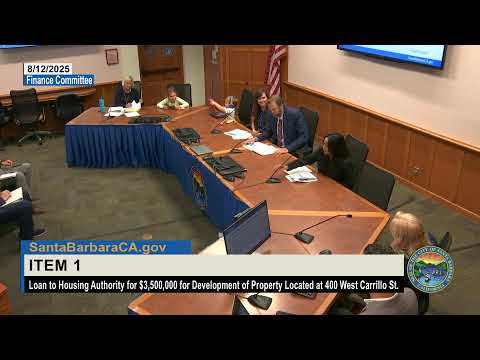
Santa Barbara City Finance Committee voted unanimously Aug. 12 to approve a $3.5 million residual-receipts loan and related actions to complete financing for Jacaranda Court, a 63‑unit permanently affordable rental development at 400 West Carrillo Street.
The Santa Barbara City Finance Committee voted unanimously Aug. 12 to recommend a $3,500,000 loan from the local housing trust fund to the Housing Authority to close a financing gap for Jacaranda Court, a 63‑unit permanently affordable rental development at 400 West Carrillo Street.
The loan, combined with a city donation of the 1.1‑acre parcel and a $10,000,000 equity commitment from the Housing Authority, is intended to allow the project to proceed to building permit issuance and break ground this fall. The loan would be a 30‑year residual‑receipts repayment loan at 3 percent simple interest, secured by a deed of trust; a 90‑year affordability covenant restricting seven low‑income and 55 moderate‑income units would be recorded on the property.
Laura Doubles, the city’s housing and human services manager, told the committee the site at 400 West Carrillo — a downtown parcel appraised at $7,750,000 and formerly used for commuter parking — will be donated to the project and developed by the Housing Authority. Rob Fredericks, executive director of the Housing Authority, said Jacaranda Court "directly targets the most underproduced category" of housing by providing deed‑restricted moderate‑income units with a small low‑income component.
Under the proposal presented to the committee, Jacaranda Court would be a three‑ to four‑story multifamily development with 63 units: 21 studios, 37 one‑bedrooms and five two‑bedrooms; one on‑site manager unit would be unrestricted. Four units would be mobility accessible and two would include communications features for hearing and visually impaired tenants. The project would include 63 at‑grade parking spaces. Seven low‑income units would receive project‑based Section 8 vouchers for rental assistance.
Doubles said the city loan would come from fiscal year 2026 Measure I and general fund reserve allocations to the local housing trust fund and that approving the loan now would fully expend the $3,500,000 allocation for FY26, leaving an approximate balance of $500,000 in the trust fund for operating costs; no additional local housing trust fund awards would be available until FY27. She also said the loan would require an ordinance and a mid‑year budget amendment and that the city administrator would be authorized to execute amendments to the existing project agreement with the Housing Authority.
Fredericks told the committee the total project cost is just under $45,000,000 and that the Housing Authority is offering an unprecedented $10,000,000 equity contribution and deferring a $900,000 developer fee back into the project. He described the funding stack as including a tax‑exempt primary loan from Citibank and a subordinate bond issuance being arranged through Jefferies; both lenders are waiting on the city commitment to finalize the financing. Fredericks said the project has received plan‑check comments and expects a building permit in early September.
Committee members praised the project as serving the "missing middle" of moderate‑income households. Member Harmon asked whether any financing remained contingent beyond the city action; Fredericks replied the lenders are committed but are waiting for the city's commitment to finalize that piece of the capital stack. Committee members also noted higher recent construction costs and prevailing‑wage requirements as drivers of the project's per‑unit cost; staff reported a projected total cost per unit of about $712,086 for the new construction.
At the close of the item, Member Harmon moved to "move staff recommendation" to introduce and adopt the ordinance and authorize the related budget and agreement actions; Member Santa Maria seconded. The committee voted unanimously in favor; the motion passed and will be forwarded to the City Council for final action.
Next steps identified by staff are formal introduction and adoption of the ordinance to provide the loan, a mid‑year budget amendment/resolution to appropriate the funds, and execution of amendments to the project agreement between the city and the Housing Authority. Fredericks said the Housing Authority will finalize required authorizations at its September meeting before construction financing is closed.