Get Full Government Meeting Transcripts, Videos, & Alerts Forever!
Get email alerts on the Budget And Finance topic
No spam. Unsubscribe anytime.
Superintendent presents FY2019 preliminary budget, proposes special education stabilization fund and separate capital articles
Summary
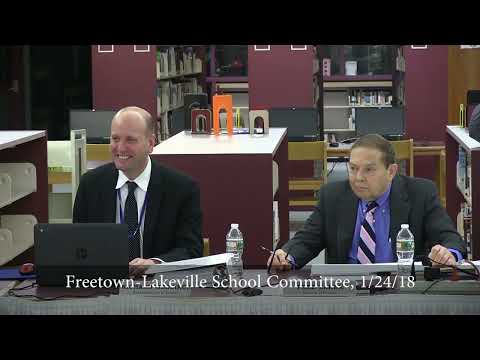
Superintendent Madera told the Freetown-Lakeville Regional School Committee the FY2019 preliminary budget holds assessment increases to town targets for operations but asks both towns to approve a one-time contribution to establish a special education stabilization fund and to vote on a separate capital article for a maintenance vehicle.
Superintendent Madera presented the Freetown-Lakeville Regional School Committee with a preliminary FY2019 budget on Jan. 24 and urged the committee and both towns to consider three separate warrant articles in addition to the operating budget: (1) to establish a special education stabilization fund, (2) to fund an initial balance for that fund as a one‑time contribution, and (3) to finance a replacement maintenance/plow truck for the district.
Madera said the superintendent’s budget is “eager” to begin the process and described it as “cautiously optimistic,” while noting it was built on conservative state‑aid assumptions. The preliminary total spending request is $38,258,474, an increase of $815,635 (2.18 percent) over FY2018, Madera said. He told the committee he had structured the submission so the operational assessment increase to each town would meet the towns’ 2.5 percent target; the combined operational assessment increase equals that town target, but the preliminary package also includes the one‑time special education contribution, which increases each town’s total assessment in the presentation.
Why it matters: Madera and staff framed the special education stabilization fund as a tool to manage large, unforeseen special‑education tuition and placement costs that have repeatedly required mid‑year transfers or other adjustments. The superintendent said the fund would be limited to special‑education uses and require both school committee and town approval before funds could be spent.
Major proposal details
- Special education stabilization fund: Madera said the district has repeatedly underbudgeted out‑of‑district special‑education tuitions and then covered shortfalls from other accounts. He presented multi‑year data showing actual out‑of‑district tuition spending exceeded budgeted tuitions in recent years and recommended creating a dedicated reserve restricted to special‑education expenses. He said the proposed initial one‑time funding amount would be part of each town’s FY2019 assessment and that the reserve would be capped by statute (not to exceed 2 percent of required net school spending). The committee previously took a first procedural step toward creating the fund; Madera asked both towns to provide an initial contribution so the reserve is usable for FY2019. The fund would be subject to school committee and town controls before expenditures.
- Capital/maintenance vehicle: The superintendent proposed a separate capital warrant to replace a district dump truck with plow (comparable pricing presented at roughly $53,000–$59,000 depending on specification). He said detailed vehicle inventories and condition reports were prepared by the director of facilities, and he characterized the request as long overdue given the district’s responsibility for multiple campus acres and maintenance needs.
- Transportation and revenue actions: The preliminary budget counts on modest transportation savings based on removing two regular education bus routes following negotiations with First Student and route redesign; Madera said those changes were “cautiously optimistic” and contingent on final routing. He also proposed expanded school‑choice enrollment, continued pursuit of facility rental revenue and athletic user‑fee reforms as ways to increase revenue and stabilize operations over time.
Cost drivers and assumptions
Madera identified the largest cost drivers in the FY2019 preliminary budget as salary/step increases and negotiated contract costs, special education tuition and placements, and health‑insurance/pension/retiree benefits. The presentation used level‑funded state‑aid assumptions (Chapter 70 and circuit breaker treated conservatively); Madera said the administration would update the budget as legislative and gubernatorial actions became firmer. He built a placeholder of 0.5 percent in the preliminary budget to tentatively cover undetermined bargaining‑unit settlements but noted negotiations could change that figure.
Madera highlighted recent and recurring pressures: increases in special‑education placements and associated transportation, textbooks and instructional materials that remain underfunded, and rising utility and maintenance costs. He presented a 7‑year capital plan showing completed projects (pool, gym floor, outdoor track, tennis courts, irrigation repair) and remaining small and large projects, and he noted the capital list itself was not funded in full in the operating budget.
Timeline and next steps
Madera asked the committee to support the approach and to bring the proposals to the two member towns for their spring warrant processes. He said the administration would invite selectmen from both towns to the committee’s next meeting (a joint session the committee scheduled for Feb. 7) and provide additional data and prioritized lists of “what is missing” from the operating budget. He urged that the towns consider the one‑time special‑education contribution to establish the reserve so it can be available if unexpected placements or tuitions arise during FY2019.
Quotations
“It is eager. It is eager that I begin the budget process with the committee this year. It’s cautiously optimistic would be another description,” Superintendent Madera said during his presentation. On the stabilization fund he said creating a fund targeted to special education would allow the district and towns to “put the money in the special education stabilization fund” and limit its use to unforeseen special‑education circumstances.
Ending
Madera closed by asking the committee to continue discussion at upcoming meetings and to prioritize invitations to town officials so the towns understand the proposed articles and the rationale behind the stabilization fund and capital request. He said staff would publish the full preliminary budget materials and the presentation to the district website for public review.