Get Full Government Meeting Transcripts, Videos, & Alerts Forever!
Get email alerts on the Green Economic Development topic
No spam. Unsubscribe anytime.
City staff report progress on Tacoma's Green Economic Development Strategy, highlight attraction and workforce efforts
Summary
City staff presented a progress report on the Green Economic Development Strategy, citing business retention successes, new partnership work with technical colleges, several site-specific projects and continued integration of sustainability principles into planning documents.
City of Tacoma economic development staff presented a progress report on the Green Economic Development Strategy at the Aug. 12, 2025, Economic Development Committee meeting, summarizing two years of implementation work, partner coordination and specific industry recruitment efforts.
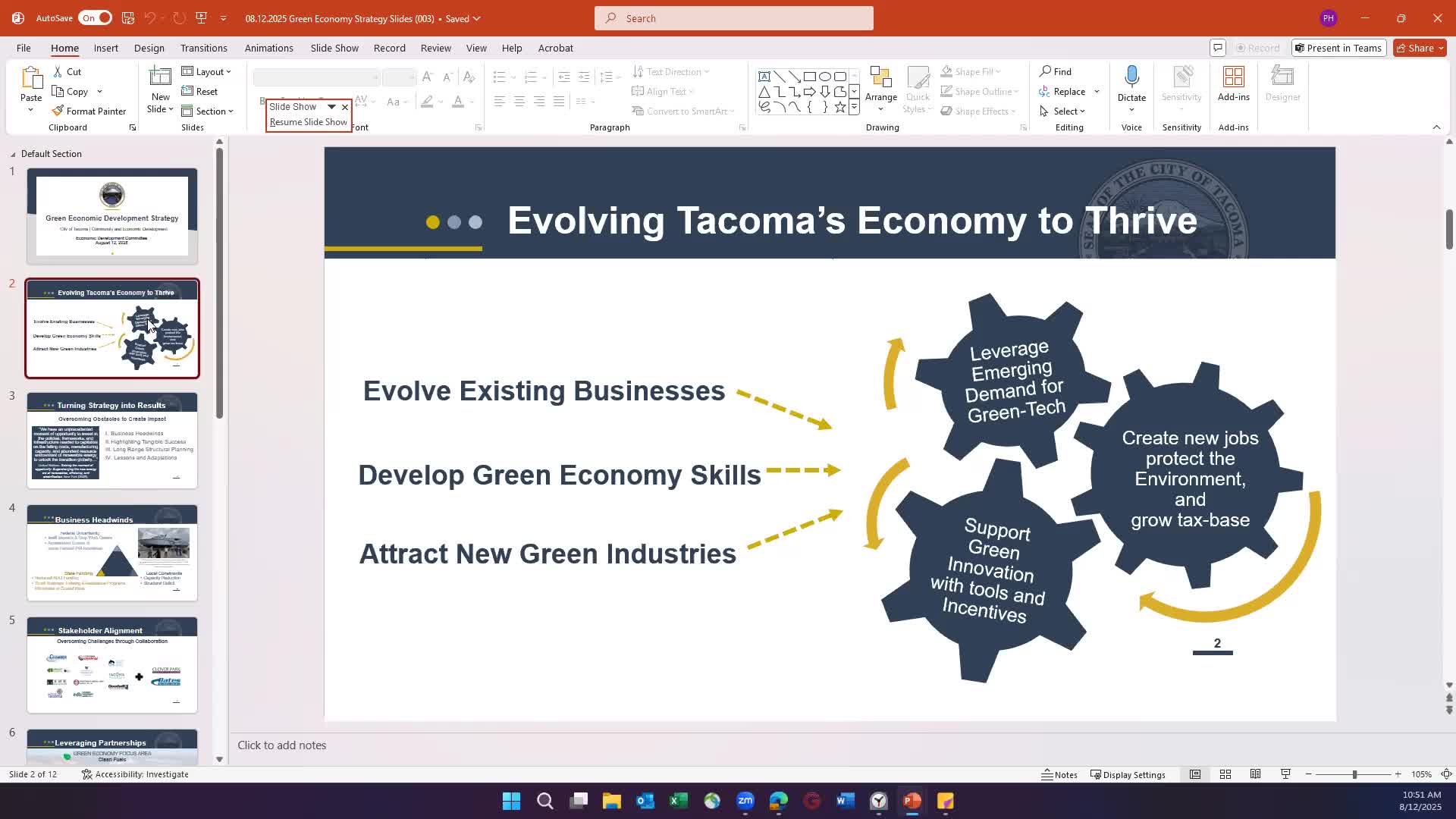
Paul Bacher, business and economic development analyst, said the strategy—launched in 2023 as an 81-page plan—focuses on three priorities: helping existing businesses evolve, preparing the workforce for green-economy jobs and attracting new businesses to Tacoma. Bacher said staff had to adapt implementation because of federal and state funding shifts, tighter local budgets and staffing changes.
Bacher highlighted a few case studies of work the city and partners have taken on. One example involved a green methanol producer that needs very low-cost, off-peak electricity to operate; staff and Tacoma Public Utilities (TPU) are exploring a customized off-peak arrangement that would require TPU board approval if the company proceeds. Bacher described the effort as an example of using utility partnerships and creative terms to keep projects viable.
The Engineered Wood Association (APA), which considered relocating, was persuaded to remain in Tacoma after the city and economic development partners worked on a retention pitch and feasibility support; Bacher said the association will retain about 50 higher-paying jobs in the near term.
Bacher also described a prospective cold-storage and seafood processing project in the Tideflats (the port-area industrial zone), led by the Port of Tacoma, that aims to combine storage with on-site processing and internal reuse of waste streams. He said outside estimates the city heard were "well above 400" jobs but that staff preferred to cite lower, unspecified estimates until permits and final plans are complete.
Another highlighted project involved a grant-funded electric boat for Communities for a Healthy Bay to conduct harbor patrols. That work required the city to act as a pass-through for a Washington State Department of Transportation (WSDOT) funding agreement because the grant did not fit existing distribution frameworks. Bacher said the executed local agency agreement was received and construction can begin.
Bacher said staff continue to pursue industrial land preservation, build workforce partnerships (including technical colleges and the Good Jobs, Great Cities initiative), promote target sectors such as industrial symbiosis, maritime, sustainable building materials and clean energy, and expand low-barrier business programs such as EnviroStars to help small firms reduce environmental impacts.
Committee members praised staff flexibility and the department's willingness to act as a convener. Several council members offered to assist in business retention and attraction when elected-official presence would be useful.
Bacher closed by noting staff will fold green-economic principles into the comprehensive plan and upcoming economic development strategic plan revision and that the green economic development hub meets bimonthly to coordinate partners on implementation.