Get Full Government Meeting Transcripts, Videos, & Alerts Forever!
Get email alerts on the Bond And Enrollment Growth topic
No spam. Unsubscribe anytime.
Olentangy board reaffirms ‘no new millage’ pledge as it advances $235 million bond proposal amid rapid growth
Summary
Treasurer and superintendent told the Aug. 5 board meeting that current property valuations and the district’s existing 6-mill debt levy can cover projected debt service for a $235 million bond; the board approved a resolution to set the millage limit at no additional mills.
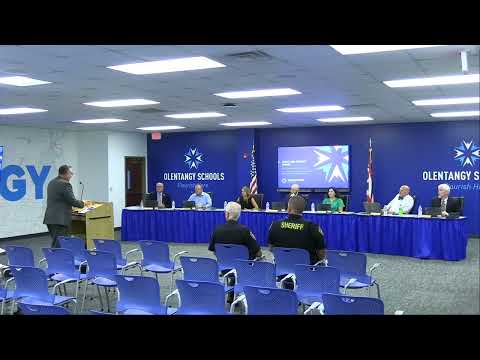
At its Aug. 5 meeting the Olentangy Local School District Board of Education discussed a proposed $235 million bond issue to fund a new high school and an elementary school and approved a resolution affirming the district’s pledge that the ballot measure will not require “additional” millage for taxpayers.
Treasurer Mister Jenkins explained the district’s finance calculations and told the board that existing collections from the district’s 6 mills will, based on current forecasts, cover both the district’s existing debt service (about $33.9 million in principal and interest in calendar 2025) and the additional first-year debt service tied to a $235 million bond (about $9.5 million). “We will not have to collect any of that 1.77,” Jenkins said of the tax rate calculation that must appear on the ballot under Ohio law.
Superintendent Javier Meyer and facilities staff presented long-term enrollment projections the board has used to justify new construction. Meyer said the district is on track with forecasts and reiterated that the board voted to put “no new millage” bond language on the November ballot after a special meeting. The presentation showed projected enrollment growth across grade levels over the next decade, with districtwide projections that the student population could level off “a little over 32,000” by about 2042. Meyer highlighted immediate pressure points at several elementary schools (including Indian Springs and Liberty Tree) and at Berlin High School, where enrollment is projected to exceed capacity in coming years.
Jenkins and other staff discussed how property valuation growth and reappraisals increase the revenue side of the millage calculation. Jenkins cited the district’s roughly $7.2 billion taxable valuation forecast as a key factor that allows the district to advertise the bond as “no additional mills” even though Ohio Revised Code requires ballot language reflecting the calculated millage rate (1.77 mills for the new borrowing, in isolation).
Board members and staff noted trade-offs for delaying construction—construction costs and the scale of future projects may rise—and emphasized that the board will continue discussing facilities and redistricting as enrollment changes. Meyer said the board plans to proceed with community outreach and repeated that he wants residents to ask questions and use the district’s information page.
Votes at a glance: the board approved the treasurer’s slate of consent items (commercial paper and bankers’ acceptance report; minutes from July 9 and July 24; and a resolution setting the millage limit so no additional mills will be collected) by roll call; it then approved the superintendent’s consent slate (personnel items, transportation routes and stops, declaration that transportation is impractical for certain students, and a resolution of intent not to provide CTE in grades 7–8) by roll call. All recorded votes on consent slates were unanimous yeses.
No OFCC funding was identified for new construction: Jenkins told the board the Ohio Facilities Construction Commission (OFCC) has not awarded state construction funding to the district because the district’s equity ranking is low, meaning Olentangy has received zero state facility-construction grants for new schools.
The board convened into executive session later in the meeting and adjourned after returning; no substantive action items were taken in executive session.