Get Full Government Meeting Transcripts, Videos, & Alerts Forever!
Get email alerts on the Animal Welfare topic
No spam. Unsubscribe anytime.
Oh My Dog Rescue proposes 24/7 microchip scanning station; council directs staff to find site
Summary
Oh My Dog Rescue asked the Boone City Council to allow a citizen-run microchip scanning station on city property. Council voted to direct the presenter to work with the police chief (or, if needed, the library director) to identify a suitable, surveilled location; the nonprofit will cover the roughly $400 equipment cost.
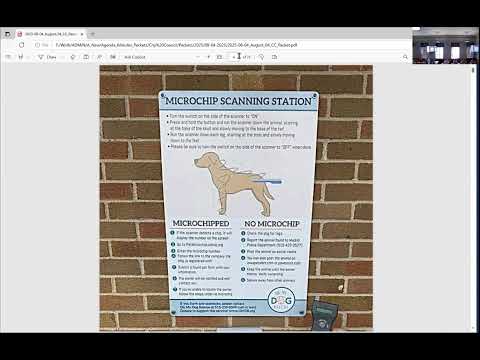
Holly Kilstrom, founder of Oh My Dog Rescue, asked the Boone City Council to allow the nonprofit to install a publicly accessible microchip-scanning station on city property to help reunite lost pets with owners.
Kilstrom told the council the unit is a weatherproof metal sign with a locked box containing a retractable microchip scanner. “The purpose of this is to allow the public access to the microchip scanner 24/7, 365,” she said, adding that Oh My Dog Rescue would cover “the entire cost of the whole setup, which is about $400.” She also said the scanner runs on a rechargeable 9‑volt battery and that the group could swap in an insulated box for winter use.
City officials and residents raised safety and operational questions during public comment. Joe Punczak, who identified himself as a Boone resident with experience in animal handling, said the public sometimes mishandles animals and urged caution: “Handling an unknown dog is a danger,” he said. Multiple residents said many local veterinarians and the Boone Area Humane Society already have chip readers and noted the need to direct residents to existing resources.
Police Chief Adam (surname not specified in the record) said the activity of scanning occurs in the community already and offered a placement preference: “I think PD may be a better spot for it to be,” he said, citing concerns about children and public safety near other public buildings. Councilmembers and staff discussed locating the station under video surveillance — Kilstrom said she preferred a surveilled placement to reduce theft — and suggested the police department or fire station as likely sites.
Councilmember motioned that Kilstrom work with the police chief, and if a suitable location cannot be found there, to consult the library director on a placement. The motion passed on roll call. The council did not propose to run or staff the station; Kilstrom said the nonprofit would install and maintain the unit and include contact directions for finders and references to microchiplookup.org so the finder can notify the registered owner.
Clarifying details provided at the meeting: the scanner displays the microchip’s 15‑digit code on screen for about 15 minutes so a finder can record it; the finder then uses microchiplookup.org to locate the registry for that chip. Oh My Dog Rescue said the unit can be mounted on an exterior wall or on a 4x4 post and that the organization would prefer a location “under surveillance.” Kilstrom said the group will also continue to run chipping clinics and offers ongoing microchipping for owners.
Next steps recorded in the meeting: staff were asked to email the police chief and confirm suitable locations; Kilstrom was directed to follow up with the police chief (or library director if needed) and coordinate placement and installation details with city staff.
The record of the council’s vote and the discussion are in the meeting minutes; no city program, license change or fee was adopted at this meeting.
Ending: The nonprofit will proceed only after locating a surveilled site with city staff; no installation timeline was specified at the meeting.