Get Full Government Meeting Transcripts, Videos, & Alerts Forever!
Get email alerts on the Hazard Mitigation Plan topic
No spam. Unsubscribe anytime.
Livingston Parish begins public update of hazard mitigation plan; public meeting, survey and CRS points highlighted
Summary
Stephenson Disaster Management Institute (SDMI) led a kickoff public meeting in Livingston Parish to start a federally required five‑year hazard mitigation plan update, outline hazards to be assessed, explain Community Rating System (CRS) crediting and public outreach steps, and set a timeline toward FEMA review and local adoption.
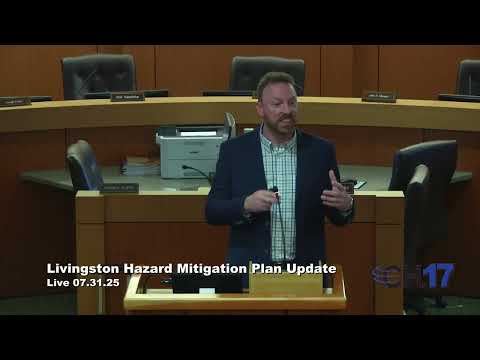
Chris Rippetoe, hazard mitigation program manager with the Stephenson Disaster Management Institute, told a public meeting in Livingston Parish that the session was the first public meeting to update the parish's hazard mitigation plan. “This is part of the Livingston Parish hazard mitigation plan update process. This is the very first public meeting that we're having for this process,” Rippetoe said.
The meeting, attended by parish planning‑committee members and residents, explained why a current plan matters for federal mitigation grant eligibility and flood insurance discounts under the National Flood Insurance Program's (NFIP) Community Rating System (CRS). Rippetoe said the plan describes natural hazards, assesses community risk and records mitigation strategies that local governments must formally adopt for the parish to remain eligible for mitigation funding.
The plan update is primarily focused on natural hazards — the presenters said it does not cover biological, cybersecurity or most technological hazards — and will use FEMA's national risk index as a guide for which hazards to profile. Rippetoe listed hazards carried forward from the prior plan and those the planning team considers relatively high or moderate risk, including coastal flooding (with subsidence, coastal land loss and sea level rise), riverine flooding, tropical cyclones, tornadoes, thunderstorms (high winds, lightning, hail), heat waves, winter weather and ice storms. He urged committee members to think about “what is most prevalent in your communities” ahead of a scheduled risk assessment meeting.
SDMI staff said the planning process requires participation from every incorporated jurisdiction in the parish, a planning committee that represents those jurisdictions and broad public engagement. The presenters outlined state worksheets the parish must complete — including NFIP policy counts, building inventories and identification of vulnerable populations — and said each participating community must formally adopt the updated plan by local resolution before FEMA will issue final approval.
Rippetoe described timing requirements: the parish must hold a public information meeting within 60 days of the kickoff; the planning team will hold a separate risk assessment meeting and a mitigation strategy meeting; and the public plan review meeting must occur at least two weeks before the package is submitted to FEMA to meet CRS requirements. Attendees were told FEMA review times vary and that the plan must be updated at least every five years to retain mitigation grant eligibility.
On the CRS and flood insurance, Rippetoe explained this is a voluntary program that awards credits for heightened floodplain management practices and that hazard mitigation planning contributes points under CRS activity 512. During the presentation he said, “There's a a possible total of 382 points, and it's every 500 points you increase in class,” language from the meeting that attendees should treat as a discussion point rather than a final scoring summary; the planning team said more detailed CRS documentation will be provided and referenced in plan materials.
Staff urged community participation through a mitigation survey and the SDMI parish webpage, where meeting materials and previous plans can be downloaded. Rippetoe encouraged residents to report hazard observations and potential mitigation project ideas so the plan’s mitigation strategy can identify problem areas for future funding applications. He also noted FEMA expects inclusion of neighboring communities in planning to reduce actions that could transfer or worsen flood impacts across parish lines.
Next steps announced at the meeting included scheduling the required 60‑day public information meeting, completing state worksheets and building the risk assessment and mitigation strategy for the draft plan. Rippetoe invited attendees to email the SDMI planning team — including Jason Martin, identified as the primary plan builder — with hazards, data questions or suggested projects and reminded planning committee members that adoption by each jurisdiction will be required before FEMA grants final approvable status.