Get Full Government Meeting Transcripts, Videos, & Alerts Forever!
Get email alerts on the Enrollment And Facilities topic
No spam. Unsubscribe anytime.
Kyrene committee narrows long‑range plan options to 4‑ and 5‑region K‑5/6‑8 models
Summary
At a long‑range planning meeting, Kyrene Elementary District demographer reviewed enrollment projections and the committee ranked two district configurations—a 4‑region and a 5‑region model, both using K‑5 and 6‑8 grade bands—for further modeling; staff outlined costs, next steps and a public‑hearing timeline.
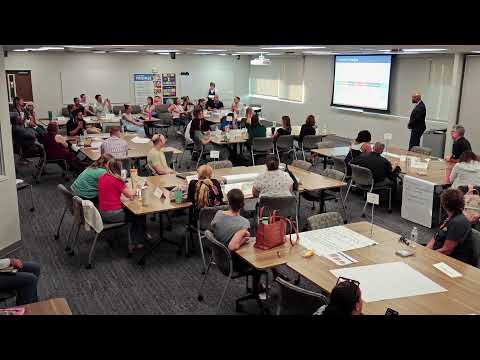
A Kyrene Elementary District long‑range planning committee meeting focused on declining enrollment, facility costs and program redesign, and recorded consensus to advance two configuration options for demographer modeling: a 4‑region model and a 5‑region model, both using K‑5 elementary schools and 6‑8 middle schools.
The committee’s demographer, Rick Brammer of Applied Economics, reviewed district data going back decades and told the group he would use choices the committee made to produce technically feasible boundary and facility options. “We have enrollment data for this district going back to 1988 at small area levels,” Brammer said, noting the work includes subdistrict (grid) modeling, tracking new residential development and enrollment patterns from inside and outside district boundaries.
Why it matters: Kyrene’s physical plant is sized for roughly 20,000 students while current enrollment is near 12,000, and the district projects losing roughly 1,100 students over the next five years. The committee heard staff estimates of the financial impact of declining enrollment — about a $7,000,000 gap — and operational running costs roughly estimated at $800,000 per elementary school and $1,300,000 per middle school per year; capital costs were shown as decade‑scale estimates (about $5.6 million per elementary and just under $13 million per middle school over ten years).
The committee exercise and outcome
Committee members worked in small tables to review nine configuration options and to rank their top two choices. Facilitators reported that two options emerged as the district‑wide priorities for next modeling: “Option C‑1” (four regions, K‑5 + 6‑8) and “Option B‑1” (five regions, K‑5 + 6‑8). The results were presented as the committee’s top two priorities to give Brammer the parameters he needs to run boundary‑change and reuse scenarios.
What the demographer will model
Brammer said he will combine the committee’s region/grade configuration input with current attendance patterns, out‑of‑district open‑enrollment flows, planned residential development (including a large Nineteenth Avenue parcel), and the district’s guiding principles to produce technically feasible options. He emphasized that open enrollment and program choices make outcomes less predictable: “Students inside the district go to a district school other than their own,” he said, noting roughly one‑third of in‑district students currently attend a Kyrene school other than their home school.
Program and redesign ideas raised
Tables submitted a wide range of redesign concepts staff and the demographer will consider while testing scenarios: creating or consolidating choice programs, adding or expanding dual‑language offerings, exploring a district gifted/honors academy, expanding early childhood/preschool capacity, designing dedicated special‑education supports, repurposing closed campuses for community uses (recreation centers, childcare, adult services), and improving facilities such as performing arts spaces and athletic fields. Several groups emphasized equity — preserving small class sizes and Title I services — and asked staff to prioritize where program drivers (open‑enrollment magnets) should be located to attract students.
Concerns and clarifications from staff and specialists
District staff and consultants repeatedly cautioned that attendance‑area shifts interact with open enrollment and transportation rules. Superintendent Tanya said the process will include legally required public hearings for boundary changes: “We are required by law to seek input from our community and actually officially hold a public hearing where the governing board is in session that gets comments for and against anytime there is a boundary change,” she said. Staff also noted statutory limits on transportation distances that affect whether certain students can be bused if local schools are closed.
Next steps and timeline
- The demographer will run models based on the committee’s two prioritized options and the other parameters the committee provided. - The governing board will hold a study session to discuss choice programs and program location. The committee’s next long‑range meeting is scheduled for Aug. 27, when model options will be returned. Staff indicated a revised package incorporating public‑hearing feedback would be presented Dec. 2, with a governing‑board vote anticipated Dec. 16.
Costs, capacity and local development
Staff presented district cost and capacity figures to ground the conversations: annual operations estimates per building, decade‑level capital estimates, and an explanation of “chiring capacity” (capacity for instructional and wraparound programs). Brammer flagged the large Nineteenth Avenue housing development as likely to add an estimated 200–300 elementary students over the next few years and noted roughly 1,300 single‑family and 2,100 multifamily units remain in the district’s development pipeline; he cautioned that market‑rate multifamily in the area has generated fewer school‑age children than subsidized multifamily in recent analyses.
What committee members asked staff to track
Committee members requested that staff and the demographer: analyze where Title I students live and how boundary scenarios affect them; consider the placement of program‑driven (open‑enrollment) schools to maximize recruitment; model transportation and staffing implications of different grade configurations; and identify reuse or community‑partnership options for properties vacated under closure scenarios.
Ending
District staff said they will compile the committee input and return modeled options at the next meeting. The demographer will deliver technically feasible packages that reflect the committee’s preferred region and grade‑band parameters, community input and the district’s guiding principles. The committee and staff stressed that public engagement and legally required hearings will follow before any final board action.