Get Full Government Meeting Transcripts, Videos, & Alerts Forever!
Get email alerts on the Infrastructure Drainage topic
No spam. Unsubscribe anytime.
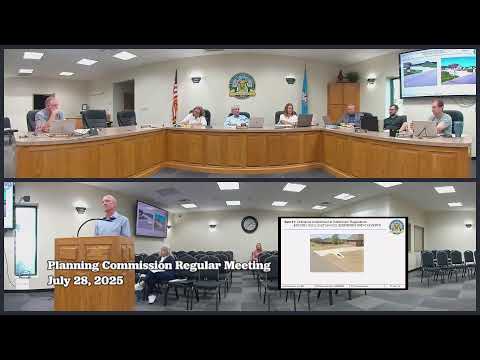
Commission approves ordinance amendment to permit plastic culverts and headwalls on low-speed residential streets
Summary
The Planning and Zoning Commission approved an amendment to subdivision regulations (153.081 C1, C7, C8) to allow corrugated plastic pipe for residential driveway culverts, permit vertical headwalls on local streets posted 25 mph or less, and require a building‑permit acknowledgment addressing installation and maintenance.
The Newcastle Planning and Zoning Commission voted to approve an ordinance amendment to subdivision regulations (section 153.081, subparagraphs C1, C7 and C8) that would (1) allow corrugated plastic culvert pipe (HDPE/CPP) as an approved material for certain residential driveway culverts, (2) permit vertical headwalls in lieu of sloped headwall treatments on local residential streets with posted speeds of 25 mph or less, and (3) revise driveway profile and permitting requirements including a required acknowledgment to be attached to building permits.
Keith, Development Services Coordinator, presented staff's evaluation. Staff said the city's review, including an engineering memo, concluded corrugated plastic pipe (sometimes marketed as ADS or HDPE/CPP) is acceptable for residential driveway culverts with diameters between 18 inches and 36 inches when installed strictly to manufacturer specifications and industry standards. Staff also proposed allowing vertical headwalls on low‑speed residential streets because those streets have a lower risk of vehicles leaving the roadway at high speed.
Staff described an administrative "acknowledgment" to be required with any building permit that involves a roadside ditch or driveway culvert; the form would be signed by the owner/developer and contractor and would note construction, placement and maintenance responsibilities, and that culverts must be installed to manufacturer specifications. Staff said the requirement is intended to reduce confusion about long‑term maintenance responsibility and to provide inspectors with a basis to verify installation when complaints arise.
Commissioners and several attendees debated technical points at length: single‑wall versus dual‑wall plastic pipe, minimum cover requirements and compaction, HS‑20 loading specifications, minimum culvert diameter, and how design in shallow ditches might create driveway humps. Participants repeatedly emphasized that proper installation, compaction, and appropriate cover are critical for plastic culverts to perform under traffic loads. Commissioners asked staff to obtain manufacturer specifications and ODOT guidance and to add a requirement that plastic culverts be dual‑wall construction rather than single‑wall.
The commission discussed existing approach standards called out in the detail drawing (6 inches minimum asphalt or 5 inches minimum Portland cement concrete for the approach). Staff and commissioners noted the subdivision regulations already require driveways and culverts to convey the 100‑year storm without overtopping the driveway and that 18 inches is the current minimum culvert size; deviations below 18 inches must be supported by an engineering report.
A motion to approve the ordinance amendment as revised (including language that plastic culverts "shall in no event be less than dual‑wall design") and subject to final edits by the city attorney was made, seconded and approved unanimously by the commissioners present.
Staff said the ordinance language and the revised standard detail will be updated to reflect the commission's direction; the administrative acknowledgment will be implemented through the building permit process and inspectors will check installation against plans and the acknowledgment.