
Founder urges United Nations to prioritize accessible cities, demonstrates mapping app
Get AI-powered insights, summaries, and transcripts
Subscribe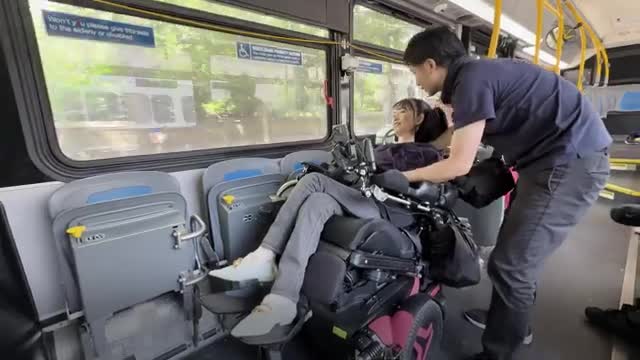
Summary
Yuriko Oda, founder of a user-generated accessibility mapping app, addressed the United Nations about mobility, dignity for people with disabilities and an app that maps accessible routes and simulates spaces.
Yuriko Oda, founder of a user-generated accessibility mapping application, told the United Nations that people with severe disabilities can contribute fully to society if given appropriate supports. Oda said she was diagnosed with a myopathy at age 22 and began using a wheelchair at 26; she described those experiences as motivating her work on the mapping tool.
Oda outlined features of the app, which she described in her remarks using the names "WeWork" and "We Love," saying the platform allows users to post information and photos, record routes on a map and indicate which paths are accessible. She said the app includes a three-dimensional simulation feature that "makes it possible to check whether a space is large enough and accessible for their needs."
"Even if we live with severe disabilities, we have dignity and inner strength," Oda said. She framed the technology as a tool to help people with disabilities move, study, work and participate in society, and tied the work to the United Nations Sustainable Development Goals, calling them "a global promise to create a better and more inclusive world."
Oda emphasized that people with disabilities are not only recipients of services but also contributors: "We can also be the ones who make peace, solve problems, and lead the way," she said. She closed by urging broader inclusion in urban design and public spaces: "Together, we can create a world in which anyone can go anywhere."
The remarks delivered in the transcript were a policy appeal and demonstration of tools; no formal decisions, votes or requests for specific UN action are recorded in the transcript.