Get Full Government Meeting Transcripts, Videos, & Alerts Forever!
Get email alerts on the Environmental Review topic
No spam. Unsubscribe anytime.
Goshen board finds IWS DEIS incomplete after residents raise water and leachate concerns
Summary
The Town of Goshen board voted to deem the IWS draft environmental impact statement incomplete and return it to the applicant after staff, the town engineer and public commenters flagged missing information on stormwater, leachate, soil borings and off-site uses of nearby parcels.
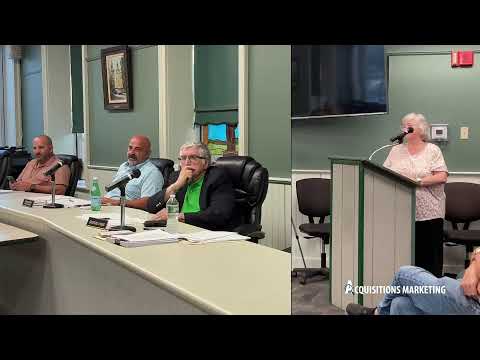
The Town of Goshen Board of Supervisors voted July 24 to deem the draft environmental impact statement (DEIS) submitted by Industrial Waste Solutions (IWS) incomplete and returned it to the applicant for revision, after receiving written comments from the town engineer, the town’s environmental review board (ERB) and board members.
The vote followed extended public comment and questions from board members and residents about stormwater routing, leachate from on-site asphalt and trucks, soils testing and the use of off-site parcels for stormwater and storage. Resident Jermaine said the DEIS omitted what he described as “a fracture trace” that could connect the site to the village well and groundwater. He warned, “If there is enough leachate going in there, ultimately we drink it here in the village.”
Why it matters: The board must determine whether the DEIS contains the information required for a substantive environmental review; deeming the document incomplete triggers a formal response to the applicant and gives the applicant 30 days to reply. The decision affects whether the town can move forward with permitting and whether downstream water users and neighbors will receive clearer analysis and protective measures.
At the meeting, town staff summarized that comments from multiple reviewers had been compiled and transmitted to the applicant and that the reviewers and the board had identified redundant and missing material. The supervisor stated the board has until July 31 to act; after the town deems the DEIS incomplete, the applicant has 30 days to respond. The supervisor moved “to deem the DEIS incomplete,” a motion that was seconded and approved by voice vote.
Public testimony and technical concerns: Several residents described how IWS’s plans, as represented in the DEIS, route stormwater off site and may rely on nearby parcels the company uses or leases. Jermaine and other speakers said the DEIS either omitted or did not analyze use of four adjacent properties for stormwater and storage and that one parcel was described as leased but lacked town approval for the solid-waste uses being claimed. Speakers said the DEIS did not quantify expected leachate volumes from asphalt or truck operations; the transcript shows residents and board members seeking numerical estimates and a clearer stormwater flowpath.
Neil, who the board and residents described as having prior building-inspector experience, pointed to DEC (New York State Department of Environmental Conservation) and EPA violations listed in public records and questioned whether the DEIS had adequately disclosed those enforcement histories. Residents urged that soil borings and laboratory testing be completed before the DEIS is considered complete; the transcript records that the DEIS referenced soil borings as a future requirement but did not include results. One speaker said the project estimates removing about 800 tons of soil for construction and that the applicant had indicated reusing roughly 600 tons and removing about 200 tons, but that the degree of contamination—and whether soil could be moved off site—remained unknown without borings and testing.
Board procedure and next steps: Board members and staff said they compiled comments from the ERB, the town engineer and the board and forwarded them to the applicant. The board’s motion to deem the DEIS incomplete was brief and approved by voice vote; no roll-call tally was recorded in the transcript. Board members said that when the applicant returns revised material the town will have another review period; the applicant may take an extended time to respond.
What the town and commenters asked for: Repeated requests included: (1) explicit identification and mapping of stormwater flowpaths and where off-site discharges would go; (2) soil borings and contaminant testing prior to final completeness determinations; (3) documentation of leases or approvals for off-site parcels the applicant is using or proposing to use for stormwater or storage; and (4) disclosure of DEC and EPA enforcement actions and how remediation or upgrades address those records.
Residents and board members noted that some corrective work involving the state Department of Transportation (DOT) (for an intersection sign/controls) would be state-funded if DOT undertakes construction, but they continued to press for local analysis of potential impacts on groundwater and neighboring properties. The supervisor and staff said the compiled reviewer comments would remain part of the town’s record and would be provided to the applicant for a formal response.
The board will revisit the matter after the applicant submits a response to the town’s completeness determination. No permit was issued, and no construction approvals were granted at this meeting.