Tusayan, Coconino County officials outline drainage master plan to reduce flood risk
Loading...
Summary
Town and county officials presented preliminary alternatives for a drainage master plan to reduce flood risk in Tusayan, emphasizing upstream (forest) detention and in-town channels, an initial $2.4 million planning grant, an estimated $20M–$50M construction cost, and the need to pursue federal and state grants by September 2026.
Tusayan council members and Coconino County and engineering officials reviewed preliminary options for a drainage master plan at a town workshop, focusing on a mix of upstream watershed measures and in-town conveyance projects intended to reduce flood risk to the wastewater treatment plant, Highway 64 and town businesses.
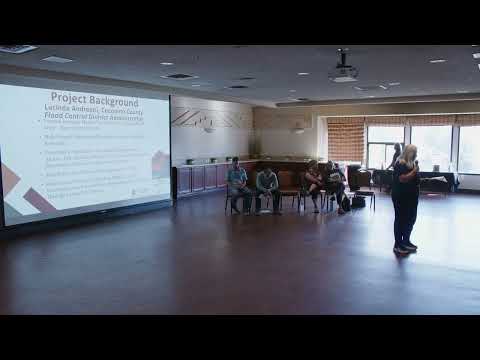
Lucinda Andriani, flood control district administrator for Coconino County, said the project grew out of a planning grant secured through the State Transportation Board and that the team is still in a conceptual phase: “We started off with a whole lot of ideas. . . . We're at a still at a preliminary conceptual phase,” Andriani said. She noted the grant that funded the planning work was about $2,400,000 and that the district and town will need to pursue additional federal and state funding for construction.
The plan addresses a watershed of roughly 60 square miles above the Tusayan sewer treatment plant and models a 100-year storm with peak discharges in Coconino Wash on the order of 10,000 cubic feet per second (cfs), figures project hydrologist Joe Levrich presented to the council. “The watershed itself is about 60 square miles at the sewer treatment plant,” Levrich said. He described the watershed’s main tributaries—Long Jim, Bridal Wash, Coconino Wash and Water Tank tributary—and said recent study work used data from the August 2022 storm to calibrate hydrologic models.
Why it matters: project leads said the wastewater treatment plant and the highway are critical infrastructure priorities. Chris Dusa, project manager for Civiltech Engineering, told the council that pairings of upstream forest measures (detention/retention basins and similar treatments on Kaibab National Forest lands) with in-town work (channels, culverts, and storm drains) drive how much flood risk can be reduced downstream. “The level of flood mitigation that's provided . . . is really highly dependent on what we can do out in the forest,” Dusa said.
What was presented: the team outlined a three-phase project. Phase 1 (current): develop a master drainage plan and select conceptual alternatives; Phase 2: a design concept report with roughly 30% design and field survey/utility potholing and geotechnical borings; Phase 3: final design and construction documents, permitting and acquisition of permanent and temporary drainage easements.
Upstream measures discussed include excavation of detention/retention basins and embankment-raising on smaller tributaries; on the largest (Coconino Wash) the team evaluated sites for large basins that could reach 20–25 feet in height or broader, shallower floodplain-type storage. The presenters said they considered a diversion option (cutting a channel through a saddle to divert Coconino Wash to Rain Tank Wash) but are not recommending it because of NEPA, water-rights, National Monument, FAA, potential litigation and very high construction cost.
In-town alternatives examined included concrete channels, box culverts, and underground storm drains. Dusa said the largest practical circular pipe the team can place through town without adding sewer lift stations or inverted siphons on existing gravity sewers is about 72 inches; for larger capacity they are considering arch pipes (two 103-inch-by-71-inch arch pipes, roughly equivalent to a 90-inch circular pipe). In one concept the team would reconstruct the channel adjacent to the wastewater treatment plant, lower the channel invert by about 3 feet and replace it with a roughly 40-foot-wide rectangular concrete channel; doing so in combination with upstream measures could reach near a 100-year level of mitigation at the treatment plant. Box culverts sized about 10 by 8 feet were shown as an option across Long Jim; presenters estimated each such box could convey about 900 cfs.
Cost and funding: presenters repeatedly cautioned that construction would be expensive. Andriani estimated preliminary construction cost range “somewhere 20 to maybe up upwards of $50,000,000.” She said neither the flood control district nor the town can fund construction alone; the team will apply for federal and state grants, coordinate with ADOT and the Tusayan Sanitary District, and pursue congressional and state legislative support. As part of grant requirements, the project team must apply for a transportation grant no later than September 2026.
Permits and constraints: the team flagged multiple nontechnical constraints—NEPA environmental review for work on National Forest land, Arizona Department of Water Resources jurisdiction (for structures that could be classified as dams), ADOT coordination for highway crossings, tribal water-rights considerations and potential FAA concerns for changes that would affect downstream areas. Presenters said they have begun conversations with the U.S. Forest Service and ADOT but have not submitted formal environmental documents.
Next steps and community engagement: the consultants said they will narrow the conceptual alternatives, perform no-adverse-impact modeling, reach out to affected property owners to negotiate drainage and construction easements, complete the design concept report (30% design) and then pursue final design and grant applications. Lucinda Andriani said the project team will post materials and recordings to the flood control district website and maintain a dedicated email for questions.
The council and county emphasized the scale of stakeholder coordination required. Patrice Horstman, chair of the Coconino County Board of Supervisors and supervisor for District 1, attended and said she was there to listen and provide county support. Town staff and council members thanked the technical team for work to date and encouraged continued public outreach.
No formal vote or ordinance was taken at the workshop; the meeting served as an informational update and an opportunity for public questions and for the engineering team to lay out conceptual options at back-table stations following the presentation.