Get Full Government Meeting Transcripts, Videos, & Alerts Forever!
Get email alerts on the Land Use Development topic
No spam. Unsubscribe anytime.
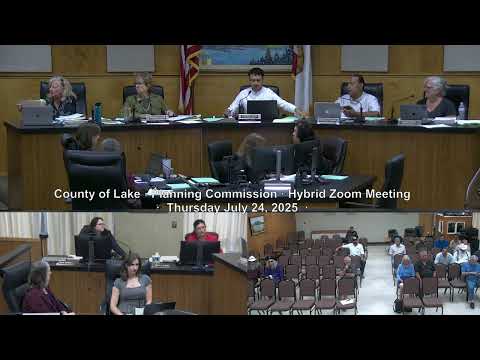
Lake County planning commission continues Middletown resort hearing after concerns over wildfire evacuation, infrastructure and workforce housing
Summary
The Lake County Planning Commission on Wednesday continued public hearings on a proposed resort and residential development near Middletown to a special meeting set for Friday, Aug. 8, at 9 a.m., after commissioners and members of the public pressed the applicant and staff for more details about wildfire evacuation, local road capacity and workforce housing.
The Lake County Planning Commission on Wednesday continued public hearings on a proposed resort and residential development near Middletown to a special meeting set for Friday, Aug. 8, at 9 a.m., after commissioners and members of the public pressed the applicant and staff for more details about wildfire evacuation, local road capacity and workforce housing.
Commissioners and several residents said they could not complete review of the voluminous environmental documents before the meeting and expressed particular concern about evacuation capacity if a wildfire threatened the project and nearby communities. Chair Chavez said she wanted to see updated countywide evacuation planning materials before making a land-use decision.
Why it matters: Commissioners said the project could materially change traffic and emergency response patterns in eastern Lake County, and residents described lingering trauma from past fires. The commission paused the hearing to allow additional review and for the applicant to respond to written questions at an open meeting.
The applicant’s team told the commission the project now includes three emergency egress routes and a set of mitigation measures tied to the project’s draft partially revised environmental impact report. “The evacuation community evacuation analysis, which is appendix H‑1 to the draft partially revised EIR, took very conservative assumptions,” Rob Bridal, an applicant representative, told the commission, summarizing the analysis. Bridal said the analysis assumed near–rush-hour evacuation, 100% project occupancy, and other conservative inputs and concluded that, with mitigation, impacts on community evacuation would be “less than significant.”
Developer Kevin Case, identified as one of the project partners with Mahlmaan Development, said the project team has sought Cal Fire and academic expertise on wildfire risk and will fund local safety measures. “We hired fire scientists at UC Berkeley,” Case said, and the developer plans to fund an emergency response center and build and equip a fire station that the applicant said it would staff and pay for. Case also said the development team conducted a wildfire risk assessment that concluded development could reduce certain risks on the property compared with the undeveloped condition; he encouraged commissioners to review the technical reports.
Commissioners said they needed time to parse the documents and review mitigation obligations. One commissioner asked whether the project had been considered by the 2010 Middletown Local Area Plan advisory group; staff replied the project implements a special study area in that plan and that a new Article 14 zoning overlay (the Guenavac Valley District) would set design and development standards, including parcel minimums, 40‑foot maximum heights and setbacks. Staff said the Article 14 standards and the project’s specific plan are included in the documents provided to the commission.
Several commissioners and public commenters focused on road capacity and evacuation logistics. Commissioners and speakers noted that many county roads are one‑ or two‑lane, and one commissioner said she was “not seeing it yet” when asked whether existing roads would allow safe evacuation of thousands of people in a worst‑case fire scenario. The applicant replied that the project would add a Grange Road connector as a third emergency egress, improvements at the Highway 29/Butts Canyon Road junction (a two‑lane, two‑lane roundabout in the mitigation package), and other signal and routing measures. The applicant said improvements to Grange Road would be made before the first certificate of occupancy for project units and that Phase 1 buildout is contemplated over about 10 years, with subsequent phases extending into later decades.
On workforce housing, commissioners asked why planned workforce units intended for the project’s employees were proposed off‑site in Middletown instead of colocated on the project parcel. Kevin Case told the commission the Middletown location was chosen to support downtown revitalization and to keep workers on the east side of the hills, but that the housing would be rental units and “not restricted to our employees.” Case said the earliest occupancy for project housing would be roughly three years away, given the time needed for infrastructure and construction.
The commission voted to continue the item to Aug. 8 at 9 a.m. and asked staff to coordinate written questions from commissioners so that applicants can provide responses at the continued public hearing. Staff reminded commissioners that written answers must be presented at an open meeting and that site visits are permitted only if no more than two commissioners attend together to avoid violating open‑meeting rules.
Additional context: Staff and commissioners referenced parallel county efforts, including the Lake County 2050 update, a climate adaptation plan, and ongoing work to update the county health and safety element and a countywide evacuation plan. Commissioners and the applicant also noted the project has been amended after a 2020 attorney general action, and the applicant said that changes in design and road standards led to the attorney general’s withdrawal of a prior lawsuit.
The commission did not take final action on entitlements. The hearing will reopen at the Aug. 8 special meeting; commissioners asked that questions about the project be directed to staff in advance so they may be included in the public record and answered at the continued hearing.