Get Full Government Meeting Transcripts, Videos, & Alerts Forever!
Get email alerts on the Transportation Infrastructure topic
No spam. Unsubscribe anytime.
Livingston Parish leaders weigh $50 million road bond to speed major collectors, set timeline for council approval
Summary
Parish officials discussed issuing roughly $50 million in bonds to advance major collector and arterial road projects, with bond counsel outlining a late-year timeline and legal limits on how bond proceeds can be used.
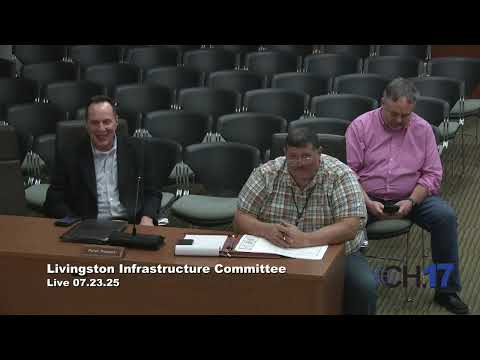
Livingston Parish officials on Wednesday discussed seeking roughly $50 million in bonds to accelerate a list of major collector and arterial road projects, and asked the parish council to authorize bond work at its first August meeting so bond counsel can begin paperwork if interest-rate conditions are favorable.
The proposal is intended to fund upfront costs — design, right-of-way acquisition and utility relocation — that make larger projects “shovel ready” for state and federal matching funds, officials said. Parish bond counsel Jim Ryan described a timeline that would put the parish on the State Bond Commission agenda this autumn if the council approves starting the process in August.
"One of my jobs under federal securities law is to advise my clients on timing," said Jim Ryan, the bond counsel and former local debt officer at the State Bond Commission, during the meeting. Ryan urged officials to be prepared to lock interest rates by mid-November and to avoid starting the sale process in December when market participation typically drops.
Why this matters: parish leaders said the bonded money could be used as match money to leverage larger state and federal grants — converting local seed dollars into substantially larger construction budgets — and to get major corridor projects into DOTD’s project “hopper” (Stage 0). But speakers repeatedly cautioned the funds may not be used for routine maintenance and overlays; federal and IRS rules require bond proceeds be used for capital projects and generally expect a reasonable plan to expend proceeds within roughly three years.
What officials discussed
- Bond amount and scale: Council members and staff repeatedly referred to a target in the roughly $50 million range; officials also discussed a planning figure of about $60 million when identifying projects that could fit a single bond issue. A figure of $50 million was used repeatedly as the working example.
- Funding source and pledge: Parish leaders said the bonds would be repaid from the parish road sales-tax stream, not by raiding current fund balances. "The pledge is the 3 quarter of 1% sales tax you collect," said a council member during discussion of repayment sources.
- Debt service and local budget context: Officials cited the parish road fund collects about $29 million annually and that the sheriff receives roughly $5 million a year from that fund, leaving about $24–25 million for other uses. As discussed in the meeting, a rough rule of thumb offered by advisers was approximately $1,300,000 of annual debt service for every $10,000,000 borrowed; that math was used to illustrate that a $50 million issue could produce about a $6 million annual payment under the sample assumptions presented at the meeting. Participants stressed those numbers are illustrative and depend on final interest rates, term and bond structure.
- Eligible uses and constraints: Bond counsel and parish staff emphasized the legal limits on bond proceeds. They said the IRS treats many bond-financed expenditures as capital projects (for example, widening a two-lane road to four lanes or a major rehabilitation that reconstructs the base) but will not permit routine maintenance and pothole patching to be funded with bonds. The parish would prepare a list of candidate capital projects and include a drawdown schedule to demonstrate a reasonable expectation of spending within the IRS timeframes. Ryan said the bond ordinance will require council approval before any substantial change is made to the project list.
- Timeline and process: Ryan outlined a sequence of steps for an issuance if the council gives staff the go-ahead: an initial council authorization in August to let bond counsel prepare documents; a September council action to introduce and adopt a bond ordinance (the transcript cited a September 25 adoption target); submission to the State Bond Commission in mid-October (the October 16 agenda was cited); and a possible closing and interest-rate lock around mid-November if market conditions are favorable. Ryan warned officials to avoid pushing the sale process into December when market participation tends to decline.
Project priorities discussed
Officials said the bond proceeds would focus on collector and arterial roads rather than neighborhood overlays. The meeting repeatedly cited projects or corridors that parish staff and consultants want to advance to shovel-ready status so they can compete for federal and state construction funds:
- Duff Road — cited as an example of a high-need collector that would require right-of-way acquisition before major reconstruction. - Jubin Road / Jubin extension — ongoing and expected to relieve traffic on other corridors; extension and related connections were discussed as priorities. - Burgess Road (north) / "Burgess Expressway" concept — a proposed north–south connector following power-line corridors to create capacity and additional evacuation routes. - Cook Road — identified at the meeting as about a $14 million project; staff said the parish share would be about 20% of that cost (roughly $2.8 million), a figure used to illustrate how local seed money can leverage larger state or federal construction funds. - Other items raised: roundabouts and intersection redesigns across the parish, frontage roads near the interstate to support economic corridors, and reuse of an existing old railroad bed (Old South Frost Road / Highway 63 alignment) as a potential corridor improvement.
Analytic and planning steps
Parish staff and consultant Ralph Burgess said they are compiling a digital, map-based master list of corridors and projects and expect to publish an electronic, living document. Staff also described completing a pavement condition assessment across the parish using machine-driven PCI methods and AI-assisted imagery; that tool is intended to help prioritize projects objectively.
Officials said a parishwide traffic study — estimated in discussion to cost in the low millions — would provide the counts and data needed to justify state funding requests, federal grant applications, and potential development-impact fees in growth areas.
Decision points and safeguards
Meeting participants said they will bring a recommended project list and cost estimates back to the council for formal adoption before any proceeds are spent. Bond counsel said the bond ordinance will specify the project list and require council approval for substantial substitutions. The parish will also prepare drawdown schedules and environmental/ROW planning to meet DOTD Stage 0 and IRS expectations.
Votes at a glance
- Motion to adjourn — approved (motion made, seconded and recorded as "motion carries"; no roll-call tally specified in the transcript).
What happens next
Parish staff asked the council to approve placing the bond authorization on the first August council meeting agenda so bond counsel can begin the paperwork. Officials said final decisions about the amount and the timing of a sale will depend on interest rates, the council—s approval of a project list and required State Bond Commission and other state approvals.
No final bond sale or ordinance was adopted at the meeting; the action discussed was a request to move the matter forward to the council for formal consideration and for bond counsel to prepare financing documents.