Get Full Government Meeting Transcripts, Videos, & Alerts Forever!
Get email alerts on the Assessment Roll topic
No spam. Unsubscribe anytime.
Kings County Board of Equalization accepts $16.38 billion assessment roll; shifts ag valuation to rent-based approach
Summary
The Kings County Board of Equalization on July 22 accepted the county assessment roll showing a 4.35% increase in assessed value and approved a permanent change to use rent-based income valuation for agricultural parcels amid SGMA-related water concerns.
Kings County Board of Equalization members on July 22 approved the county ssessment roll for 2025, accepting a 4.35% net increase that raises the total roll to $16,380,000,000.
The change in the agricultural valuation method also drew attention: Kings County Assessor and Clerk-Recorder Christie Lee told the board the office will permanently use a rent-based income approach rather than the historical crop-rotation method to value certain agricultural parcels, a change she said reflects water availability issues linked to SGMA.
Lee presented the roll at the board's special meeting and summarized the countywide figures. "The assessment roll grew by 4.35% this year," she said. She reported that growth represented a $682,000,000 increase in total assessed value, with the roll figure presented as a net number after exemptions.
Lee provided city-level highlights: Avenal's secured roll grew 5.8% to $330,600,000; Corcoran rose 7.7% to $641,000,000; Hanford increased 7.3% to $5,980,000,000; and Lemoore grew 5.9% to $2,660,000,000. The unincorporated area of the county declined 4.2% to $5,130,000,000, a drop Lee attributed primarily to the agricultural preserve and the new valuation method adopted to reflect current rents.
By assessment type, Lee said residential values rose 6.8%, commercial values rose 10.1%, agricultural values declined 3.4%, multifamily residential assessments rose 1.2% and unsecured personal property assessments (including boats and aircraft) rose 20.4%. She said low-income and restricted properties total about $515,000,000 and oil and gas properties declined about 6.4% in assessed value. Lee also said solar property assessments currently account for roughly 15,000 acres in the county and that the county's median sales price is about $360,000.
On agricultural valuation, Lee explained the legal standard for valuing income-producing property. "The law requires that we do an income approach to value," she said, adding that the assessor's office may apply income approaches using rents or crop-rotation calculations. Lee said the office determined rents better reflect current market conditions in parts of the county affected by water supply and SGMA-related constraints and will use that method going forward.
Lee also addressed appeals and a recent filing snapshot: the handout showed 351 assessment appeals filed for the period, but Lee said 268 of those appeals were filed by Sandridge and subsequently withdrawn, so the active caseload differs from the initial filing total.
A short public exchange followed on solar exemptions and taxation. Lee said solar installations are "typically exempt to the first owner," explaining that when the first owner installs solar the system is usually not added to the property tax assessment; a subsequent sale that reflects solar in the sales price can lead to assessment of the second owner. She noted the state-level exemption has been extended repeatedly and has not yet sunset.
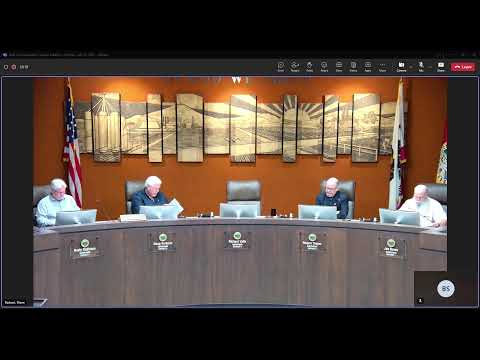
Supervisor Robert Thayer moved to accept the roll as presented; Supervisor Rusty Robinson seconded the motion. The clerk called the roll: Joan Ebs (yes), Doug Rabone (yes), Rusty Robinson (yes) and Robert Thayer (yes). The motion carried and the board accepted the assessment roll.
The meeting adjourned; the board's next meeting was announced for Aug. 19, 2025, at 1 p.m.