Get Full Government Meeting Transcripts, Videos, & Alerts Forever!
Get email alerts on the Assessment And Achievement topic
No spam. Unsubscribe anytime.
Mountain View Whisman trustees hear 2025 CAASPP results showing persistent gaps for English learners and socioeconomically disadvantaged students
Summary
District staff presented 2025 California Assessment of Student Performance and Progress (CAASPP) results and analysis; board and public questioned curriculum implementation, background knowledge and chronic absenteeism as drivers of low proficiency at high‑need sites such as Castro.
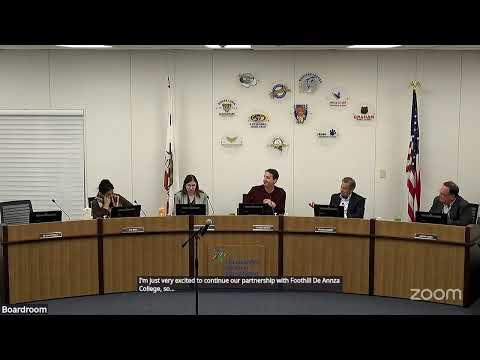
The Mountain View Whisman School District Board of Trustees received a staff presentation on the district's 2025 CAASPP (California Assessment of Student Performance and Progress) results and discussed persistent proficiency gaps affecting English learners, socioeconomically disadvantaged students and some campuses.
Kathy Bauer, a district staff member who led the CAASPP briefing, said the district continues to score above county and state averages at an aggregate level but that the district's overall proficiency rates have flattened and elementary-level scores declined while middle school scores rose modestly. She noted large gaps for Hispanic/Latino students, economically disadvantaged students, students with disabilities and English learners and said those gaps are magnified at sites such as Castro, where she reported roughly 87% of students are socioeconomically disadvantaged and 71% are English learners.
Bauer explained the CAASPP assessments administered last spring (SBAC in English language arts and math, CAST for science) and described both year‑over‑year and cohort analyses. She highlighted that middle‑school cohort data sometimes showed improvement that year‑by‑year snapshots missed, and cautioned that high student transiency complicates cohort tracking.
In response to trustees' questions, Bauer and Superintendent Charles Behr described district efforts to address the gaps: strengthening small‑cycle improvement processes, expanding targeted reading and math interventions, adding instructional coaching, embedding designated English language development (ELD), experimenting with team teaching in math at some sites and coordinating research partnerships (Stanford and AIM) to strengthen early literacy. Bauer said middle schools have added intervention periods taught by instructional coaches and that early literacy and math interventions have been expanded districtwide.
Trustees pressed staff on curriculum implementation and instructional minutes. Trustee Conley asked specifically about implementation supports for the Amplify literacy curriculum, noting it is in year two of district use and urging sustained coaching and prioritization of its writing components. Bauer said the district is emphasizing Amplify's writing strand this year and acknowledged a continuing need to bolster students' background knowledge and vocabulary so they can access Amplify's knowledge‑rich materials, particularly for students who are newly arrived or at lower ELPAC levels.
Trustees and several public commenters suggested practical supports to build background knowledge: more field trips or community partnerships, classroom experiential activities for early grades, expanded library access and leveraging after‑school programs (ELOP) for academic enrichment. Bauer and trustees also discussed limits on instructional minutes: staff said apart from PE the state does not mandate exact minute allocations for most content areas, but principals must balance minimum minute guidance, contract considerations and other programmatic pushes into the school day.
Public commenters including longtime community member Steven Nelson urged structural changes such as scheduling additional weekly instructional minutes for high‑need campuses. Several parents and community members pressed for deeper, inclusive community engagement for the district's upcoming strategic plan update.
The discussion closed with trustees requesting follow‑up: Conley asked for continued focus on Amplify supports and for a future deep dive into how the district is strengthening instructional delivery and short‑cycle improvements; Trustee DeFazio asked for a subsequent presentation on coaching and classroom practice that demonstrates how interventions are executed across sites.
Bauer provided multiple data tables in the meeting appendix showing school‑level proficiency by subgroup, chronic absenteeism correlation and cohort trends; she emphasized chronic absenteeism as a recurring complicator at specific schools and pointed to planned work to reduce absenteeism among McKinney‑Vento students and others with high absence rates.
The presentation and trustee discussion did not include a board vote but set follow‑up requests for more granular implementation detail and for community engagement as the district updates its strategic plan.