Irmo council approves business-license updates, economic development grant program and vegetation rules; OKs towing policy and police equipment purchase
Loading...
Summary
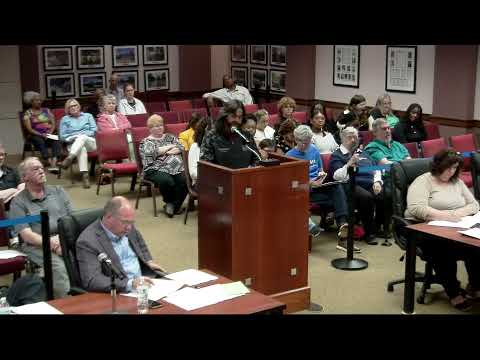
At its Oct. 21 meeting, the Town of Irmo Council approved three ordinances updating the business license schedule, creating an economic development grant program, and regulating vegetation on private property; it also approved revisions to the towing rotation policy and a purchase of police firearms and accessories.
The Town of Irmo Town Council on Oct. 21 approved several administrative and public-safety measures, including updates to the town business-license ordinance required by state law, a new economic development grant program for small businesses, regulations on vegetation and dead trees, revisions to the town's wrecker and towing policy, and a purchase of firearms and accessories for the Irmo Police Department.
Council members said the business-license update implements South Carolina Act 176 and standardizes license classifications. The economic development ordinance establishes a grant program meant to recruit, retain and support new businesses inside Irmo city limits; staff described one incentive that would waive a brick-and-mortar business's license for the first three years and then phase in charges in later years. Council also voted to add a section to the vegetation ordinance to address removal of dead trees, and the economic-development ordinance and the vegetation ordinance each give the town’s code compliance inspector authority to issue municipal summons when owners fail to abate nuisances, as noted in the meeting.
The council approved revisions to the town’s wrecker and towing policy to confirm that rotation towing services used by the police department will tow vehicles for town purposes without charge and that the town may provide vehicle storage for investigative cases. The council also approved a staff recommendation to purchase Glock firearms and associated reticle systems and holsters for the police department; staff reported a net cost of $28,584.36 and said the department seeks to standardize calibers with neighboring agencies because some local partners have moved to 9 mm rounds.
All motions on those items passed on roll-call votes. Council members voting in favor were Councilman Ward, Councilman Penfield, Councilwoman Coleman, Dr. Waldman and Mayor Daniels.
Why it matters: the business-license and economic-development changes affect how new and home-based businesses will be assessed and can change costs for local entrepreneurs; the vegetation ordinance adds enforcement authority that can lead to municipal summons if property owners do not abate defined nuisances; the towing policy and police purchase are operational decisions affecting public safety and municipal costs.
Details, clarifications and next steps - Business-license ordinance (Ordinance 25-10): staff said the amendment implements the statutory update required every two years under South Carolina law (identified in the meeting as a requirement tied to state Act 176). The council completed second and final reading and approved the ordinance. - Economic development grant program (Ordinance 25-13): the ordinance creates a small-business incentive program; staff described a waiver of business-license fees for eligible brick-and-mortar businesses for the first three years followed by phased charges in subsequent years. The ordinance also authorizes the code compliance inspector to issue municipal summons to businesses that violate the business-license code. The council approved second and final reading. - Vegetation and property-maintenance ordinance (Ordinance 25-14): the council approved limits on vine and shrub growth adjacent to structures and added a section addressing removal of dead trees because of safety and nuisance concerns. The ordinance also gives the code compliance inspector the authority to issue municipal summons where owners fail to abate nuisances. - Wrecker and towing policy revisions: staff summarized that rotation wreckers used by the police department will tow town-authorized vehicles without charge and that the town may provide storage of vehicles for investigative purposes. Council voted to adopt the revisions. - Police equipment purchase: staff requested and council approved buying 30 Glock firearms with reticle systems and holsters for a net price of $28,584.36 (the transcript identifies the vendor/quantity and the net price; the meeting record did not specify a precise model designation beyond the word "Glock" in the transcript). Staff said the department's current weapons average nine years old and that switching to match neighboring agencies' standard caliber (reported as 9 mm by staff) is a public-safety rationale.
Votes at a glance - Ordinance 25-10 (business license update required by state law): approved (roll call: Ward, Penfield, Coleman, Dr. Waldman, Mayor Daniels — all yes). Outcome: approved. - Ordinance 25-13 (economic development grant program; code compliance summons authority for businesses): approved (roll call: Ward, Penfield, Coleman, Dr. Waldman, Mayor Daniels — all yes). Outcome: approved. - Ordinance 25-14 (vegetation/property maintenance; dead-tree provision; code compliance summons authority): approved (roll call: Ward, Penfield, Coleman, Dr. Waldman, Mayor Daniels — all yes). Outcome: approved. - Revisions to town wrecker/towing policy (town rotation tow services; storage for investigative cases): approved. Outcome: approved. - Irmo Police Department equipment purchase (firearms, reticles, holsters; net price $28,584.36): approved. Outcome: approved.
What the meeting record does not specify or clarified only in discussion - Several staff remarks reference specific numeric thresholds for home-based business revenue; the transcript includes an unclear figure phrased as "over 70,000,000." That figure was not clarified in the meeting record; the council did not provide an explicit corrected amount during the meeting. - The transcript identifies the statutory requirement as tied to South Carolina Act 176; the meeting record does not list the full statutory citation.
Ending: Council members signaled administrative follow-up through staff for implementation of the ordinances and policies; implementation dates and any program application procedures were not detailed at the meeting and will be set by staff and published when available.