Get Full Government Meeting Transcripts, Videos, & Alerts Forever!
Get email alerts on the Public Records topic
No spam. Unsubscribe anytime.
Monroe staff present JLARC public‑records findings; body‑camera redaction identified as main cost driver
Summary
Monroe City records staff told the City Council on Oct. 21 that public‑records requests have remained near state averages, that body‑worn camera review and redaction is increasing staff time and costs, and that technology and vendor assistance are being used to manage complex requests.
Monroe City records staff presented the city’s 2024 submission to the Joint Legislative Audit and Review Committee (JLARC) and local data on public records management at the Monroe City Council study session on Oct. 21.
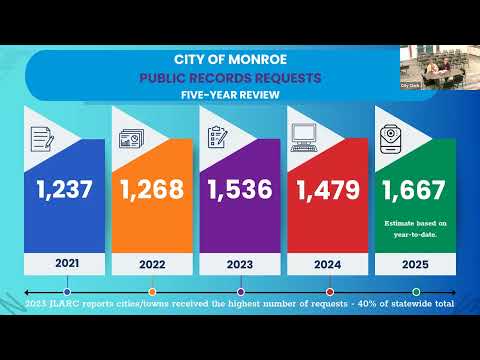
Sherry Simonson and Patricia Pendry, who led the presentation, told council members Monroe closed about 1,500 public‑records requests in 2024—near the statewide per‑agency average reported by JLARC—and noted the city faces rising staff time and software costs tied to body‑worn camera footage and complex litigation requests. “The people of the state, it says in our RCW, that they don't yield their sovereignty to the agencies which serve them,” Simonson said, reading from statute language while explaining the legal basis for disclosure obligations.
Why this matters: Monroe staff said the operational burden of handling requests can be substantial for a city of its size and that mistakes or missed records can expose an agency to penalties and litigation. The presenters also highlighted how technology choices, staffing and newly recoverable fees for redaction affect the city’s workload and potential reimbursements.
Most of Monroe’s metrics align with statewide findings, the presenters said. JLARC reported roughly 487,000 public records requests statewide and $6.4 million spent on litigation; Monroe reported closing about 1,500 requests and no penalties or litigation in the period covered. Staff noted cities and towns receive about 40% of statewide requests and that Monroe’s monthly request volume (about 1,536 per month reported in the presentation) is close to the state average.
The presentation underscored several operational pressures: - Body‑camera redaction: Staff said review and redaction of police body‑worn video is time‑intensive. Pendry summarized the work: “It’s not just the images that have to be redacted, but we also have to carefully listen to the audio,” citing scenarios—juveniles, interior residential scenes and medical facilities—where redaction requires frame‑by‑frame review. Staff estimated a review‑to‑footage ratio of roughly 3:1 in many cases and explained that multiple officers at an incident can multiply review time. - Complex requests: Simonson described a records request that took 12 months to complete, involved nine staff across four departments, required 37 staff hours, nine installments and multiple re‑searches; Pendry described another complex litigation request that took about 14 months, 15 installments and more than 80 staff hours, in part because of juvenile confidentiality concerns and repeated legal redaction checks. - Carryover caseloads and redaction backlog: Staff showed month‑to‑month carryover counts rising (for example, from 28 carryover requests in May 2024 to about 62 in a later month) and attributed much of the backlog to lengthy body‑camera redactions and requesters filing multiple simultaneous requests. City policy is to work one request at a time per requester to avoid delaying other requesters, staff said.
Costs and fees: The presenters said the city’s average per‑request cost rose to about $251, a jump they linked largely to body‑camera production work and legal review. They also noted a statewide increase in requester reimbursements and said some agencies have adopted fee schedules that allow recovery of staff time for extensive redactions. Simonson and Pendry said Monroe has recovered some costs from requesters but that reimbursements typically do not come from involved parties; involved parties receive their records without paying redaction fees.
Technology and vendors: Staff described ongoing testing of body‑camera redaction software and use of third‑party vendors to handle proprietary formats (for example, social‑media video or vendor‑specific camera exports). Pendry noted the Public Records Act allows the city to charge requesters for vendor redaction costs when outside vendors are necessary. The presentation also described records management tools used by the city (NextRequest for requests, Smarsh for archiving Teams/texts/email and Marsh for other archives) and an interest in comparing Smarsh results with Microsoft Purview for retention searches.
Policy and next steps: Staff said they are monitoring JLARC and attorney‑general model‑rule updates (a model rules hearing was scheduled for Nov. 6) and plan continued liaison training across departments to reduce search time and to improve redaction workflows. Proposed near‑term goals include fine‑tuning redaction software, testing alternative retention searches, digitizing additional records and continued cross‑department training.
Council members asked clarifying questions about the ratio of review time to footage, the city’s policy that limits simultaneous request processing from a single requester, and whether media or out‑of‑state requesters are contributing to the workload; staff said media requests have increased since rollout of body cameras and that out‑of‑state requesters sometimes drop requests once they learn estimated redaction costs. Council member Walker and others praised the staff for their work and urged continued attention to technology and staffing needs.
Ending: Staff did not request any immediate policy changes during the presentation; they asked council to note the operational strain created by body‑camera redaction and to consider the cost and staffing implications when reviewing future budgets and vendor procurements.