Get email alerts on the Instruction Workgroup Scope topic
No spam. Unsubscribe anytime.
Instruction work group previews yearlong scope; board asks to elevate class-size and allocation discussions
Summary
The Madison Metropolitan School District Instruction Work Group reviewed a draft scope and sequence for the 2025–26 school year and directed staff to elevate class-size and allocation discussions from memo updates to substantive board conversations.
The Madison Metropolitan School District Instruction Work Group reviewed a draft scope and sequence for the 2025–26 school year and directed staff to make several changes: elevate class-size reporting from a memo to a full discussion item, schedule substantive discussion of the allocation process rather than treating it as a memo, and clarify how the district will measure family experience and special education outcomes.
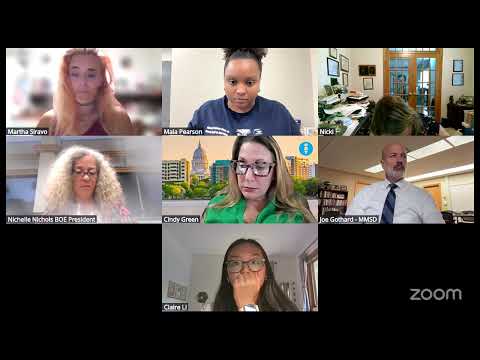
Assistant Superintendent Cindy Green walked the group through a month-by-month draft that includes September launch items and a November update on strategic-plan milestones, with anticipated agenda topics ranging from early learning and math materials procurement to special education updates, enrollment reports and summer programming. Green said the draft is intentionally flexible and that administration will coordinate with departments to finalize content once the board confirms high-level priorities.
Why it matters: The scope and sequence defines what instructional issues the board will review during the year and when. Board members pushed to reserve full meeting time for discussions they consider consequential to staffing, instruction and budgeting — particularly class size and resource allocation — rather than handling them as short memos.
Board requests and discussion points - Class size: Board member Vander Meulen asked that class-size reporting be moved from “minor” memo status to a full (“major”) agenda item. Vander Meulen said that class size warrants extended discussion: "It should just be a memo. It doesn't matter the timing of when as much as it needs to be an actual full discussion." Board members also asked that the report include effects on teacher planning and professional development when class sizes grow.
- Allocation process: Vander Meulen and others urged that the district’s staffing and allocation conversation be a deliberative board discussion rather than a memo. "The allocation process shouldn't be a memo," Vander Meulen said. "You can't negotiate, talk, work out ideas in a memo. You need a meeting for that."
- Family experience and special education: Board members asked for clarity about how family experience will be measured and whether the district can include multiple points of measurement (for example, early- and late-year surveys) to better track change over time. Board member Saravo asked whether DPI complaints would be reported as part of special education updates, noting cost and accountability implications; administration said it would review that request with the relevant departments.
- Other topics: The draft also anticipates an RFP and board updates on middle-school math materials, continued expansion of 4K, a second-semester class-size report per policy, partnerships and potential renewals, and a May strategic-plan update to present a final plan for the 2026–27 school year.
Next steps Administration will incorporate board feedback and return with a revised scope and more-detailed content outlines (including suggested KPIs and report formats) for future instruction work group meetings. Staff also offered to coordinate with student representatives and the student senate to identify opportunities to bring student voice to several agenda items, including mental health and class-size experience.
Ending Board members generally supported the draft scope while requesting several items be elevated for full discussion. Staff will revise the calendar and align department briefings to the board’s priorities and the strategic-plan timeline.
AI generated
The text on this page is AI generated. Summaries, highlights, analysis, and video transcripts are all produced from the original source material.
AI can make mistakes, so if you spot one, and we will fix it for everyone.
Note: the source content is unaltered by us. Any content source we link to, be it a video, an audio recording, or a document, is presented exactly as its publisher released it. That publisher is usually a government body, sometimes an individual official or another organisation.