Get Full Government Meeting Transcripts, Videos, & Alerts Forever!
Get email alerts on the Land Use Housing topic
No spam. Unsubscribe anytime.
Council sends 102‑acre rezoning request back to planning commission after public concerns about density and schools
Summary
Council agreed to send a developer’s request to rezone about 102 acres from agricultural to RM‑7 (multi‑residential) back to the planning commission for a planned‑district rewrite after residents voiced concerns about master‑plan consistency, school capacity and community character.
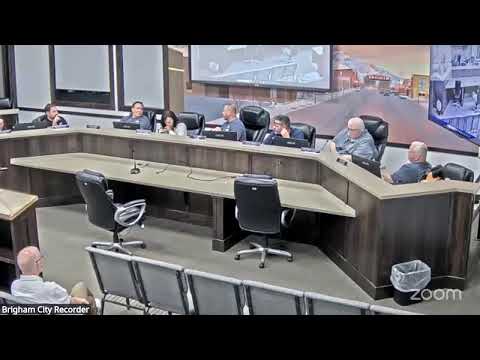
Brigham City Council voted on Aug. 21 to send a rezoning request for about 102 acres (roughly described in staff materials as west of 1200 West and north of 400 South) back to the planning commission for further review and to develop a planned‑district overlay.
Mark Bradley, the city planner, described the applicant’s request and the planning commission recommendation. Bradley said the area is shown as medium‑density residential in the general plan and that the RM‑7 zoning district would allow higher densities; the applicant and staff are preparing a planned district with a proposed density range of 5.4–5.6 units per acre — which Bradley and city staff said is lower than the unconstrained RM‑7 allowance. Bradley said the development agreement under discussion would include provisions to allow single‑family homes and townhomes and that the applicant had agreed to language restricting apartment buildings in this implementation.
During the public comment period multiple residents spoke against rezoning agricultural land for higher‑density housing. Caleb Barker of Brigham City said he was worried the city lacked a limiting principle on how many apartments to allow and asked whether the city had an upper limit in its master plan. “I don't know what the master plan looks like for the city, how far out it goes,” Barker said, and urged councilors to ensure public input is considered.
Other speakers raised related points: Leo (surname not given) warned that adding many more residents could change the small‑town character and increase costs; Kelly Oakley said rezoning would remove farmland and local food sources; Christine Nelson asked whether public comment will be taken seriously or treated as a formality given prior meetings where she said citizens felt unheard.
City Administrator Derek Oiler and Bradley told the council the applicant has requested that work continue and that the council send the proposal back to planning so staff, the applicant and the planning commission can complete a planned‑district proposal and bring that combined package back to council. Oiler said the planned district under development aims for 5.4–5.6 units per acre and that city and district staff have discussed school siting and potential future elementary‑school needs tied to large new developments.
Council voted to send the application back to the planning commission; the motion was made by Councilmember Hipp and seconded by Councilmember Jeffries. The council did not adopt the rezoning tonight, and staff said the planned‑district drafting is intended to reduce ambiguity and return a more detailed master plan and development agreement for public review and a subsequent council decision.