Get Full Government Meeting Transcripts, Videos, & Alerts Forever!
Get email alerts on the Flood Insurance topic
No spam. Unsubscribe anytime.
Norman staff review FEMA Community Rating System as local flood-insurance participation drops by half
Summary
Norman public works staff briefed the City Council at a study session Tuesday on the city's standing in the Federal Emergency Management Agency's Community Rating System (CRS) and on a sharp drop in National Flood Insurance Program (NFIP) policies held by local property owners.
Norman public works staff briefed the City Council at a study session Tuesday on the city's standing in the Federal Emergency Management Agency's Community Rating System (CRS) and on a sharp drop in National Flood Insurance Program (NFIP) policies held by local property owners.
Scott, the city's floodplain administrator in public works, said Norman remains a CRS Class 6 community and that participation in NFIP policies within the city fell from 489 policies in 2020 to 251 policies in 2025. "We're a class 6 community," Scott said during the Aug. 5 presentation. He added, "7% of all of the buildings in a flood hazard area ... have flood insurance," and highlighted the city's 17 repetitive-loss properties and 167 paid claims tied to those properties.
The CRS is a voluntary program within the NFIP that rewards communities for floodplain-management activities with reduced flood-insurance premiums for policyholders. Scott explained that a Class 6 rating yields a 20% premium discount for NFIP policies inside mapped floodplains and a 10% discount for participating property owners outside the mapped floodplain. By comparison, Scott noted, a Class 1 community can receive up to a 45% reduction in premiums.
Why it matters: a lower CRS class means smaller community discounts on NFIP premiums for property owners and signals possible gaps in outreach or mitigation. Scott warned that a steep decline in NFIP participation increases the number of property owners exposed to uninsured flood losses, and he pointed to several factors that may explain the decline: changes in FEMA's risk-based rating methodology, homeowners completing mortgages and no longer being required by lenders to carry flood insurance, and migration of some customers to private flood insurance.
Details from the presentation
- Floodplain basics and local geography: Scott summarized FEMA terms used in mapping, including the 1% annual chance flood (the SFHA or "100-year" flood), the floodway (kept as clear as possible to allow conveyance), and the flood fringe. He identified primary local flood corridors discussed in the presentation: the Canadian River, Little River, Lake Thunderbird tributaries, and creeks through Norman such as Brookhaven and Imhoff Creek.
- NFIP/CRS history and local practice: Scott said Norman has participated in the NFIP since at least the past 14 years. He described how the city's floodplain ordinances are administered through the zoning code, noted the higher local regulatory standard (two feet of freeboard above the base flood elevation rather than one), and described the city's local floodplain permit committee (five staff members and two citizen members) that reviews permits and public input.
- Insurance and policy counts: Scott presented policy-count tables from 2020 and 2025. He said 489 NFIP policies existed in 2020 (with total premiums and insurance-in-force figures presented to council) and that the count had declined to 251 policies by February 2025. He said the average coverage per policy had increased over that period (from roughly $273,000 to about $316,000), reflecting rising property values even as the total number of policies fell.
- Repetitive-loss properties and acquisitions: Scott reported 17 repetitive-loss properties within the city and 167 paid claims tied to those addresses. He recounted recent council-authorized acquisitions of two properties on Lahoma Street that have been deed-restricted to prevent future rebuilding, which earned the city CRS credit for removal of structures from the floodplain.
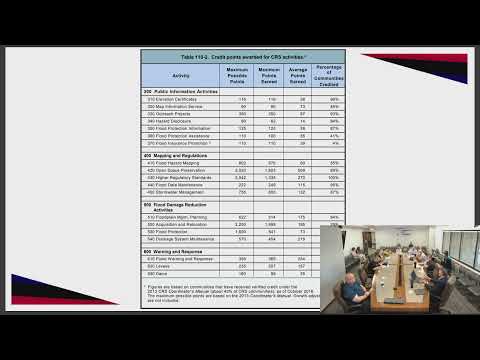
- CRS credit opportunities and the flood-warning system: Scott outlined CRS credit categories (public information, mapping and regulations, higher regulatory standards, flood-damage reduction, and warning and response). He said Norman recently pursued a grant for a flood-warning system but did not receive a final award; the project would have added points in the warning-and-response category. He described how an automated warning system would use stream gauges to trigger alerts at the Emergency Operations Center (ECOC), enabling faster, more targeted mobilization of crews and possibly automated roadway warnings.
Council requests and staff follow-up
Council members asked for comparative CRS rankings from peer cities; Scott said he would provide the ranking data to the city clerk for distribution. Council members also asked staff to reassess current flood-insurance coverage figures before the next CRS verification visit. Scott said the verification visit had already occurred and that Norman had provided additional documentation; the city expects to remain at Class 6 but will submit supplementary materials and continue seeking points where feasible.
No formal council action or vote was taken during the study session. Scott and council members discussed potential next steps, including (1) exploring capital-funding options to implement a flood-warning system if grant funding remains unavailable, (2) matching the mailed NFIP policy list with county records to identify properties with active mortgages, and (3) continuing public outreach (mailings, utility-bill inserts, community events and social media) to raise awareness about flood insurance.
Ending
Scott told the council staff will continue work before the next CRS cycle verification and that staff will provide requested peer-ranking data. Several council members urged staff to pursue options to raise the city's CRS rating to reduce insurance costs for residents and to improve the city's flood response capabilities.