Get Full Government Meeting Transcripts, Videos, & Alerts Forever!
Get email alerts on the Roads And Infrastructure topic
No spam. Unsubscribe anytime.
Evansville council adopts wheel tax after trimming proposed rates
Summary
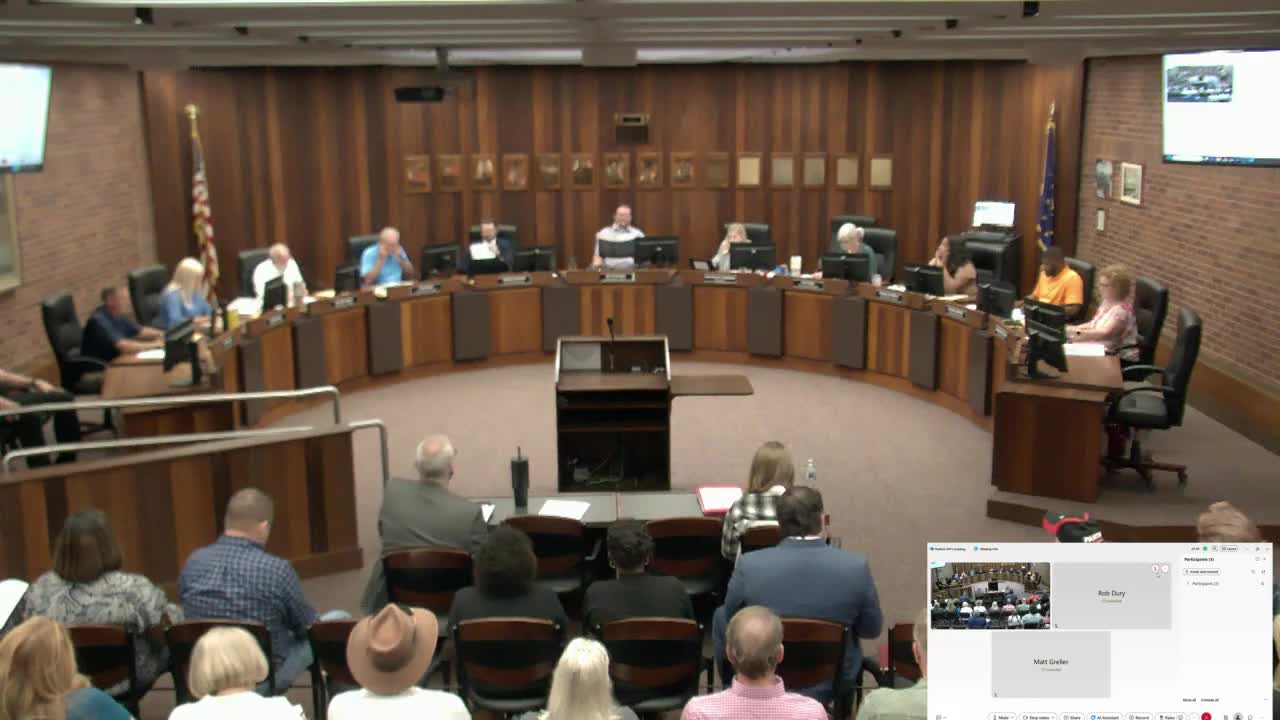
The Evansville Common Council adopted an amended ordinance imposing a municipal wheel tax and a motor vehicle license excise surtax on Aug. 25, voting 8–1 after cutting proposed rates by $5.
The Evansville Common Council adopted an amended ordinance imposing a municipal wheel tax and a motor vehicle license excise surtax on Aug. 25, voting 8–1 to approve the measure after an amendment that lowered the proposed rates.
City officials and outside advisers told council the tax is aimed at filling an expected roads funding gap tied to state changes in grant programs. Robert Country of the Controller's Office said recent state law changes and reductions to the Community Crossings matching program will reduce Evansville's share of that grant money and that the wheel tax revenue "can only be used on the roads." The council passed the ordinance after amending the proposed rates downward by $5.
City engineer Mike Levitsky gave the council a local cost picture: "It costs about $300,000 to pave 1 mile of road in this city," he said, and estimated the city needs roughly $3.6 million a year to maintain collectors and arterials on a 20–25 year cycle, with considerably more required to address local streets. Levitsky said the city currently has about $1.2 million from county distributions and has used savings from local road and motor-vehicle funds to pay recent paving work.
Matt Greller of AIM (Association of Indiana Municipalities) told the council state lawmakers are changing how infrastructure money flows to cities. He said the new lane-mile distribution fund will provide an "automatic distribution" to municipalities that levy a municipal wheel tax and that larger cities could receive, depending on formula and participation, significantly more funding than under the old program.
Public commenters expressed both support and concern. Several residents urged lower rates or more accountability: "We are going for the highest amount on passenger vehicles allowed," said Kyle Morse, a resident who urged council to consider smaller rates and to study alternatives. Others, including long-time local road workers, urged passage to secure stable funding for road repairs and to avoid losing state dollars to competing applicants.
Council discussion focused on eligibility for state lane-mile funds, which city staff said requires municipal adoption of a wheel tax, and on equity concerns for households with multiple vehicles. Finance Chair Councilwoman Mary Allen (identified in council discussion) moved an amendment to reduce the proposed schedule by $5; the amended rates announced at council were $20 for passenger vehicles, $30 for commercial vehicles (including larger trucks), and $10 for trailers and motorcycles. The council approved the amendment 8–1, and later adopted the amended ordinance by roll call (8 ayes, 1 nay).
City staff noted procedural timing: to begin collections on Jan. 1 the ordinance needed council approval by Aug. 31. Staff also emphasized statutory limits on uses of the revenue. The controller said the wheel tax money is legally restricted to road uses and cannot be diverted to other city projects.
What passed: an amended G-2025-17 establishing a municipal wheel tax and vehicle license excise surtax; the council directed staff to implement the tax schedule adopted at the meeting and to pursue the state lane-mile funding that requires municipal participation. The ordinance was declared adopted following the roll-call vote.
The council did not set a deadline for revisiting the rate; council members said the tax can be amended or repealed in future sessions. Implementation steps discussed included technical work by the controller and clerk to ensure the tax appears on vehicle registration records and to coordinate with state offices on distributions.
Ending: Council members said they will continue constituent outreach and oversight as the city implements the new revenue source and pursues available state lane-mile and matching grant funding. The ordinance takes effect under timelines required for state distribution eligibility.