Get Full Government Meeting Transcripts, Videos, & Alerts Forever!
Get email alerts on the Zoning Adus topic
No spam. Unsubscribe anytime.
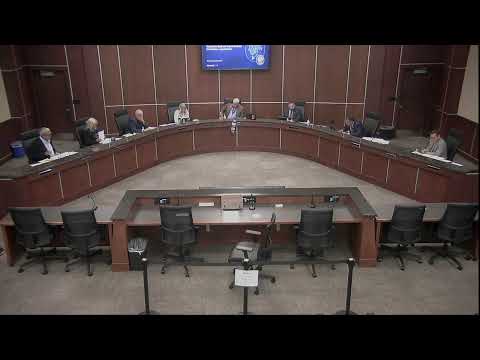
Washington County holds public hearing on accessory dwelling unit zoning changes required by state law
Summary
County planners outlined proposed zoning text amendments to allow accessory dwelling units (ADUs) across multiple districts, citing a state law deadline; commissioners took public comment and deferred action for further coordination with health, building and utility agencies.
Washington County planners on Tuesday presented proposed zoning changes to allow accessory dwelling units, or ADUs, in a wide range of rural and urban zoning districts, citing a new Maryland law that requires counties to permit ADUs by Oct. 1, 2026.
Travis Allen, senior planner in the county Department of Planning and Zoning, told the Board of County Commissioners the draft text amendment, RZ-25-005, would create a new section in the zoning ordinance to permit one ADU per lot by right and to set size, parking and use limits. "We would permit, by right, the creation of one ADU per lot in conjunction with the principal use on a given property," Allen said during the introduction of the proposal.
County staff framed the changes as part of a broader affordable-housing strategy. Allen cited data from the county's comprehensive-plan update showing nearly 30% of owners and 50% of renters spent more than 30% of income on housing in 2020. He said the amendments would allow both attached and detached ADUs, limit ADU size to the lesser of 75% of the principal dwelling or 1,500 square feet (with exceptions for converted basements or attics), and require one additional parking space unless a transit stop exists within a half-mile.
The proposal also would prohibit short-term rentals of ADUs, require that ADUs remain under common ownership with the principal residence, and exclude ADUs from residential density calculations. Allen said the planning commission recommended the changes on May 5 with a modification raising the proposed maximum ADU size from 1,000 to 1,500 square feet.
Public commenters included homeowners and housing advocates who supported ADUs as a way to add affordable units and allow multigenerational housing. Several speakers — and some commissioners — raised questions about requirements outside zoning, including septic capacity, well and water service, sprinkler triggers, and building-code and health-department reviews. Commissioner Randy Leatherman and others repeatedly noted that utilities, septic rules, and building-code requirements are separate processes that must be resolved after zoning is in place.
No vote was taken. Commissioners concluded the hearing by taking the proposal under advisement and asking staff to continue coordination with the Maryland Department of the Environment, the county health department, and permitting and building-code officials to clarify septic, water, and fire-safety implications before final action.
The planning staff emphasized the urgency created by state law (House Bill 1466) and recommended moving forward with zoning language that creates a legal pathway for ADUs, while acknowledging other agencies will need to resolve technical implementation details.
What happens next: staff will continue interagency coordination, respond to the technical questions raised at the hearing, and return with any revisions. The county must adopt enabling zoning before the state deadline, but commissioners signaled they wanted more detail about septic, sprinklers and utility capacity before final approval.