Get Full Government Meeting Transcripts, Videos, & Alerts Forever!
Get email alerts on the Property Records And Taxpayer Services topic
No spam. Unsubscribe anytime.
Property Records and Taxpayer Services budget targets elections, technology and new central license center
Summary
Property Records & Taxpayer Services Director Amy Stumptenagel presented the department’s 2026 recommended budget, citing even‑year election costs, a new central service and license center, technology upgrades and ongoing volatility in recording revenue tied to housing market trends.
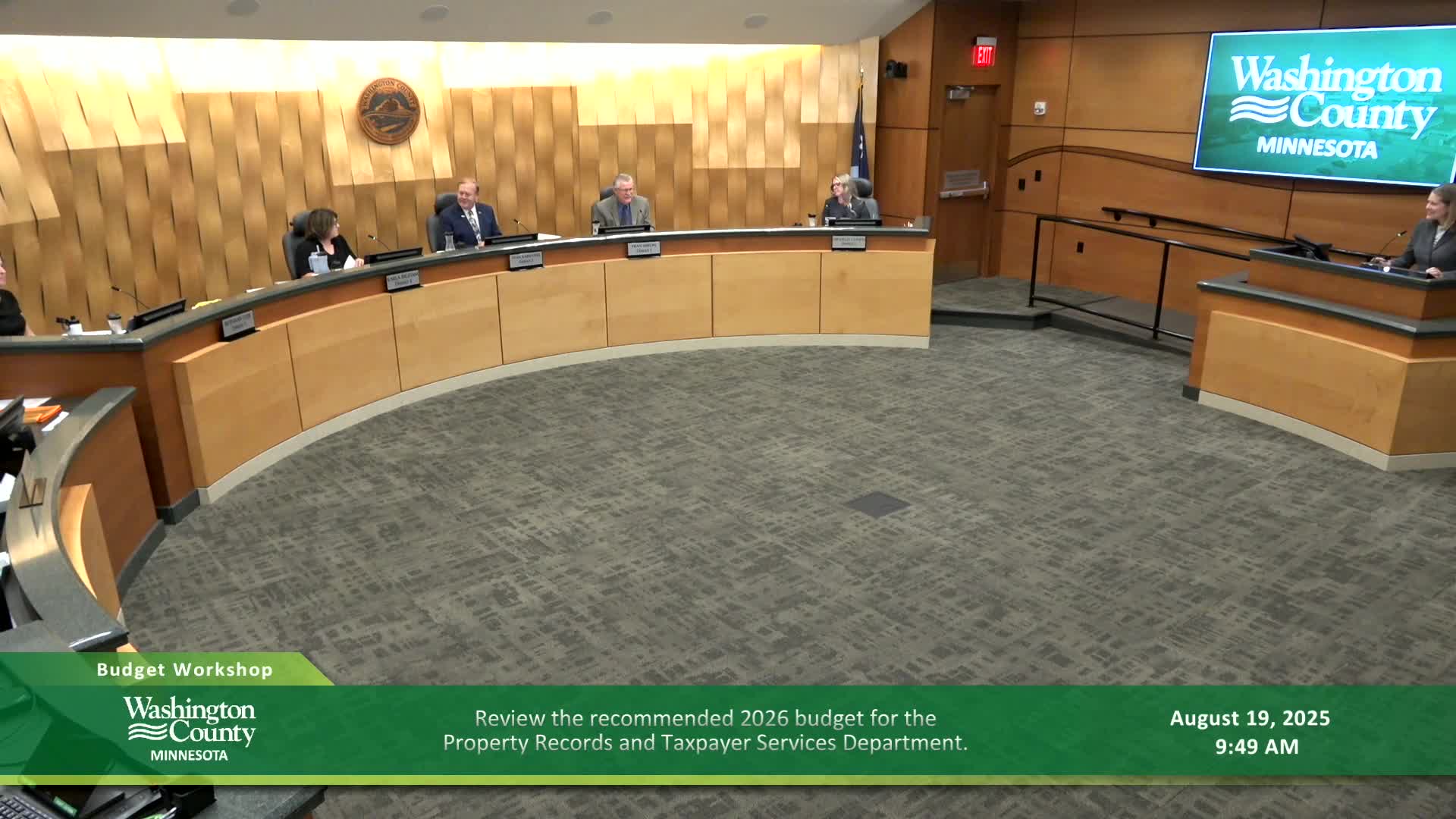
Amy Stumptenagel, director of the county’s Property Records and Taxpayer Services (PRTS) department, told the Washington County Board of Commissioners on Aug. 19 that the recommended 2026 budget reflects increased personnel costs, technology allocations and expenses related to administering even‑year elections.
Stumptenagel said PRTS touches broad parts of residents’ lives—“from administering birth certificates to helping people get their first driver’s licenses, to helping people vote, to purchasing a home”—and that the department’s operations are governed and constrained by multiple state agencies, including the Minnesota Department of Revenue and the Secretary of State.
Key workload and volume projections presented for 2026 include: about 121,000 tax parcels in the county; an expected 247,000 transactions at license/service centers; administration of elections for roughly 193,000 registered voters; an estimated 41,000 recorded documents; and responsibilities for collecting what the presentation described as “over three‑quarters of a billion dollars” annually on behalf of taxing districts.
Stumptenagel explained that PRTS non‑levy revenue is artificially elevated in even years because PRTS administers elections for 13 municipalities under joint powers agreements; that line item increases about 12.6% in 2026 largely for this reason. Separately, a one‑time $200,000 transfer was included in the recommended budget to continue growing the county’s election equipment fund.
The department plans to open a new central service and license center in Woodbury next week. Stumptenagel said the county shifted the point‑of‑sale system cost into PRTS budget for 2026 and added one new service representative FTE to staff the new center. PRTS also is moving to new software for online homestead applications and is upgrading the county’s property tax system.
On property records, Stumptenagel said recording volume and revenue remain below the 2021 peak and that some revenue categories are falling as the housing market slows. She noted that some recording fees and state deed/mortgage registration taxes are governed by statute and that a portion of recording‑fee revenue is transferred annually into a county recording‑technology fund.
Commissioners asked about precinct locations, special‑election costs and kiosk access. Stumptenagel said the department is reviewing cost‑sharing with municipalities for the increasing incidence of special elections and is working with the Secretary of State’s office and cities when precincts or polling‑place locations change. She described the central service center as having more seating and an announcement system to reduce perceived wait times and said the new Woodbury center should help ease customer waits.
Board members commended PRTS staff for customer service during high‑volume periods this year, particularly during demand for Real ID transactions. Stumptenagel said PRTS will monitor demand and staffing needs, pointing out that some election costs are reimbursed by the municipalities that contract with the county under joint powers agreements.
No formal votes were recorded during the presentation; the department’s recommended figures will be considered in the county’s ongoing budget process.