Get Full Government Meeting Transcripts, Videos, & Alerts Forever!
Get email alerts on the Legacy Businesses topic
No spam. Unsubscribe anytime.
Supervisors’ proposal to require conditional-use review for legacy businesses draws split Small Business Commission response
Summary
Supervisor Connie Chan urged making conditional-use (CU) review permanent for legacy businesses; commissioners expressed concern CU can be burdensome for small operators and instead voted to make no recommendation while urging improvements to the CU process and further study of mitigation tools.
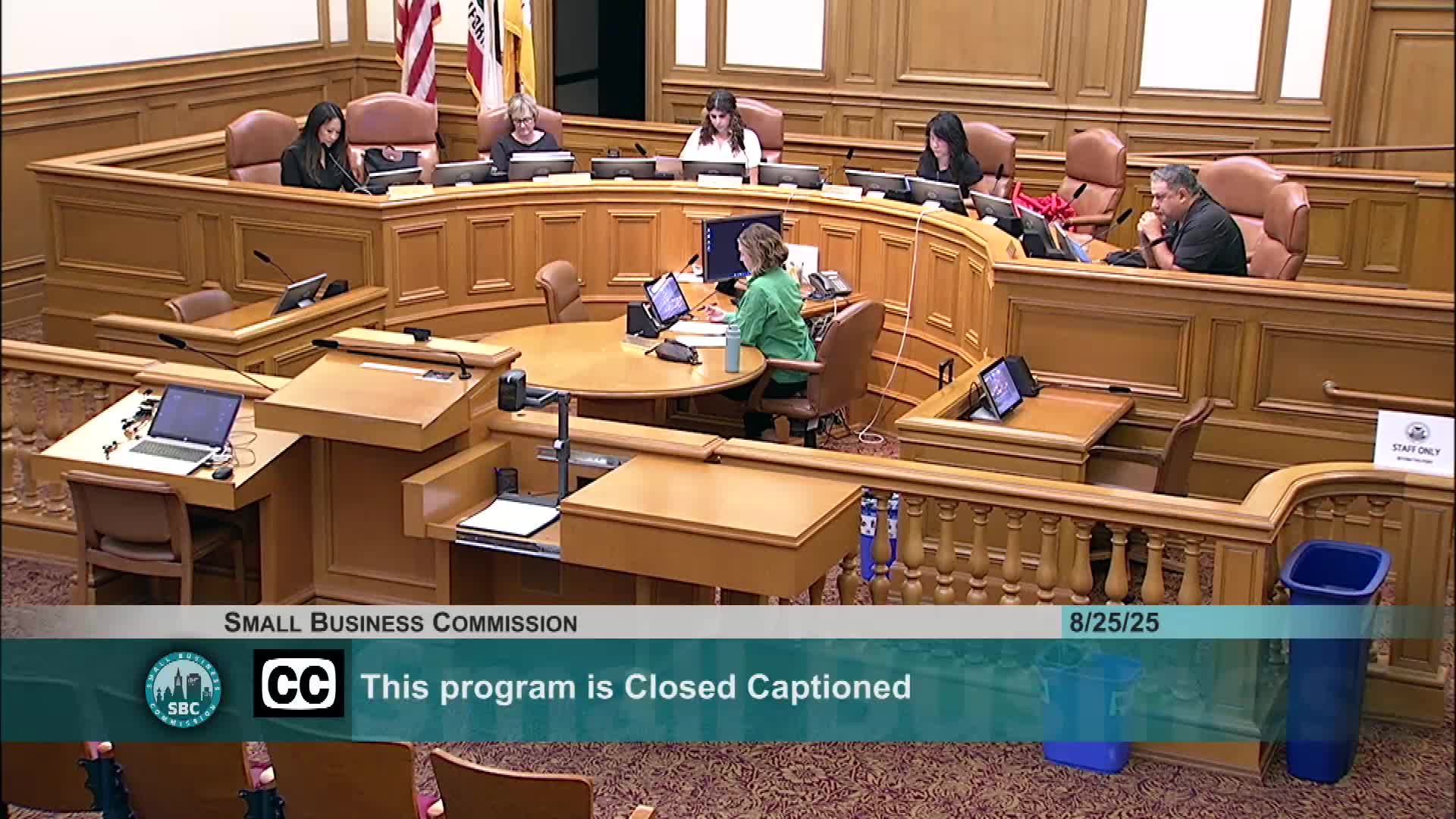
Supervisor Connie Chan asked the Small Business Commission on Aug. 25 to support legislation (Board of Supervisors file 250,808) to make permanent a conditional-use authorization process when a legacy business is replaced by a new nonresidential use in certain neighborhood commercial districts. The measure would restore or extend a review requirement that Supervisor Chan said was introduced earlier as an interim zoning control and was needed as San Francisco considers a separate upzoning package.
The proposal would apply the conditional-use requirement to ‘‘legacy businesses’’ — businesses that have operated 30 years or more — in specified neighborhood commercial and mixed-use districts. ‘‘The conditional use really…does not ban a new development. What it actually does is it require a conversation,’’ Supervisor Chan said, describing the requirement as a modest tool to trigger public review and discussion when a legacy business might be displaced.
Why it matters: Commissioners and public commenters framed the item as a narrow tool aimed at preserving long-running neighborhood businesses amid broader rezoning and redevelopment proposals. Supporters said the CU process creates a public forum for neighbors and merchants to influence reuse plans; opponents and several commissioners said the CU process can be slow, costly and sometimes deters new small entrepreneurs from taking over spaces.
Discussion and concerns
Commissioners raised multiple objections to CU as a broad remedy. Commissioner Ortiz Cartagena said the CU process can ‘‘strike fear’’ into small-business owners and described instances in the Mission where CU requirements delayed or discouraged new entrepreneurs. ‘‘It is a scary process,’’ Ortiz Cartagena said, describing cases where required review added years and expense and ultimately harmed small entrepreneurs.
Vice President Zazunas and others pressed for clear exemptions and faster timelines. Commissioners and Supervisor Chan discussed possible refinements, including waivers for another legacy operator returning to the same site, a streamlined CU timeline, and development bonuses or impact-fee structures to offset relocation costs. Supervisor Chan said she was open to amendments that would shorten the process or exempt certain small-business situations, and she flagged that related mayoral zoning proposals (files 250,700 and 250,701) did not contain CU or impact-fee requirements for relocating legacy businesses.
Public comment and context
Small-business advocates who helped secure the temporary protection said the CU tool was a needed ‘‘tool in the toolkit’’ in cases where a single property owner had been creating vacancies and evicting long-standing businesses. A speaker representing merchants in Fillmore cited two long-running businesses that faced evictions and urged retention of tools to allow public scrutiny of proposed changes.
Commission action
Rather than recommending approval of Supervisor Chan’s ordinance, the commission voted on a motion to make no recommendation to the Board of Supervisors while urging further work. The motion called for continued study and improvements to the conditional-use process (including transparent timelines), investigation of alternative tools and incentives to mitigate displacement, and consideration of impact-fee or developer-incentive approaches. The motion passed on a 3–1 roll call: Commissioner Herbert, President Huey and Commissioner Ortiz Cartagena voted yes; Vice President Zazunas voted no. The commission recorded no formal approval of the ordinance itself.
What’s next
Because the commission chose not to forward a recommendation, the item remains before the Board of Supervisors. Commissioners asked staff and the sponsor to pursue amendments that would shorten CU timelines, create exemptions or faster tracks for small or returning legacy businesses, and explore nexus studies on displacement mitigation including financial assistance or developer incentives.
Ending note
Speakers on both sides said the CU is only one tool among many. Supporters urged retention of any process that creates a public forum before longtime neighborhood businesses are displaced; critics said the city must pair any review requirement with streamlined procedures, funding and meaningful relocation help so small businesses are not hurt by the remedy intended to protect them.