Get Full Government Meeting Transcripts, Videos, & Alerts Forever!
Get email alerts on the Ada Transition topic
No spam. Unsubscribe anytime.
ADA transition work advances while street-maintenance funding tightens
Summary
Staff reported progress on the city's ADA transition plan — new staffing, small bid packages and several active accessibility projects — even as Measure C and pavement funds were reallocated to the new police station, reducing near-term sidewalk and ramp work.
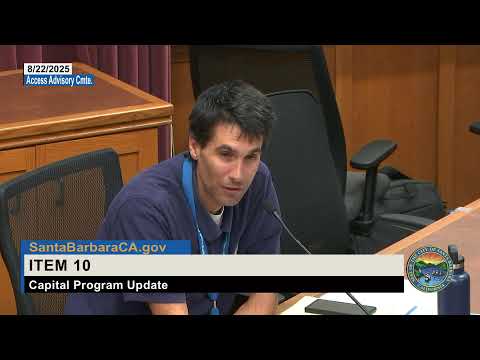
Santa Barbara City staff told the Access Advisory Committee on Aug. 12 that work to implement the city's ADA transition plan is proceeding, with new staff assigned and several projects either under construction or moving into procurement — but members were also warned that near-term sidewalk and ramp work will be constrained by budget reallocations to the city’s police station project.
Craig Schallenberger, who presented the update on the transition plan, said staff have added an engineering resource (Ashley Lopez) to the team and are preparing a sequence of bid packages. He said a small signage contract has already been issued at 630 Garden Street to establish procurement procedures and that larger path-of-travel items — curb ramps, handrails and restroom work — will follow.
Schallenberger said multiple city projects already underway overlap items in the transition plan, including the new police station, the Dwight Murphy Park renovation and Chase Palm Park work. He said those overlapping projects have obliged staff to use a combination of dedicated transition-plan bid packages and integration with larger capital projects.
At the same meeting, capital projects staff said the pavement-maintenance budget for fiscal year 2026 and the following years has been reduced to free up money for the police station. Committee members were told the city expects roughly $6 million this year for pavement maintenance, and higher police-station-related allocations this and next fiscal year (staff cited about $14 million in the current year and $13 million next year allocated to the police station); staff said the police-station contract itself is roughly $9.6 million and that other program costs bring the overall project higher.
Despite those cuts, staff said the ADA transition plan line items were not cut from the budget and that smaller, targeted initiatives are beginning. The meeting also included a listing of near-term pedestrian-access projects that remain funded: a previously awarded FY25C project covering about 60 curb ramps and sidewalk repairs (Upper East neighborhood, Anacapa and Laguna streets), an earlier FY23C contract that includes more than 100 ramps (Mesa, Westside and San Roque), and an upcoming De La Vina curb-extension project with new accessible pedestrian signals (APS).
Public-works and capital staff also said the city recently learned a Caltrans grant was successful: a traffic-signal safety upgrade that will add 19 APS devices and 28 pedestrian-access ramps at multiple signalized intersections; construction timing for that grant was estimated around 2027–2028.
Committee members asked when they would see contract awards and construction. Schallenberger said the spreadsheet tracking transition-plan items will be updated before the committee's November meeting and that staff expect to issue additional bid packages and begin spending on the prioritized items in the coming months. The capital projects representative said the budget added modest new line items for accessibility work — $50,000 for “trails and walkways” and $50,000 for on-street disabled parking spaces — and that staff plan to use that funding to pilot fully compliant on-street accessible spaces and to address small trail improvements such as at Douglas Preserve.
Why it matters: the transition plan sets a schedule for removing physical barriers on public property; budget changes that divert Measure C and pavement funding to major capital projects can slow pavement and ramp repairs unless staff find other funding sources or prioritize differently. Committee members stressed the need to move from design to construction to avoid unspent balances being reallocated in future budgets.
Looking ahead: staff said they will present an updated transition-plan progress spreadsheet at the next committee meeting in November and will bring specific bid packages and project schedules to the ad hoc committee for technical review.