Get Full Government Meeting Transcripts, Videos, & Alerts Forever!
Get email alerts on the Preschool For All topic
No spam. Unsubscribe anytime.
County panel schedules public hearing, delays first reading of Preschool for All indexing ordinance
Summary
The Multnomah County Board voted to hold a public hearing and delay the first reading of a proposed ordinance to index the Preschool for All tax thresholds to inflation while the commission seeks additional analysis and community input.
The Multnomah County Board of Commissioners voted to schedule a public hearing and delay the first reading of an ordinance that would index income thresholds for the county's Preschool for All (PFA) tax to inflation.
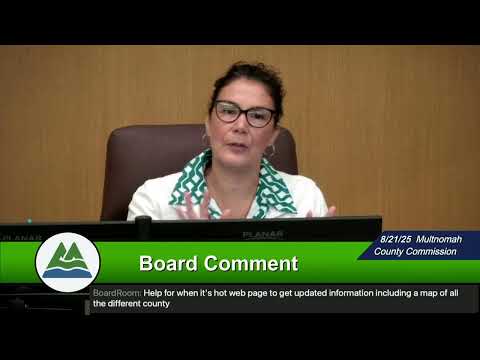
The motion to hold a hearing and postpone the first reading — moved by Commissioner Julie Bridal Edwards and later approved by the board 3–2 — directs staff to conduct a public hearing and sets a later date, to be agreed by the full commission, for any formal vote on the ordinance.
Board members said they supported airing the issue publicly but want more analysis and community engagement before changing the county code. Commission supporters of delay cited outstanding technical questions, the need for additional demographic and economic modeling, and concerns raised about the Technical Advisory Group (TAG) process; opponents said speedier implementation and preserving program funding should be the priority.
County staff summarized the proposal and its fiscal context for the board. Brian Hockaday, chief of staff for Commissioner Bridal Edwards, said the county's April audit showed the PFA tax has generated roughly $230 million more than anticipated over three years while the program underspent by about $67 million, producing roughly a $300 million cumulative surplus. Jeff Renfro, the county economist, explained the indexing mechanism proposed: the county would tie PFA income thresholds to changes in the Consumer Price Index (CPI-W, West, size A) beginning tax year 2026. "We use the change in that index as our measure of inflation," Renfro told the board.
Under the modified indexing proposal presented to the board, some income thresholds would rise: for a single filer the $125,000 threshold would roughly move to $153,000; joint thresholds and higher brackets would also shift. Staff described an approach that would reduce the indexing impact on the highest earners by not fully indexing the liability calculation for those brackets.
County CFO Eric Ariano told the board that the proposed administrative change to require estimated quarterly payments only when tax liability exceeds $5,000 (instead of $1,000) would align with Metro's recent change and would be revenue-neutral; it would shift some cash flow timing but not the underlying revenue expected for the program.
Public commenters were largely opposed to indexing and urged preserving or accelerating the rollout of universal pre-K. Lauren Goldberg, a resident and disability-rights attorney, said she opposed cuts: "No cuts be made to the funding of Preschool for All," she testified. Parents and providers described the program as life-changing, raised concerns about implementation speed and provider confidence, and pressed the board for transparency on long-term funding and on how to expand access more quickly.
Several commissioners said they want the TAG's forthcoming work, additional demographic projections, and clearer implementation plans before voting on ordinance changes. Commissioner Bridal Edwards framed the motion as creating a public forum to gather the necessary information and align the ordinance with broader program rollout decisions.
Next steps: the board ordered a public hearing to be scheduled; commissioners and staff said the commission will agree on the hearing date and receive further analyses from staff and TAG members before any first-reading vote is scheduled.