Get Full Government Meeting Transcripts, Videos, & Alerts Forever!
Get email alerts on the Budget Finance topic
No spam. Unsubscribe anytime.
Marion County Community Corrections presents 2026 budget: $22.49 million projected, Duval facility needs highlighted
Summary
Directors presented a condensed 2026 budget projection of $22,492,408 and program updates including grant revenue, staffing pressures, Duval facility maintenance needs and planned workforce and financial‑literacy programming; board discussed attrition, revenue collection and potential operational impacts.
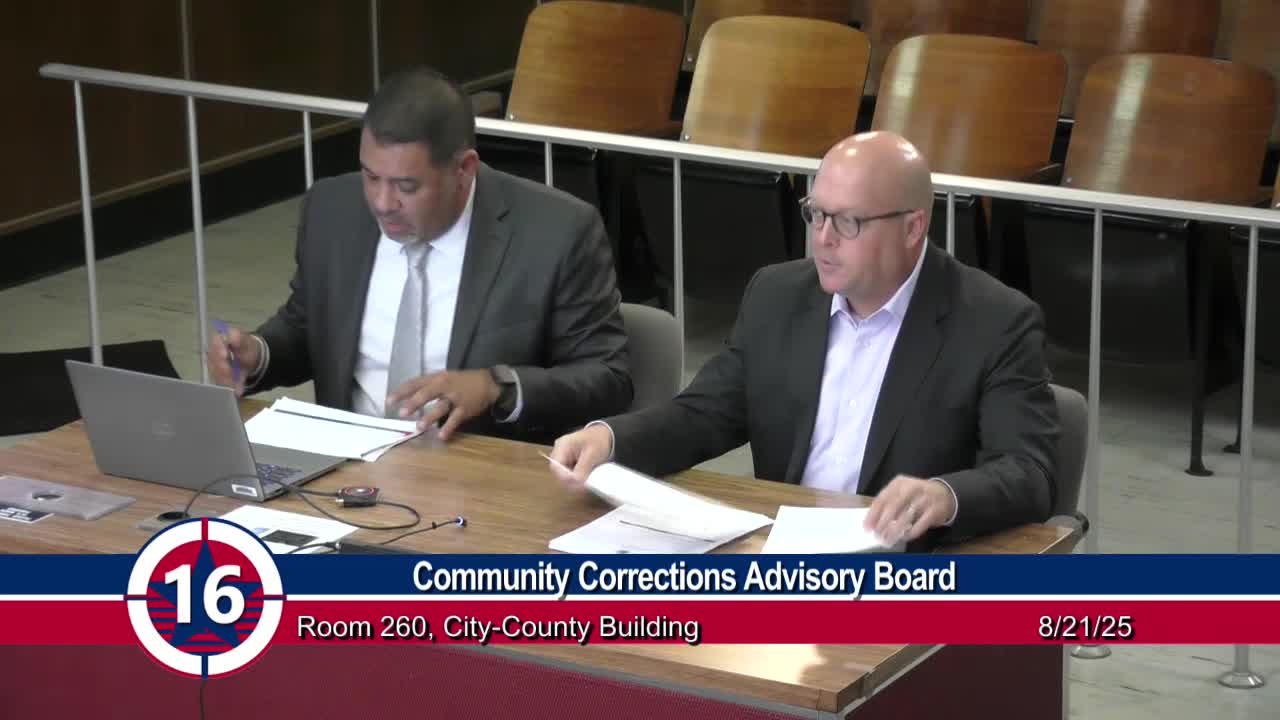
Scott Hole, director of Marion County Community Corrections, and Justin Garcia, chief financial officer, briefed the advisory board on the agency's 2026 budget projection and program updates.
Garcia summarized the agency's total projected 2026 budget at $22,492,408, spread across seven funds, with three funds comprising about 93% of the total. He said the 2026 projection represents a $462,000 decrease (about 2%) from 2025 and that the agency projects just over $1 million in user‑fee revenue. "A majority of that is gonna come from user fees that are charged to individuals serving home detention or work release," Garcia said.
Garcia said the agency received just over $6,000,000 in grants, primarily from Department of Correction grants and the Justice Assistance Grant, and that a full‑time grant specialist works to locate grants. He told the board that federal and state grant availability has been difficult to find this year.
On expenses, Garcia said salaries (character 1) account for about 66% of the budget, and the agency submitted a 4% reserve to OFM. The presentation noted an 11% attrition rate used in the projection; the department froze four positions to save just over $300,000 and removed an additional $220,000 from the salary character to account for expected attrition. Garcia and Hole cautioned that lower attrition and higher caseloads could increase spending and that limits on overtime at 24‑hour services could have operational effects.
Board members asked about collection of user fees. Garcia said the county's collection rate is low—"below 30%"—and that unpaid fees can be sent to the state's tax intercept program, which yields seasonal payments (often in spring). He added that the agency does not file violations solely for nonpayment; nonpayment may be noted to the court when combined with other noncompliance such as strap tampers or misses.
Hole highlighted needs at the Duval facility, saying the agency has spent nearly $200,000 in the past 18 months on maintenance beyond normal upkeep and cited deferred needs such as roof and equipment repairs. He said a facility condition assessment vendor has been selected and scheduling is pending. Hole also announced program updates: an electronic monitoring simulation planned for Sept. 24 at Frederick Douglass Park, two graduating cohorts at Duval (four Second Chance graduates and 16 Excel Center participants), and a job fair at Duval on Sept. 29 from 1 p.m. to 5 p.m. that will include employers and supportive services.
The board discussed contingency planning, grant dependencies and the need to monitor budget buffers throughout the fiscal year. No budget vote was taken at the advisory meeting; the presentation was informational and intended to prepare the board for forthcoming council-level budget discussions.