Get Full Government Meeting Transcripts, Videos, & Alerts Forever!
Get email alerts on the Affordable Housing topic
No spam. Unsubscribe anytime.
MDC approves rezoning for Life Village supportive‑housing project but denies variance request
Summary
The commission approved a rezoning for a 42‑unit supportive housing project proposed by Universal Church of Truth and partners but denied variance requests for reduced unit size, reduced open space and parking on a 5–4 vote against the variance; opponents said they had not been adequately informed.
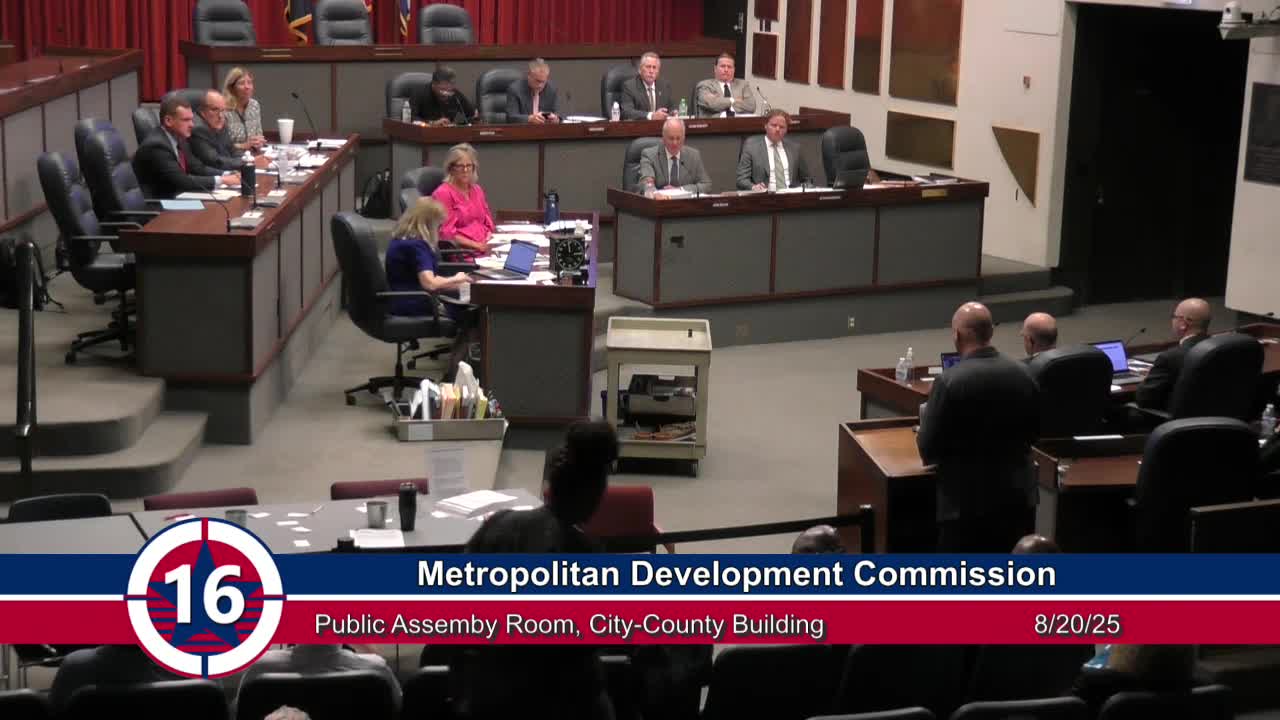
The Metropolitan Development Commission on Aug. 20 approved a zoning change for the Life Village project — a proposed permanent supportive housing campus led by Universal Church of Truth, Radiant CDC and Collins Housing Solutions — but denied the project’s requested variance that would reduce unit sizes, lower open‑space requirements and reduce parking.
Petitioner Justin Kingen described Life Village as a 42‑unit supportive housing community for very low‑income seniors, delivering duplexes, triplexes and a three‑story apartment building plus a community service facility. Project partners at the hearing included Bishop Anthony Boyd (Universal Church of Truth), Keith Collins (Collins Housing Solutions) and Dwayne Miller (Radiant Communities). They told the commission the development has service partnerships, proposed transit‑oriented access and an intent to secure tax credit financing.
Staff recommended denial of the variance requests and raised concerns about the proposal’s compatibility with the surrounding low‑density, single‑family neighborhood, the lack of site continuity across multiple parcels, reduced floor‑area and open‑space waivers, and a proposed shortfall in on‑site parking. Staff asked the petitioner to provide a tree inventory and a property‑maintenance commitment; the petitioner agreed to those two staff commitments.
Several long‑time neighborhood residents testified in opposition, saying they were not adequately informed about the project and that the proposed density, unit sizes and the reduced parking would create safety and circulation problems on narrow local streets. Gladys Whitfield, owner of a home adjacent to the site since 1961, said the neighborhood was not consulted and asked that the matter be returned to the regular hearing cycle to allow fuller public engagement.
After rebuttal and discussion, the MDC voted 6–3 to approve the rezoning petition (2025CZN828) that changes the three parcels to a zoning category that allows the proposed walkable‑neighborhood housing types. Commissioners then voted on a separate variance (2025CVR828) that would have allowed smaller minimum unit sizes, less open space and fewer parking spaces; the variance was denied by a 5–4 vote. The commission chair asked petitioners and neighborhood representatives to sit down with staff and neighbors to resolve outstanding concerns and return with revisions that could meet both programmatic needs and neighborhood standards.
The petitioners said they intend to pursue housing tax credits and other funding and will continue working with staff and neighborhood stakeholders. Staff noted the rezoning approval does not itself authorize the reduced unit sizes or parking that the variance would have allowed; those requests must be reconsidered if the petitioners return with revised proposals.