Get Full Government Meeting Transcripts, Videos, & Alerts Forever!
Get email alerts on the Data Centers topic
No spam. Unsubscribe anytime.
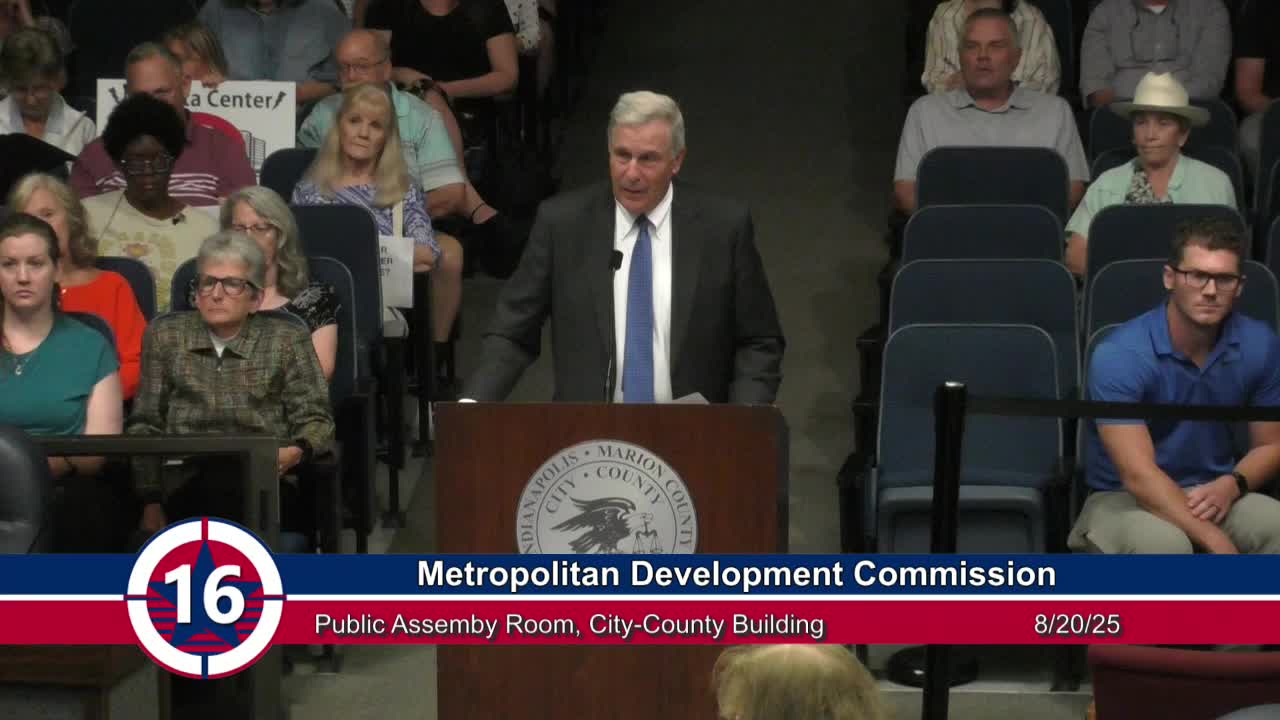
Metropolitan Development Commission approves rezoning for Google data center campus after contentious hearing
Summary
The MDC approved a rezoning request from Deep Meta Ventures LLC (a Google entity) to allow a CS-zoned data center campus on about 467 acres in Franklin Township by an 8-1 vote after hours of public testimony and negotiated commitments; opponents raised concerns about noise, water, height and transparency.
The Metropolitan Development Commission on Aug. 20 approved a rezoning petition from Deep Meta Ventures LLC, an entity created by Google Inc., to allow a data center campus on roughly 467 acres in Franklin Township.
The commission voted 8–1 to approve 2025CZN814 after a full hearing that included a 15‑minute presentation by the petitioner, extended questioning from commissioners, and more than an hour of testimony from remonstrators and civic leaders. The rezoning will allow a campus layout under the CS (Commercial Special) district with a binding list of commitments negotiated with city staff and the Franklin Township Civic League.
The petitioner’s attorney, Joe Calderon, said Deep Meta Ventures has worked with township groups and city departments to shape a site plan and a bundle of commitments that he said exceed standard CS requirements. Calderon described the project as a campus that can accommodate up to four buildings and said the design removes warehousing/distribution uses to limit truck traffic. Engineer Todd Cunningham said the first building would be the easternmost structure, and that the team has completed traffic and environmental due diligence and coordinated studies with the Department of Public Works.
Opponents, led by Julie Goldsberry and other Franklin Township residents, said the project is too large for the area and raised repeated concerns about stormwater, groundwater and flood risks, noise from emergency generators, light pollution, building heights and the number of diesel generators and batteries that can create public‑safety risks. Goldsberry said the remonstrator group submitted thousands of signatures and urged denial of both the rezoning and a companion variance to increase maximum building heights. She said commitments negotiated by the petitioner used imprecise language and some important protections had been removed.
District Counselor Hart, who said he had signed a nondisclosure agreement to review portions of the proposal, told the commission that he had conducted his own financial analysis and had concluded the project offered limited recurring tax benefits to local schools and long‑term constraints on infrastructure. Jim Schellinger, chief executive of the Indianapolis Economic Development, said the scale of investment — which the petitioner described to staff as substantial — warrants additional study but urged the commission to allow the process to produce the facts needed.
Staff recommended approval, noting the site’s proximity to I‑74 and existing utility corridors and citing commitments to a 150‑foot landscape buffer, minimum building setbacks of 200 feet, mounded berms and planted trees, and coordination with Citizens Energy Group and AES for water and power. A staff presentation said the petitioner proposed an operational noise limit of 65 decibels at the property line once the center is fully operational, with exceptions for emergency generator use and testing, and had committed to bury utilities where possible and to fund public amenities such as trail connections.
The commission took a roll‑call vote after deliberation. Both the rezoning (2025CZN814) and the companion variance (2025CVR814) were approved by the MDC; the rezoning was recorded as passing 8–1 and the variance also passed 8–1 on the record.
The petitioner and staff said the approvals will be followed by continued design work, detailed engineering reviews, and coordination on permits for utilities, stormwater and fire suppression systems. Community critics said they will continue to press for stronger, enforceable protections on noise, water quality and generator use.