Get Full Government Meeting Transcripts, Videos, & Alerts Forever!
Get email alerts on the Land Use Zoning topic
No spam. Unsubscribe anytime.
Dallas officials launch long rewrite of zoning code, set public feedback deadlines
Summary
City staff and consultant team presented a diagnostic for a wholesale rewrite of Dallas’ development code and outlined a multi‑phase engagement plan; council members pressed for more district‑level outreach and asked how new Texas laws will affect proposed changes.
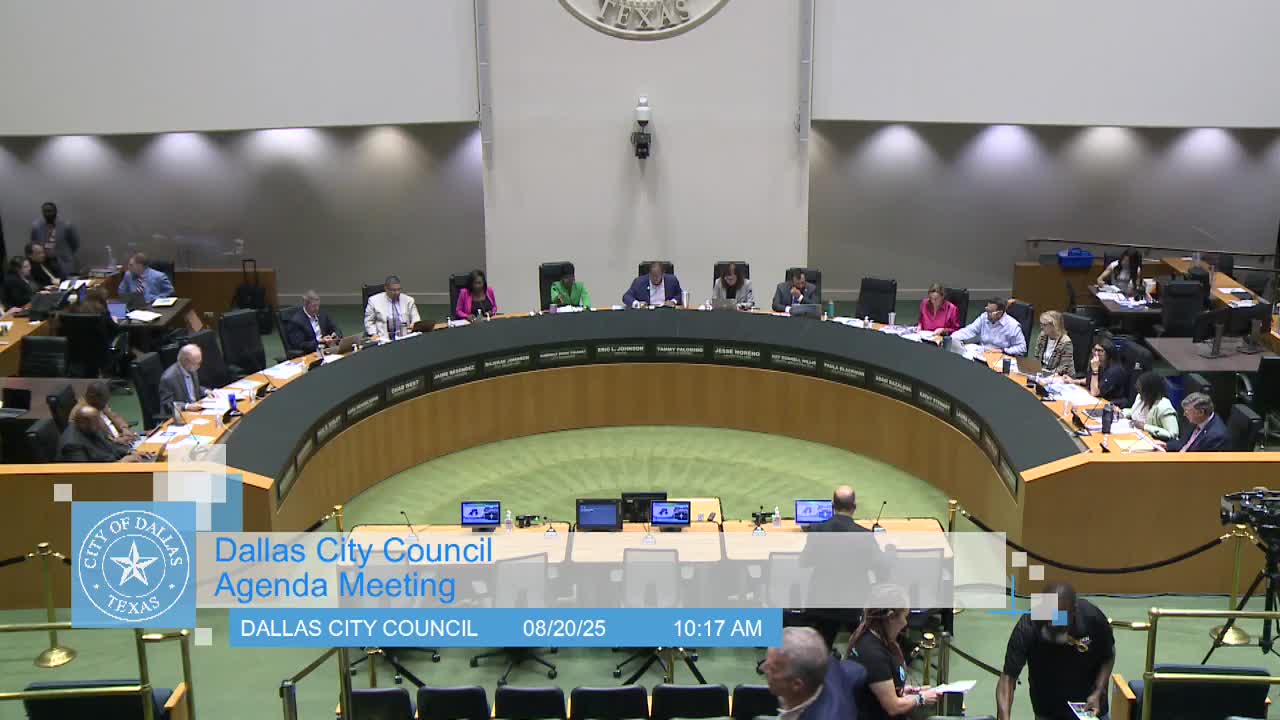
Dallas City Council members heard a planning and development briefing Wednesday on a diagnostic report that lays the groundwork for a near‑citywide rewrite of the city’s zoning and subdivision rules.
The presentation, led by Planning Director Emily Lu and consultants Rista Stungen and Chris Jeannette of Camaros, described a multi‑phase effort to replace the current, patchworked code with a single, reorganized chapter (proposed Chapter 63) that planners say will be “simple, clear and future ready.” The team said the diagnostic analyzes how the existing code functions, identifies common special approvals that could be converted to standards, and proposes new districts and form‑based tools to increase certainty for developers and residents.
Why it matters: Dallas’ development code traces back to a 1960s framework and has been amended many times; staff said the result is inconsistent rules that drive frequent use of Planned Development (PD) and other special approvals. The city manager’s office framed the rewrite as a long‑term effort intended to improve predictability for people repairing homes, running businesses or building new housing.
Key points from the briefing and council discussion: - Scope and timeline: The consultant team said the diagnostic was released publicly in March 2025 and that staff is conducting a “September series” of listening sessions (Sept. 9, 11 and 16) and will close the formal diagnostic comment period on Oct. 3. Draft 1 of the new code text is targeted for spring 2026, with subsequent public drafts and redlines before council consideration. The team emphasized the diagnostic itself is a proposal intended to collect feedback and is not a final code. - Content highlights: Proposals shown in the diagnostic include reorganizing zoning and subdivision rules into Chapter 63, creating a consolidated use matrix, reducing reliance on discretionary approvals by converting many conditions into objective standards, removing the unusual Dallas practice of automatic renewal of Specific Use Permits (SUPs), and introducing “general density” districts (gentle density) that would allow duplexes, triplexes and small multifamily types in selected areas. The diagnostic also proposes clarifying industrial districts, adding context‑sensitive design standards, and revising residential adjacency and unit‑mix controls. - State law interaction: Staff and consultants repeatedly noted recent Texas legislation (identified in the briefing as Senate Bill 840 and Senate Bill 815) will affect the code. Staff said parts of the proposed code must be studied to ensure compliance with state law that becomes effective Sept. 1, and that some provisions the city had considered (for example, certain local controls over multifamily near allowed commercial uses) may be limited by the new statutes.
Council reaction and next steps: Council members across the horseshoe pressed for more outreach, clearer technical examples, and better district‑level briefing before any draft is released. Several members asked the team to provide a breakdown showing how many meeting attendees were Dallas residents and to post incoming comments publicly and frequently rather than waiting for an October cutoff. Others asked staff to separate purely technical cleanup (organization, definitions, fixing inconsistencies) from policy items that would change allowable uses (for example, ADU by‑right, plexes in single‑family neighborhoods, or eliminating SUP renewals). Staff agreed to meet one‑on‑one with council members, to post comment summaries, and to return with draft materials after the September engagement series.
Direct quotes from the meeting: "We're trying to make a code that's simple, clear, and future ready," Rista Stungen, principal at Camaros, told council. "The diagnostic isn't set — it's a proposal to gather feedback." "We have to make sure the engagement is meaningful so that as we're receiving comments, we're giving something back that folks are aware of," Mayor Pro Tem said during the discussion.
What council will see next: The consultant team will finish a public engagement push through the fall, close the formal diagnostic comment window on Oct. 3 (staff said comments will still be accepted but that date marks the transition), then begin drafting a public Draft 1 targeted for spring 2026. Councilmembers asked staff to slow the schedule if more district outreach is needed and to provide clearer comparisons between the current rules and proposed text in upcoming briefings.
Ending note: The briefing underscores a tension typical in large code rewrites: staff and consultants want a code that reduces discretionary approvals and increases predictability, while many residents want strong local controls and formal processes to weigh in on changes affecting single‑family areas.