
Board counsel briefs Scottsdale Unified governing board on new mandatory-reporter duties for trustees
Get AI-powered insights, summaries, and transcripts
Sign Up Free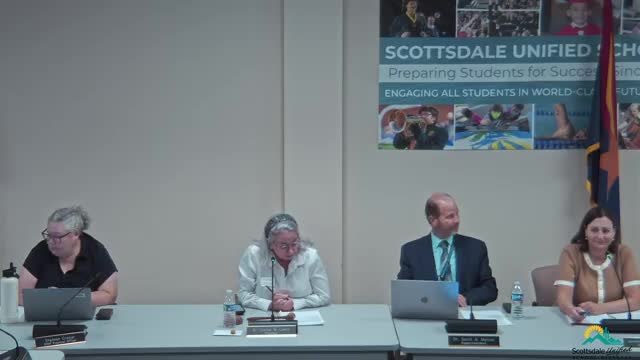
Summary
District legal counsel told the governing board that recent changes to Arizona law list governing board members as statutory mandatory reporters and explained duties: immediate reporting to law enforcement/Department of Child Safety, SRO reports do not satisfy the duty, and possible criminal penalties for failing to report.
Scottsdale — District legal counsel provided the Scottsdale Unified School District governing board with an overview of recent changes to Arizona’s mandatory-reporting laws and explained how the changes affect governing board members.
Counsel told the board that governing board members are now listed as statutory mandatory reporters. "You have a reporting obligation as a mandatory reporter in the law," counsel said, adding that the obligation attaches when a board member forms a reasonable belief that a minor "is or has been the victim of physical injury, abuse, [a] reportable offense or neglect." Counsel explained that the duty is personal: the individual who forms the belief must report immediately and cannot discharge the requirement merely by telling a supervisor.
Counsel outlined the agencies to which reports should be made: local law enforcement and the Arizona Department of Child Safety, and for certificated staff alleged to be perpetrators, a report to the State Board of Education. Counsel said that reporting to a school resource officer or school safety officer does not satisfy the statutory obligation and recommended simultaneous contact with dispatch and the SRO when practicable to allow coordinated response. Counsel also described the statutory immunity for reporters who act without malice and summarized criminal penalties mentioned in the presentation: a class 1 misdemeanor for failing to report child abuse and a class 6 felony for failing to report certain listed crimes.
The presentation referenced a recent legislative change described in the meeting as "Senate Bill 1437, which has become chapter 40 in the laws" and noted that the new rules will be effective Sept. 26; district staff said they have already trained administrators on the updated procedures. Counsel also described the county-level, multidisciplinary protocols used to limit repeated interviews of students and stressed that school staff and board members should limit questions of students to basic, fact-gathering prompts ("What happened? Who did it? Where were you when it happened? When?").
Board members asked whether the obligation applies to conduct outside school settings; counsel said the statute lists governing board members as reporters and advised that if a board member forms a reasonable belief that harm is occurring they should report even if it occurs outside the school context. Board members also asked about which local law enforcement agency to call; counsel said to contact the agency for the location where the alleged incident took place (for example, a field trip site).
District staff said they will continue training administrators and staff and will provide follow-up materials. Counsel reiterated that reports should be made immediately and that staff will take direction from law enforcement during any subsequent investigation.
The board thanked counsel for the briefing and proceeded to other agenda items.