
Alamance County planners present draft land-use map; residents warn higher rural lot sizes will price out buyers
Get AI-powered insights, summaries, and transcripts
Subscribe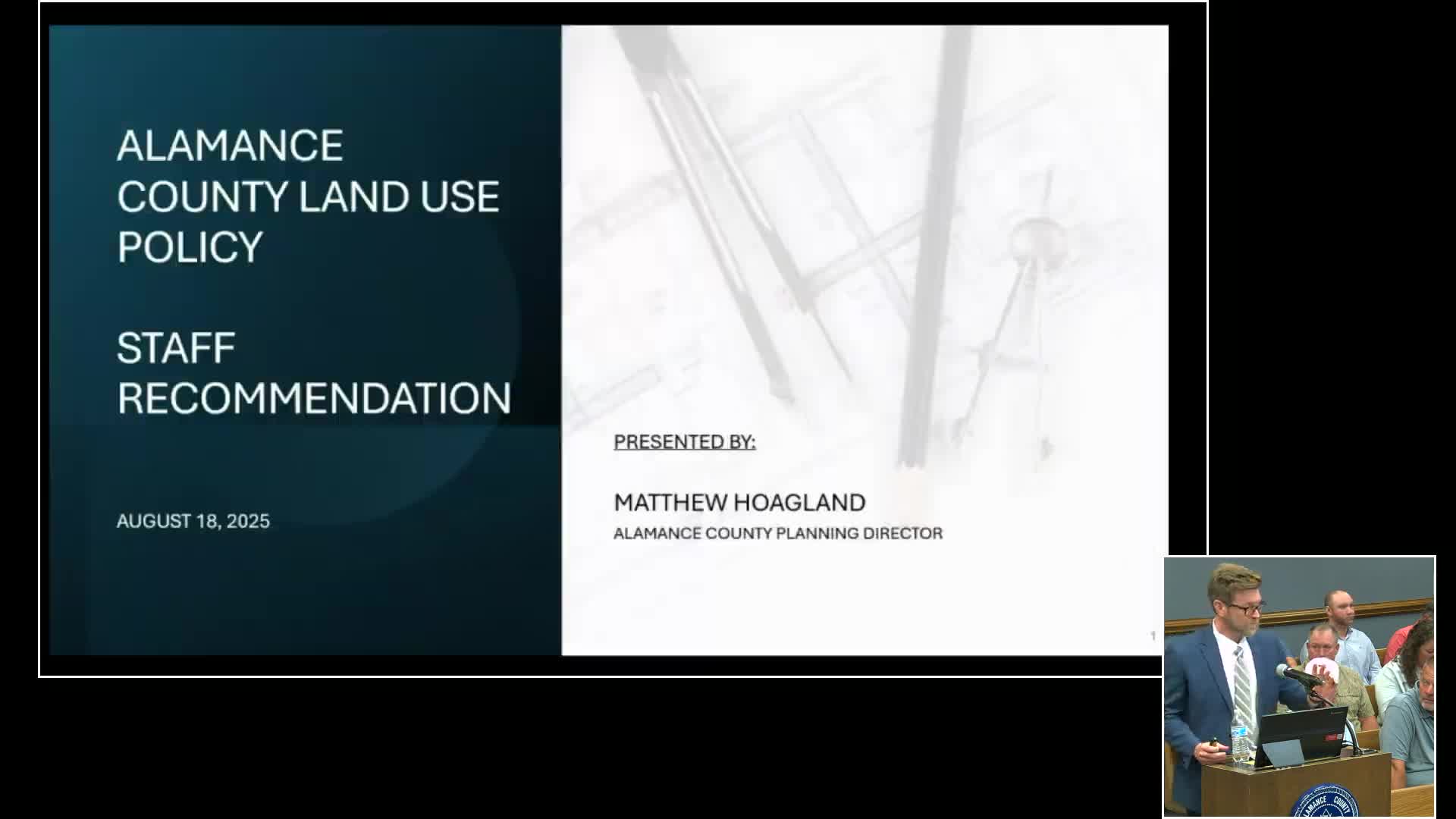
Summary
Planning staff presented a draft land-use map and rural preservation ordinance that would raise minimum lot sizes in much of the county; commissioners heard extended public comment both for mill-village preservation and against proposals that would increase minimum rural lot sizes to 2–5 acres.
Alamance County Planning Director Matthew Hoagland presented a staff draft of a countywide land-use map and companion rural preservation ordinance at the Aug. 18, 2025, meeting of the Alamance County Board of Commissioners, prompting extensive public comment on minimum rural lot sizes and preservation of historic mill villages.
The draft map divides unincorporated county land into six districts, staff said, including agricultural (a proposed 5-acre minimum), rural residential (proposed 2-acre minimum), rural community centers, suburban transition areas, employment centers and “mill village” districts intended to preserve the look and feel of historic communities such as Saxapahaw. The proposal also includes changes to the subdivision ordinance to allow cluster, density and family subdivisions as alternative ways to achieve the same average density in the agricultural district.
Hoagland told the board the planning board gave a favorable recommendation in July 2025 to the staff proposal. He said the draft is intended to protect farmland and rural character, encourage development near existing infrastructure, and provide flexibility in subdivision types rather than instituting “old-fashioned zoning.” He also noted the proposal was informed by the county’s 2020 Land Development Plan and by recent local land-use conflicts.
Residents and interest groups offered sharply different views in public comment. Amy Beth Kessinger, vice chair of the community nonprofit Saxapahaw Forward, praised the mill-village designation as a way to retain the historic character and local identity of mill-centered villages and to encourage compatible nonresidential development. “This designation strikes a balance that’s both respectful of the past and oriented toward our future,” Kessinger said.
Multiple speakers representing homebuilders, realtors and county residents urged the board not to adopt a broad increase in minimum lot sizes. Jeff Thornburg, representing the Alamance County Home Builders Association, said economic conditions have changed since the data used in earlier outreach and warned higher minimums would push modest houses out of reach. He also referenced pending state legislation, saying, “House Bill 765, the Save the American Dream Act, [is] designed specifically to prevent local governments from enacting the kind of restrictions this proposal suggests.”
Marlo Kaufis, a realtor with nearly two decades of local experience, told commissioners she had not seen factual justifications for the larger minimum lots and said the change would reduce housing affordability and lower land values for owners who might otherwise sell. Several speakers made similar points about pricing and access for first-time buyers and young families.
Other commenters urged more public engagement and updated data; multiple speakers said the 2020 plan and associated surveys predate significant post‑pandemic changes in the housing market. Several callers asked the board to hold additional community forums that include builders, landowners, realtors and county staff before moving from a staff recommendation to formal ordinance text.
Hoagland described several optional subdivision mechanisms intended to preserve average densities while permitting smaller individual lots via cluster or density subdivisions and a family subdivision option that would allow one-acre parcels for transfers within a family. He said minor and major subdivision definitions would be clarified, and that where mill-village nonresidential projects are proposed, form‑based elements would guide exterior appearance but would not apply to residential work.
The presentation was informational; Hoagland reminded commissioners that the planning board vote was advisory and that no action was required or requested at the Aug. 18 meeting. Commissioners asked questions about how the proposal differs from conventional zoning, the nature of the public outreach that produced the 2020 plan, and whether the plan’s survey pool and stakeholder meetings provided a representative sample of county residents. Hoagland said the 2020 process included steering‑committee and stakeholder meetings, open houses and online surveys and estimated roughly 1,700–1,800 survey responses, but he said he would supply detailed survey documentation later.
The board did not take a formal vote on the staff proposal at the meeting. Several commissioners expressed skepticism about adopting broad new land‑use controls without additional public outreach and clearer data; others said they appreciated the effort to preserve rural character and villages but wanted to see specific ordinance language before any action.
The land-use draft, the planning board package, and the proposed subdivision amendments will remain in staff and board discussions. Commissioners and staff indicated they could return the item for further review and possible formal action at a future meeting if they choose to proceed.
For now, the matter remains an informational presentation with the planning board’s favorable advisory vote noted; the board did not adopt ordinances, maps or formal restrictions on Aug. 18.