Get Full Government Meeting Transcripts, Videos, & Alerts Forever!
Get email alerts on the Environment Ecosystem Health topic
No spam. Unsubscribe anytime.
Jackson council approves 2025 Ecosystem Health Indicator Report; directs annual tracking and public posting
Summary
Jackson—6s Town Council voted unanimously Aug. 18 to accept the town—6s 2025 Ecosystem Health Indicator Report and directed staff to track the report—6s 12 priority indicators annually, post the report on the town website and work with external affairs to share it with the public.
Jackson—6s Town Council voted unanimously Aug. 18 to accept the town—6s 2025 Ecosystem Health Indicator Report and directed staff to track the report—6s 12 priority indicators annually, post the report on the town website and work with external affairs to share it with the public.
The report, presented by Tanya Anderson, the town—6s ecosystem stewardship administrator, and Olivia Park, ecosystem stewardship engineer, compiles long-term data on air quality, night-sky brightness, water temperatures and flow, aquatic and terrestrial invasive species, barriers to wildlife movement and wildlife disease across the Snake River Headwaters watershed. Anderson said the intent was to provide an early-warning set of measures: "That's ultimately what indicators are. They're taking the temperature of our waterways," she told council.
Why it matters: Council members and staff emphasized that the indicators connect environment, community and local economy — for example, wildfire smoke and particulate matter affect human health, mountain visibility and tourism; river temperatures affect trout fisheries and recreational fishing; and bear conflicts driven by food attractants pose both public-safety and wildlife-management costs.
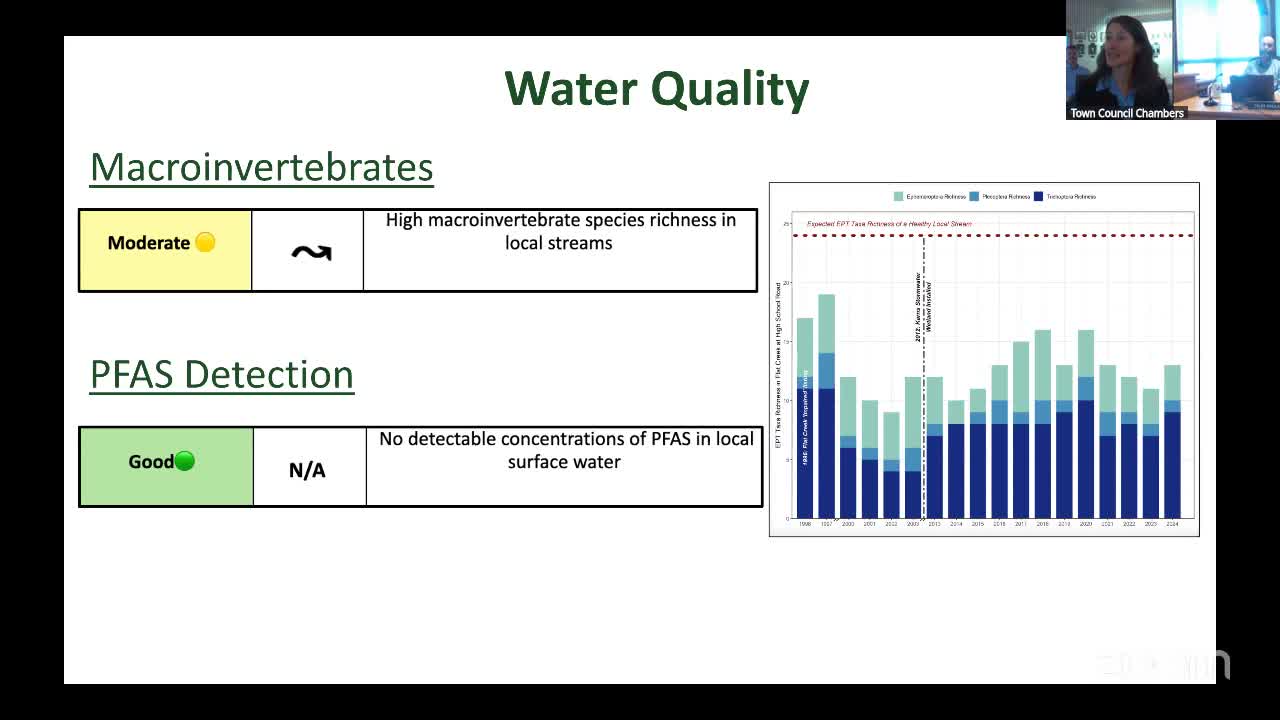
Key findings from the report - Air: PM2.5 (fine particulate matter) was judged "moderate" for 2024, with two exceedances tied to last October—6s Pack Trail wildfire; PM10 (larger particles) met EPA human-health thresholds and rated "good." Staff recommended public education about human-health risks and suggested follow-up study on wildfire smoke impacts on animal health or algae blooms. - Night sky brightness: Grand Teton National Park measured nearly "excellent" dark-sky conditions while the town of Jackson measured closer to suburban skies. Winter light-reflection and holiday lighting are likely contributors; the town is required to convert lighting to dark-sky-compliant fixtures by 2030. - Water temperature and flow: At Grand Teton National Park—6s Moose gauge (upstream of development), days with maximum summer temperature above 68—6F rose to 21 in 2021 and 32 in 2022 before dropping in 2023-24; staff noted reservoir drawdowns at Jackson Lake and inter-annual snowpack timing as contributing factors. Stream discharge is managed by dam operations; staff said current ramp-down patterns are less abrupt than in 2021 but that ongoing University of Idaho work may provide more quantitative guidance. - Macroinvertebrates: A long Flat Creek dataset showed high variability over decades, with recoveries after municipal stormwater treatments and declines during periods of disturbance. Anderson and councilors flagged this metric as a strong, actionable indicator linked to town-level infrastructure and stormwater management. - PFAS (per- and polyfluoroalkyl substances): A contracted study sampled three locations and seasons; two of three lab results have returned. Staff reported detections in inflow to the town—6s stormwater-treatment wetlands and lower concentrations in outflow, with no detectable concentrations in Flat Creek itself under current lab detection limits. Anderson said the results are preliminary and that further study and public education about potential sources (for example, some ski waxes, vehicle products, consumer goods) are next steps. - Aquatic invasive species: No quagga or zebra mussels were detected; inspectors examined more than 2,000 watercraft last year and removed mussels from two boats before they entered local waters; New Zealand mudsnail is present but not widespread. - Plant invasive species: The report used acres affected as a summary metric; staff noted 12,000 acres as a recent low and that today—6s total acres impacted has risen, with some species (e.g., cheatgrass) posing heightened wildfire risk. - Wildlife corridors and human-wildlife conflicts: Fencing removal peaked in 2019 inside the county; 2024 removal efforts outside the county were higher than in prior years. Councilors and public commenters emphasized local concerns about new tall privacy fences that can impede seasonal movement, particularly in East Jackson. The chart on bear conflicts showed 186 total conflicts in the region (168 in the county proper), and staff told council that 127 of 168 county conflicts were related to trash and food attractants. - Wildlife disease: Chronic wasting disease prevalence remains lower in Teton County than in other parts of Wyoming, but staff cautioned the deer sample size for 2024 was small (39 deer tested; three positives) and recommended continued support for Wyoming Game & Fish testing and education.
Council direction and next steps: Staff recommended continuing the 12 priority-1 indicators annually and adding priority-2 and -3 indicators as capacity and budget allow, including groundwater monitoring, nutrient parameters and additional wildlife metrics. After discussion, council voted to approve the report and directed staff to: track the indicators annually; post the report on the town—6s website; and work with the town—6s external affairs team to share the report publicly, "as discussed today." The motion passed unanimously with Councilman Schechter absent.
Public comment and stakeholder input: County and nonprofit partners appeared during the public-comment period. Chris Pels, Teton County—6s water resources coordinator, urged continued town-county coordination and highlighted ongoing action items in the county's Water Quality Management Plan; Protect Our Water Jackson Hole asked for increased attention to nitrogen and nitrate monitoring; and a number of residents pressed for continued emphasis on fencing removal and wildlife permeability in East Jackson.
What staff asked council to decide: Whether to continue annual reporting of the same 12 indicators and whether to direct staff to add higher-resource indicators. Staff noted that adding priority-2 or -3 indicators often requires additional staffing, time, or contracted studies.
Background and scope: The report covers the Snake River Headwaters watershed above the Grays River confluence and draws on datasets from the Wyoming Department of Environmental Quality (air monitoring site at High School Road), Grand Teton National Park, the Snake River Headwaters Watershed Group, contracted PFAS sampling (Alder Environmental), and local monitoring such as the Flat Creek macroinvertebrate dataset. Anderson said the report was the product of multi-year stakeholder engagement, focus groups on air, water, wildlife, plants and land, and intern-supported data analysis.
Council members said they supported continued distribution and use of the report to guide education, enforcement and policy — including stormwater management, dark-sky lighting conversions, riparian restoration, and coordination on Jackson Lake water releases to balance irrigation needs and fishery protections.