
Creighton board adopts its self-evaluation; discusses superintendent evaluation scoring and pay-for-performance
Get AI-powered insights, summaries, and transcripts
Subscribe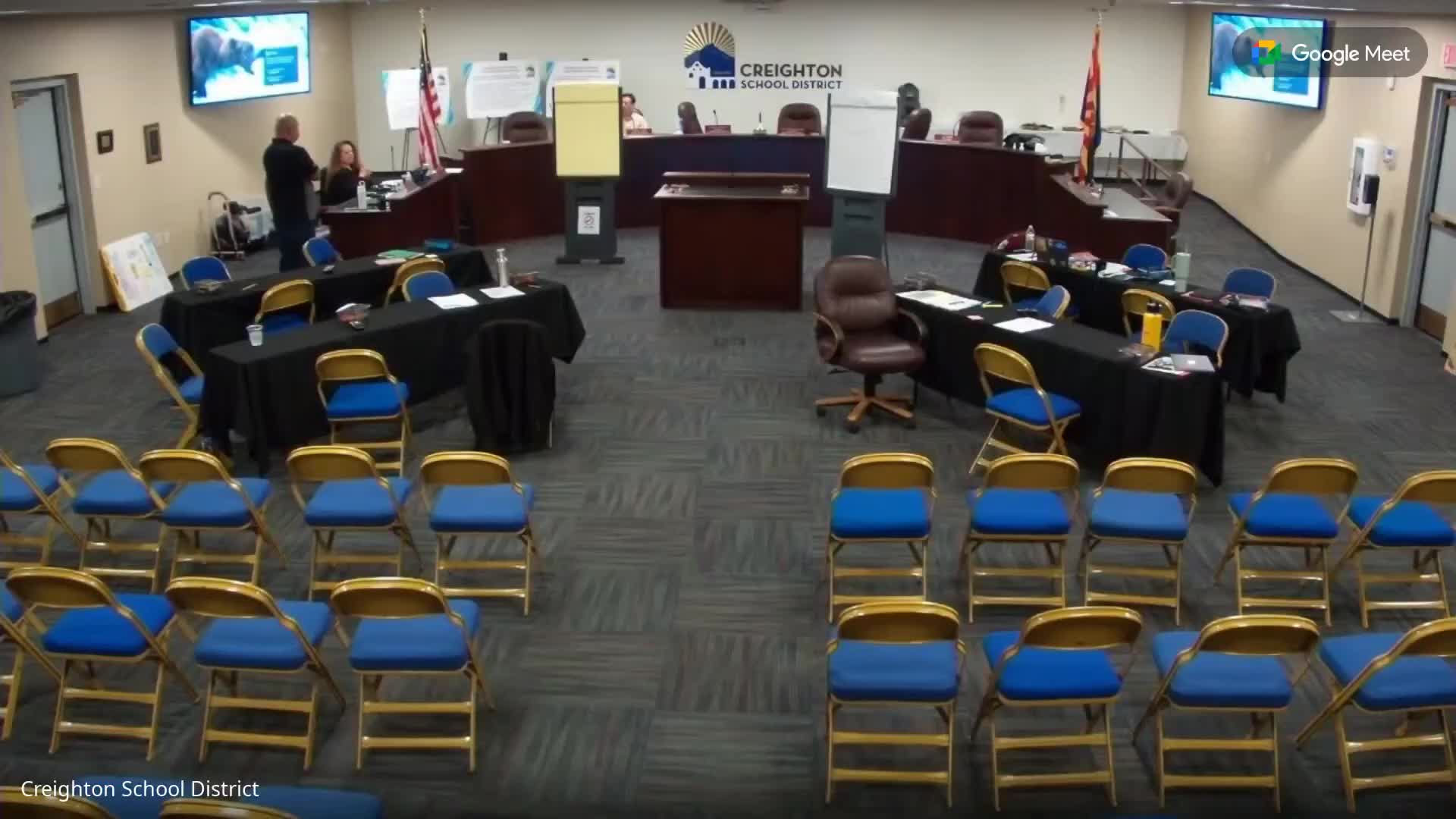
Summary
The Creighton Elementary District governing board adopted its board self-evaluation and discussed revisions to the superintendent evaluation scoring, including equalizing weights for goals and guardrails and adjusting pay-for-performance bands.
The Creighton Elementary District governing board adopted its board self-evaluation at the study session and spent substantial time reviewing how the district'level student-outcomes-focused governance (SOFG) framework should be used to evaluate superintendent performance.
At the close of the study session a member moved that "the governing board approve the Creighton School District's board self-evaluation of 08/16/2025"; the motion was seconded and approved by voice vote. The board did not record individual roll-call tallies in the study-session transcript; the motion carried by unanimous voice vote.
Before the vote, board members and district leadership discussed an evaluation instrument staff had drafted that maps the district's four board goals and four board guardrails to a points-based rating for superintendent performance. Staff and the board's consultant (Dr. Ramos) recommended two technical changes:
- Equal weighting for goals and guardrails. Staff had initially given heavier weight to academic goals; the board and consultant said the guardrails (community values and operational limits) should carry equal weight in the evaluation arithmetic. The board signaled support for restructuring the instrument so each of the eight categories receives an equal share of the overall possible points.
- An adjusted percentage scale for "pay-for-performance" eligibility. Board members discussed whether the superintendent must achieve a perfect numerical score to qualify for the full pay-for-performance amount. The group favored a more graduated scale (for example, treating a 90'100 performance band as equivalent to 100% eligibility rather than requiring an absolute 100-point score). Members said they wanted to preserve high standards while avoiding an all-or-nothing outcome for marginal shortfalls.
District staff said they will rework the numeric worksheet, equalize the category weights for goals and guardrails, and update the percentage bands before the final adoption. Staff also said the superintendent evaluation and any pay-for-performance calculation will be treated in accordance with state law and district policy; the board and superintendent also discussed whether evaluation details should be considered in public or executive session. District staff argued the instrument is largely public (interim measures and final goal outcomes are published in regular progress reports) and suggested some elements could be reviewed in public session; the board will finalize the procedure at its August public meeting.
Why this matters: The superintendent's evaluation ties district goals and the board's guardrails to leadership accountability. The board's decision to equalize weights and to consider a graduated pay-for-performance scale affects how staff and community members interpret the district's priorities and how the superintendent is held accountable for progress toward outcomes.
What's next: staff will update the evaluation worksheet and return it to the board for approval at the next meeting. The board also asked staff to include a short summary and the calculation method when the evaluation is presented publicly.