Get Full Government Meeting Transcripts, Videos, & Alerts Forever!
Get email alerts on the Parks Restrooms topic
No spam. Unsubscribe anytime.
Parks board recommends against installing restroom at Prairie Park after neighborhood concerns and cost questions
Summary
The Prosper Parks and Recreation Board voted unanimously to recommend not installing a restroom at Prairie Park, after staff outlined limited complaints, high costs for permanent facilities and porta-potty maintenance, and board members raised precedent and vandalism concerns.
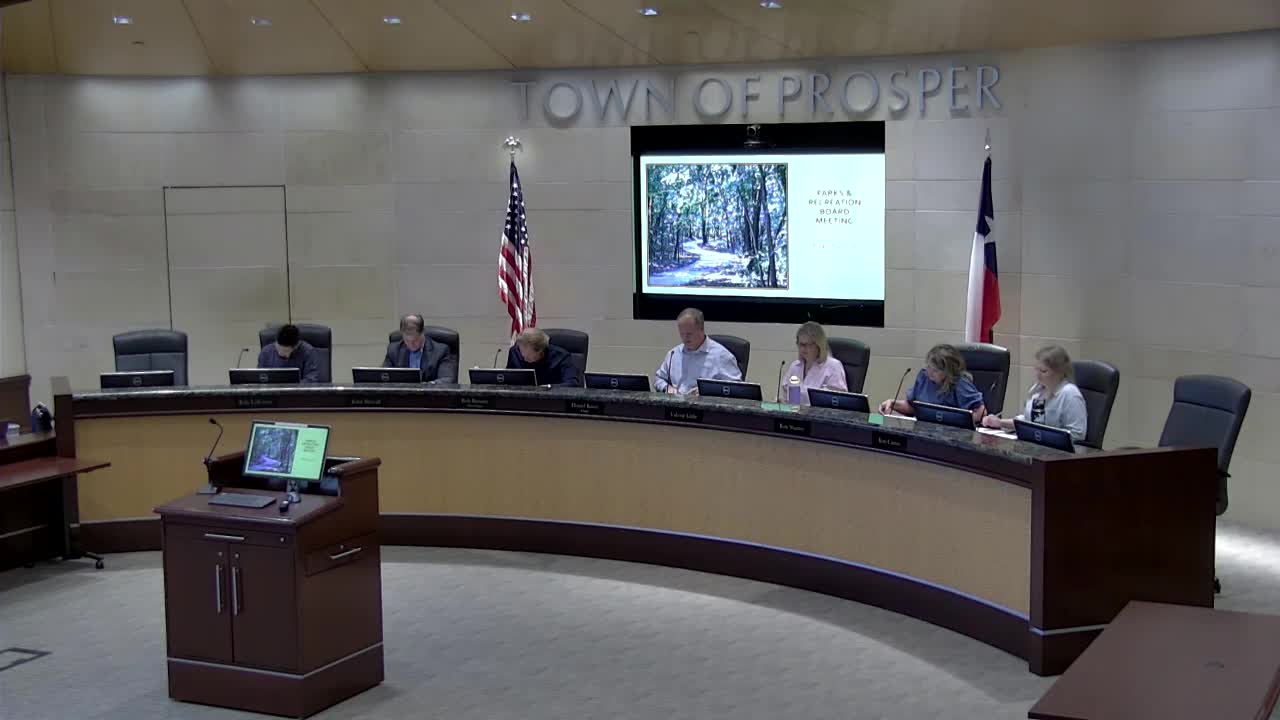
The Parks and Recreation Board of Directors voted unanimously Aug. 14 to recommend not installing a restroom at Prairie Park.
Parks staff presented the item as a response to a homeowner complaint that a child had been seen urinating behind a bush, a concern documented on a doorbell camera. Parks and Recreation staff member Dan Baker said the department has received “one or two” such complaints and asked the board for a recommendation on whether to pursue a temporary porta‑potty, a screened porta‑potty structure, or a plumbed restroom building.
The board’s decision reflected three recurring concerns raised during the discussion: cost, maintenance and vandalism risk, and setting a precedent for other neighborhood parks. Baker told the board the department’s standard does not currently specify when a restroom is required for a neighborhood park and that a permanent plumbed building could cost roughly $250,000 to purchase and install, while lower‑profile options such as enclosed porta‑potties or a wraparound screened unit were shown in staff materials at approximately $75,000. Baker also said contracted cleaning and maintenance for any portable unit would add further annual costs, “probably several thousand dollars” a year.
Board members emphasized existing practice and precedent. One member said neighborhood parks in Prosper typically serve nearby residents who can walk home for restroom access and that installing a facility could prompt requests from other parks of similar size and use. Concerns about vandalism and damage to standalone restrooms and temporary units were raised from several board members who cited prior incidents at other neighborhood facilities.
Several board members suggested alternatives rather than a new stand‑alone restroom: asking the homeowners association for access to an existing pool restroom when practicable, exploring a monitored shared‑use agreement with the adjacent pool facility, or leaving the park as is while monitoring complaints. Staff said they could study options further if the board asked, but the board instead moved to recommend against adding a restroom at this time.
Valerie Little made the motion to recommend against installing a restroom at Prairie Park; Bob seconded. The motion passed by a voice/visual vote with all members in favor.
The board noted the recommendation is advisory: staff will not purchase or install a unit based on this motion alone. If future complaints or usage patterns change, the board may revisit standards for restroom placement at neighborhood parks.
Board members said they want staff to consider a formal restroom‑installation standard for future requests, to reduce ad hoc debates about precedent.
The board moved on to other agenda items after the vote.