Get Full Government Meeting Transcripts, Videos, & Alerts Forever!
Get email alerts on the Energy Storage topic
No spam. Unsubscribe anytime.
Worcester County board signals preliminary denial for Cedar Hall battery storage after hours of testimony
Summary
After hours of testimony from the applicant and dozens of residents, the Worcester County Board of Zoning Appeals moved toward denying a special-exception application for a 150-megawatt battery energy storage facility and asked staff to return with formal written findings at a later meeting.
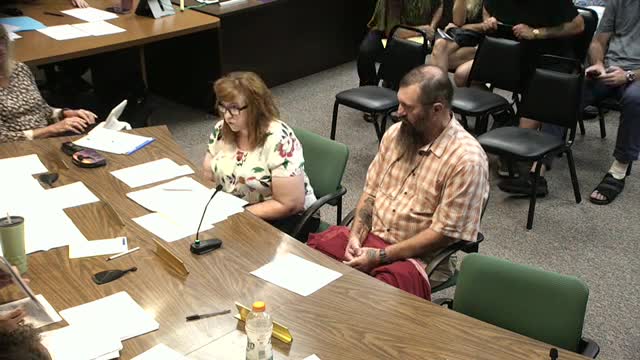
Worcester County’s Board of Zoning Appeals on Aug. 14 heard more than four hours of testimony on a special-exception application by Cedar Hall Energy LLC to build a utility-scale battery energy storage system (BESS) on Tax Map 91, Parcel 68 near the intersection of Cedar Hall Road and the Pocomoke Beltway.
The applicant’s attorney, Mark Spencer Crawford, and several technical witnesses described the project as a grid-stabilizing storage site consisting of containerized battery enclosures, an electrical switching/substation area, a gravel work pad, perimeter fencing and a vegetative screening plan. The applicant said the facility would be monitored 24/7 and coordinated with local emergency services. As Mark Spencer Crawford told the board at the start of the hearing, “I have no additions or corrections to the application read.”
The applicant’s technical presentation described the facility’s function: it would “take power off of the grid during times of low demand and provide power to the grid during times of peak demand,” testimony from the applicant team said. Project representatives told the board they plan native-species buffering and coordinated emergency-response training with the county fire marshal and local departments, and that Delmarva/utility review and PJM interconnection approvals would follow permitting.
Why it mattered: the request drew dozens of nearby residents and multiple public-safety experts. Speakers who oppose the project cited fire risk, water- and soil-contamination potential if a lithium-ion fire occurred, impacts to nearby wildlife and the Pocomoke/St. Martin river system, and the proximity of local schools and residences. Several residents said they had moved to the area for its rural character and darkness at night and that the proposed site lay within a few hundred feet of existing homes. Resident Glenn Holland said the project “isn’t really gonna create one; maybe it’s gonna help with distribution,” reflecting residents’ uncertainty about local benefits versus local impacts.
Fire-safety experts and the applicant’s operations witnesses described industry changes since earlier, high-profile BESS incidents elsewhere. They said modern cabinets meet higher IP and fire-test standards, that battery enclosures have battery-management systems and remote monitoring to shut down units if abnormal conditions are detected, and that local fire departments would be offered training and an emergency-response plan. The applicant team also said mitigation commitments would include stormwater controls, one-to-one and three-to-one mitigation ratios for canopy and buffer impacts as required by county critical-area rules, and a decommissioning bond if the site is abandoned.
Residents pressed the board on specifics: where firefighting water would come from, how quickly a company representative would respond to an incident, and how mitigation trees would be guaranteed to reach mature screening height. County staff and the applicant agreed the project would be subject to subsequent stormwater, building and state permitting if the county allowed the special exception.
Board action: after public comment and applicant rebuttal, the board did not render a final permit decision that evening. Instead members signaled that the application would be denied in principle and directed staff and the board attorney to prepare formal written findings and conditions for the denial to return to the board at a subsequent meeting. The applicant agreed to several commitments on the record, including working with staff on decommissioning/security bonding and expanding vegetative screening along the edges the neighbors identified during comment. The board’s procedural direction means no final zoning permit was issued that night; staff will prepare the formal findings the board requested and bring them back for a formal vote.
Context and next steps: the applicant repeatedly said the project’s timetable depends on the PJM interconnection study and state permitting changes; the applicant estimated a construction start window contingent on interconnection and state review. County staff told the board that formal conditions — including landscape species, mature-screen timelines, stormwater controls, mitigation ratios and surety for decommissioning — need to be written into any approval or denial record.
The hearing drew a large turnout from the neighborhood; the board’s next procedural step is to accept staff-prepared written findings and conditions before issuing any final decision. Residents and the applicant said they expected to continue working with county staff before the next hearing.