
Agoura Hills council directs staff to negotiate extension with Waste Management for residential hauling
Get AI-powered insights, summaries, and transcripts
Sign Up Free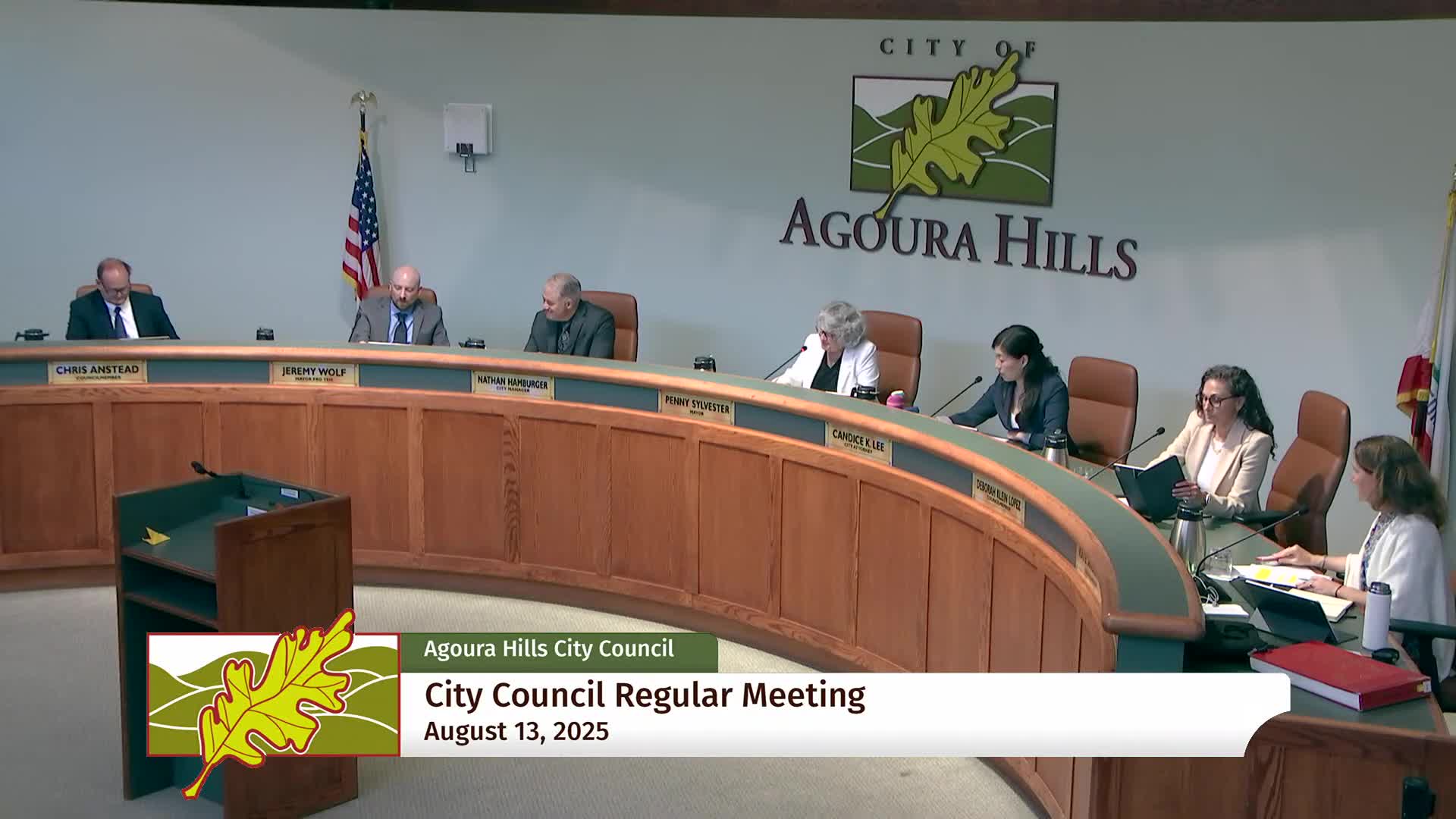
Summary
The council voted 5-0 to pursue negotiations with current residential hauler Waste Management for a new franchise agreement ahead of the contract expiration in June 2027, with the option to issue a competitive RFP if talks fail.
The Agoura Hills City Council voted unanimously to begin negotiating a contract extension with Waste Management (WM) for residential and multifamily solid waste services, while keeping an open option to issue a competitive request for proposals (RFP) if negotiations fail.
Assistant City Manager Ramiro Adeva told the council the city’s exclusive franchise agreement with WM, in place since January 2017, expires June 30, 2027, and staff recommends starting negotiations now because extending the existing provider is likely to be a faster process than issuing an RFP. “Option 1 is to negotiate and extend with the current residential waste hauler,” Adeva said, describing that route as roughly a six‑month process compared with about 12 months for an RFP and transition.
The recommendation reflected three practical priorities: continuity of service, meeting California diversion mandates, and allowing staff time to avoid service disruption during any transition. Adeva emphasized that any negotiated terms would take effect after the current contract’s expiration; staff is not proposing mid‑term changes to the existing agreement.
Waste Management representatives told the council they want to remain the city’s provider. Justin Hansinger, representing WM, said the company performs about 816,000 lifts in Agoura Hills annually and maintains a 99.9% service accuracy rate there. Steve Lee, WM’s district manager, added that he and his operations team keep direct contact with city staff and are prepared to respond when service problems occur.
Council members said they favored starting with negotiations but stressed that the city must protect residents’ pocketbooks. Council member Anderson noted that Agoura Hills currently pays higher residential rates than some neighboring cities and pressed staff to return with rate‑model scenarios and service benchmarks when negotiations advance. “If there is going to be any kind of steep jump, I would like to discuss a pathway to that,” Council member Deborah Klein Lopez said, asking staff and WM for modeled rate projections and scenarios when terms are negotiated.
Mayor Pro Tem Jeremy Wolf and other council members also cited WM’s local presence, investments (including clean‑fleet projects discussed by WM), and a long service history as reasons to try negotiations first. Council member Chris Anstead moved to pursue Option 1 (negotiate and extend with WM); Council member Anderson seconded. The motion passed 5‑0.
What happens next: staff will begin formal negotiations with WM under direction from the council. If negotiations do not produce acceptable terms, the city retains time to launch an RFP and manage a transition before the June 30, 2027 contract expiration.
Clarifying details noted during the meeting included several rate comparisons provided by staff: Agoura Hills current residential 64‑gallon rate cited in the packet was $29.35 versus Thousand Oaks at $27.21 for the same container size; 96‑gallon rates cited were $36.63 for Agoura Hills and $30.80 for Thousand Oaks. Adeva and the council emphasized those comparisons are part of the information staff will use to inform any renegotiation.
The council’s decision preserves continuity of service for residents while requiring staff to pursue cost and service details in forthcoming negotiations.