Get Full Government Meeting Transcripts, Videos, & Alerts Forever!
Get email alerts on the Public Safety Budget topic
No spam. Unsubscribe anytime.
Jacksonville sheriff presents $638 million FY‑26 budget, cites salary, technology and grants as drivers
Summary
Jacksonville Sheriff's Office Director Ed Cayenne told the TRUE Commission the JSO proposed FY‑26 budget totals $638 million, a $4.8 million increase largely driven by contractually required pay and benefit costs; Cayenne also outlined investments in technology, specialized units and grant-funded work.
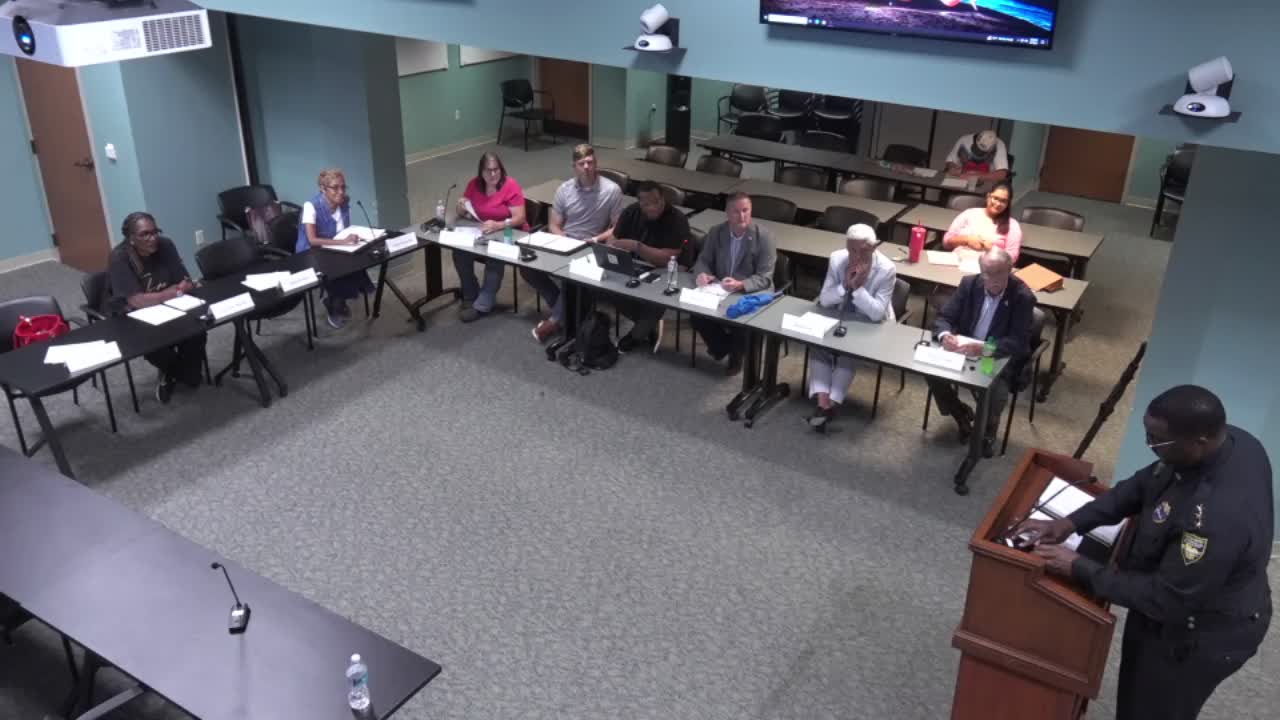
Director Ed Cayenne of the Jacksonville Sheriff's Office told the Taxation, Revenue and Utilization of Expenditures (TRUE) Commission on Aug. 7 that the JSO’s proposed fiscal year 2026 budget is $638,000,000, “which was only an increase of $4,800,000 from the FY '25 budget.”
That sum, Cayenne said, is driven primarily by personnel costs and contractual raises. “What most don't understand is that 80% of our budget is dedicated to salaries and benefits, which are predetermined through negotiations with the City of Jacksonville,” he said. The director said the remaining 20% covers operational costs such as software licensing, equipment maintenance and upgrades for more than 3,000 JSO employees.
Why it matters: the JSO budget is a significant portion of the city’s spending and the commission’s work focuses on taxation and how public money is used. Commissioners asked detailed questions about whether JSO’s reorganization, technology investments and vehicle changes have reduced costs or improved response; Cayenne described a mix of data-driven patrol reorganization, grant-funded projects and gradual equipment replacement as part of the agency’s strategy.
Cayenne highlighted the role of technology and federal grants in investigative work and crime reduction, citing the real time crime center, license-plate readers and advanced forensics. He cited a recent multi‑state narcotics investigation funded in part by a Florida Department of Law Enforcement SAFE grant that led to 14 arrests and large seizures of narcotics and weapons. He also noted the agency pursues federal and state funding “to ease the financial burden on the taxpayers of Jacksonville.”
On patrol deployment, Cayenne described a multi‑year reorganization into patrol districts intended to equalize officer workloads across growing and changing neighborhoods. He said the sheriff’s office shrank some districts’ geographic area and redistributed officers so “each district covers the same square mileage and has the same amount of police officers in hopes of reducing response times.”
Commissioners asked about specific items: - Vehicles: Commissioners questioned the switch from white sedans to silver SUVs. Cayenne said the fleet change incurred “absolutely no cost increase…to the taxpayers of Jacksonville” and was phased in as sedans reached end of life. He added the nationwide shift to SUVs also reflects manufacturers’ product lines and operational needs in a climate prone to flooding. - Crime trends and technology: Cayenne attributed recent declines in homicide and violent crime to the reorganization, improved response times and technology-driven investigations. He recounted two recent business robberies solved by tracing a vehicle tag and matching phone location and other investigative leads, noting that technology “has made us a better police agency.” - Hazardous device and dive teams: Cayenne explained that the JSO’s hazardous device unit and marine/dive teams require specialized, often grant-funded equipment; the agency does not pass costs for ordinance disposal to private individuals.
Requests and follow-up: Commissioner Raymond Day asked for a district-level matrix comparing patrol staffing, calls for service and average response times for fiscal years 2023–24 and 2024–25. Cayenne agreed to provide the data through the JSO crime analysis unit and staff contact Miss Hemingway. The director also said the sheriff had not requested additional personnel in the current budget (he noted 40 positions were previously funded via a COPS grant).
The JSO presentation framed the budget as constrained by long-term personnel commitments and a limited remainder for new initiatives. Cayenne closed by reiterating the office’s intent to continue pursuing grant funding and technology investments while emphasizing stewardship of taxpayer dollars.
Ending: Commissioners said they would follow up with written requests for the data Cayenne offered and planned further review of the proposed city budget as part of the commission’s upcoming work.