Get Full Government Meeting Transcripts, Videos, & Alerts Forever!
Winter Springs commission rescinds prior action, reinstates $227,400 arbor fee for Blake Commons project after extended debate
Summary
After hours of public comment and legal arguments about contract interpretation, the commission voted 4–1 on Aug. 11 to rescind a prior decision and reimpose a $227,400 arbor fee for the Blake Commons/Seahawk Cove development; the vote followed competing interpretations of 2015 and 2017 development agreements.
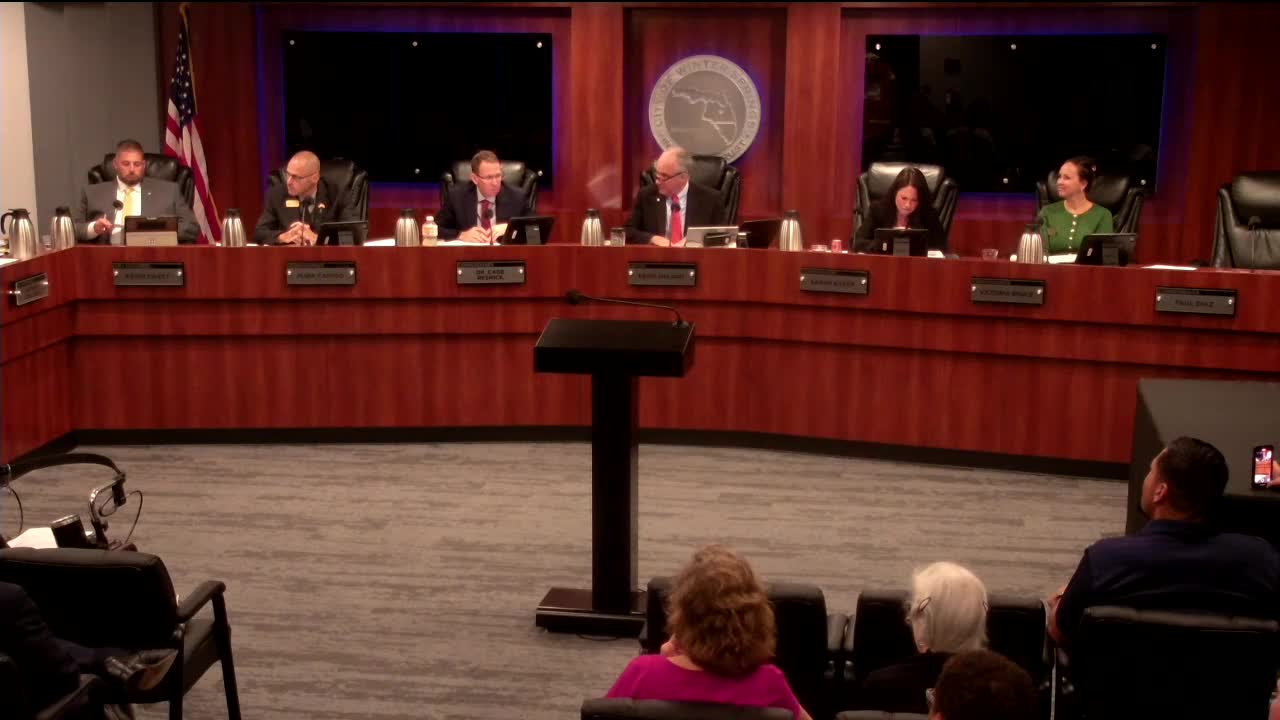
Winter Springs — The City Commission voted 4–1 on Aug. 11 to rescind its earlier action and reimpose a $227,400 arbor mitigation fee on the Blake Commons / Seahawk Cove development in a contentious discussion that centered on contract language and whether past agreements covered tree mitigation for the entire development or only an initial phase.
Deputy Mayor Cade Resnick moved to rescind the commission’s prior decision and restore the original arbor fee amount of $227,400; Commissioner Sarah Baker seconded. The motion passed with Resnick, Baker, Commissioner Mark Caruso and Mayor Kevin McCann voting in favor and Commissioner Victoria Bruce opposing.
The item — listed as agenda item 500 — grew into an extended debate over documents dating back to a 2015 developer agreement and a first modification dated 2017. Developer representatives, including Paul Partika of NAI Realvest (project broker), land‑use attorney Allison Jones and project manager Clayton Cheek, argued the agreements, taken together, show the developer satisfied obligations and that an adjusted arbor fee had already been calculated and paid for the project. Jones, who represented the developer in drafting and negotiating the agreements a decade earlier, invoked Florida contract‑interpretation law and the parol evidence rule, saying that when an agreement is reduced to writing, extraneous prior communications cannot be used to change an unambiguous contract.
"When a contract is reduced to writing, it subsumes all other agreements," Jones said, arguing the documented development agreements govern the matter and that a court would enforce the written terms. Partika read excerpts from the development agreement and a subsequent modification to show obligations tied to the town‑center project, including a master stormwater retention facility and roadway improvements that were negotiated as part of a larger 45‑acre project area.
City staff, several commissioners and members of the public disagreed on how to read the documents. City Attorney Anthony Garganese told the commission the contracts present an interpretation question: the presence of recitals and overlapping language can create ambiguity that would allow extraneous communications to be considered in court. Garganese said that ambiguity would expose both…
Already have an account? Log in
Subscribe to keep reading
Unlock the rest of this article — and every article on Citizen Portal.
- Unlimited articles
- AI-powered breakdowns of topics, speakers, decisions, and budgets
- Instant alerts when your location has a new meeting
- Follow topics and more locations
- 1,000 AI Insights / month, plus AI Chat