Get Full Government Meeting Transcripts, Videos, & Alerts Forever!
Get email alerts on the Development Arbor Fee topic
No spam. Unsubscribe anytime.
Winter Springs commission rescinds prior action, reinstates $227,400 arbor fee for Blake Commons project after extended debate
Summary
After hours of public comment and legal arguments about contract interpretation, the commission voted 4–1 on Aug. 11 to rescind a prior decision and reimpose a $227,400 arbor fee for the Blake Commons/Seahawk Cove development; the vote followed competing interpretations of 2015 and 2017 development agreements.
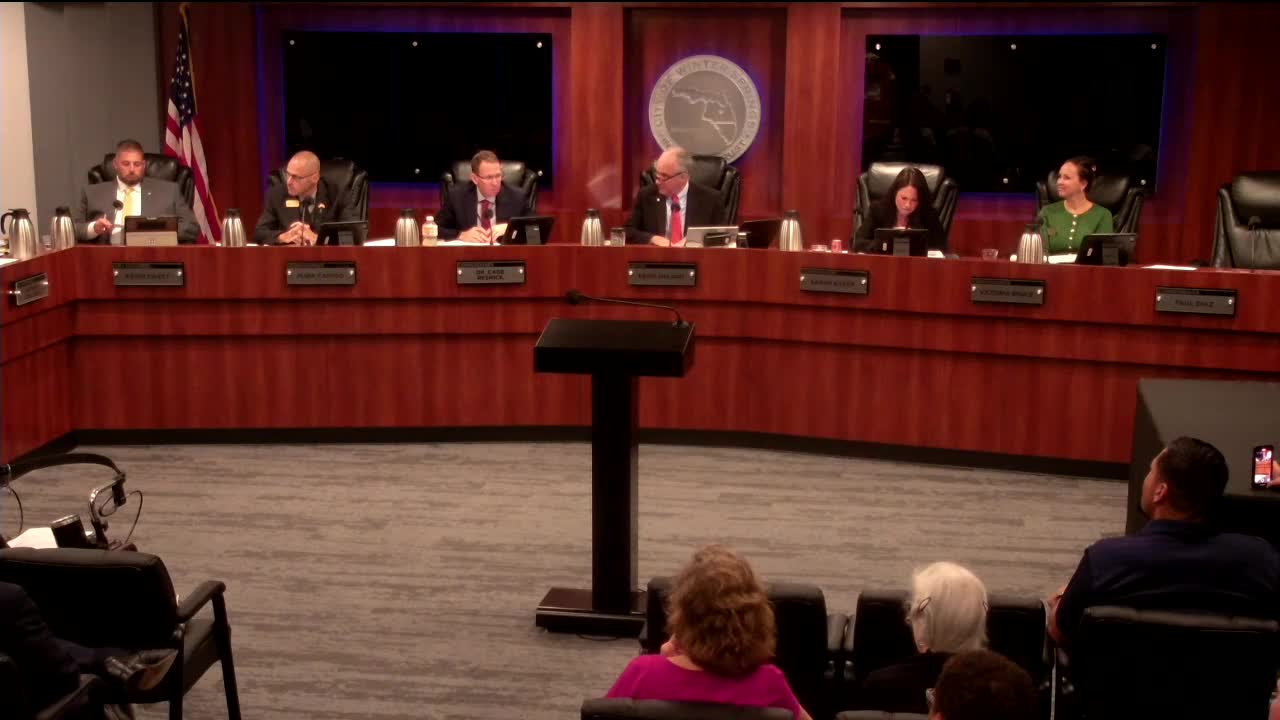
Winter Springs — The City Commission voted 4–1 on Aug. 11 to rescind its earlier action and reimpose a $227,400 arbor mitigation fee on the Blake Commons / Seahawk Cove development in a contentious discussion that centered on contract language and whether past agreements covered tree mitigation for the entire development or only an initial phase.
Deputy Mayor Cade Resnick moved to rescind the commission’s prior decision and restore the original arbor fee amount of $227,400; Commissioner Sarah Baker seconded. The motion passed with Resnick, Baker, Commissioner Mark Caruso and Mayor Kevin McCann voting in favor and Commissioner Victoria Bruce opposing.
The item — listed as agenda item 500 — grew into an extended debate over documents dating back to a 2015 developer agreement and a first modification dated 2017. Developer representatives, including Paul Partika of NAI Realvest (project broker), land‑use attorney Allison Jones and project manager Clayton Cheek, argued the agreements, taken together, show the developer satisfied obligations and that an adjusted arbor fee had already been calculated and paid for the project. Jones, who represented the developer in drafting and negotiating the agreements a decade earlier, invoked Florida contract‑interpretation law and the parol evidence rule, saying that when an agreement is reduced to writing, extraneous prior communications cannot be used to change an unambiguous contract.
"When a contract is reduced to writing, it subsumes all other agreements," Jones said, arguing the documented development agreements govern the matter and that a court would enforce the written terms. Partika read excerpts from the development agreement and a subsequent modification to show obligations tied to the town‑center project, including a master stormwater retention facility and roadway improvements that were negotiated as part of a larger 45‑acre project area.
City staff, several commissioners and members of the public disagreed on how to read the documents. City Attorney Anthony Garganese told the commission the contracts present an interpretation question: the presence of recitals and overlapping language can create ambiguity that would allow extraneous communications to be considered in court. Garganese said that ambiguity would expose both sides to litigation risk and potentially to an award of attorney fees to a prevailing party under the contract.
Public commenters were divided. Environmental advocates and residents urged stricter mitigation and challenged the city to require the developer to demonstrate mitigation steps beyond paying into an arbor fund, while others urged commissioners to respect the negotiated agreement or noted the developer's past contributions to public infrastructure.
Commissioners described the packet of documents the city received in the days before the meeting as substantial; some members said additional time to review would have helped, but a majority opted to proceed with the matter that night. During the debate the commission discussed an escrow agreement and whether required documents (a letter of credit or performance bond and an initial development agreement) had been delivered, and staff said the city had received the signed escrow agreement and payments but was missing two security documents required by the escrow.
Background presented during the hearing noted the original development agreement and its first modification contained language about a "project" (variously defined) and a property legal description. The developer read provisions stating the final adjusted arbor fee for the project had been set and, in some calculations in the record, referenced amounts that developers and staff previously exchanged. During the meeting staff and developers cited payment entries: $16,160 paid 03/24/2017 and $133,500 paid 10/19/2018 (dates and amounts discussed in the meeting record).
After commissioners voted to rescind and reinstate the $227,400 arbor fee, the commission moved on to other business. The decision does not itself settle all contractual disputes: city staff and legal counsel signaled that interpretation differences could lead to further review, and the commissions' action reopens the specific fee determination for the project based on the motion it approved.
Speakers
- Paul Partika — NAI Realvest, project broker and project representative for the developer (presenter) - Allison Jones — Land‑use attorney for the developer (presenter) - Clayton Cheek — Project manager for the developer (presenter) - Kevin McCann — Mayor, City of Winter Springs (presiding) - Cade Resnick — Deputy Mayor / Commissioner (mover of motion) - Sarah Baker — Commissioner (seconded motion) - Victoria Bruce — Commissioner (voted no) - Mark Caruso — Commissioner (voted yes) - Kevin Sweet — City Manager (staff) - Anthony Garganese — City Attorney (legal advice) - Public commenters: Michael Lincoln McCrae; Jesse Phillips; Gina Schaeffer; Leah Turnbull Jones; Nick Berg; R. Gallo; Leah Wiseman and others (public input)
Authorities referenced
- Development Agreement (City of Winter Springs & developer) — dated March 10, 2015 (referenced in meeting documents) - First Modification of Development Agreement — dated Jan. 9, 2017 (referenced in meeting documents)
Actions
1) Rescind prior action and reinstate arbor fee of $227,400 for the Blake Commons / Seahawk Cove project - kind: motion - motion: "Rescind the original vote and reconsider the original document to set the arbor fee at $227,400 as presented." - mover: Deputy Mayor Cade Resnick - second: Commissioner Sarah Baker - vote_record: [{"member":"Deputy Mayor Cade Resnick","vote":"yes"},{"member":"Commissioner Sarah Baker","vote":"yes"},{"member":"Commissioner Mark Caruso","vote":"yes"},{"member":"Mayor Kevin McCann","vote":"yes"},{"member":"Commissioner Victoria Bruce","vote":"no"}] - tally: yes 4, no 1, abstain 0, absent 1 (Commissioner Paul Diaz absent), recused 0 - legal_threshold: {"met":true,"notes":"Simple majority required; motion passed 4–1."} - outcome: approved - notes: The motion recalibrates the arbor fee for the project based on the commission vote; developers contested the legal interpretation of the contract language during debate.
2) Procedural actions recorded earlier in the meeting - Consent agenda approved (motion by Deputy Mayor Resnick, second by Commissioner Baker); vote unanimous. - Second reading/adoption: Ordinance 2025‑12 (city commission rules and procedures) adopted on second reading; vote unanimous. - Second reading/adoption: Ordinance 2025‑13 (conveyance of easement to Duke Energy for feeder‑hardening) adopted on second reading; vote unanimous.
Clarifying details
- Payments discussed in the meeting record: $16,160 (03/24/2017) and $133,500 (10/19/2018) were cited in the packet/record as amounts that moved through city accounts; the engineer/attorneys discussed several different arbor fee calculations in prior correspondence and attachments to the agenda packet. - Developer obligations referenced: conveyance of a 2.2‑acre parcel and construction of collector roads/roundabout and master stormwater facilities on broader property were cited as part of the negotiated developer agreements. - Escrow: Staff confirmed an escrow agreement was signed and payment received but said the city had not yet received a letter of credit or performance bond that the escrow required.
Proper names
- Blake Commons (project name)/Seahawk Cove (project extension name) - NAI Realvest (broker) - Kimley‑Horn (consultant referenced elsewhere in meeting) - Raftelis (rate study consultant referenced elsewhere in meeting)
Community relevance
- Geographies affected: Town Center / Michael Blake Boulevard corridor; residents near the 6.45‑acre initial phase and the broader 45‑acre property footprint - Impact groups: nearby residents, future tenants and patrons of the proposed development, tree‑canopy advocates and environmental stakeholders - Funding sources: developer funds, city impact‑fee credits cited in documents
Meeting context
- Engagement level: high — long public input period, developer legal presentations and sustained commissioner discussion; item generated an extended public presence and media attention during the meeting. - Implementation risk: medium to high — legal ambiguity noted by the city attorney could result in further review or litigation and potential attorney‑fee exposure under contract language. - Historical continuity: issue traces to 2015 development agreement and a 2017 modification; multiple exchanges among staff, developers and the commission occurred over the decade.
Searchable tags: ["arbor fee","Blake Commons","Seahawk Cove","development agreement","tree mitigation","contract interpretation","escrow"]
Provenance
- topicintro: {"block_id":"b-4354","local_start":0,"local_end":120,"evidence_excerpt":"That brings us then to the regular agenda and, really the final big, topic of the evening. How shall we begin?"} - topfinish: {"block_id":"b-9480","local_start":0,"local_end":120,"evidence_excerpt":"And the motion passes. I for anyone wondering why we're giggling, I called commissioner Baker, commissioner Bacon 1 time, months ago, and it kinda keeps coming around."}