Get Full Government Meeting Transcripts, Videos, & Alerts Forever!
Get email alerts on the Zoning Text Amendment topic
No spam. Unsubscribe anytime.
Commission continues mixed‑use phasing text amendment after residents and developers clash over oversight and notice
Summary
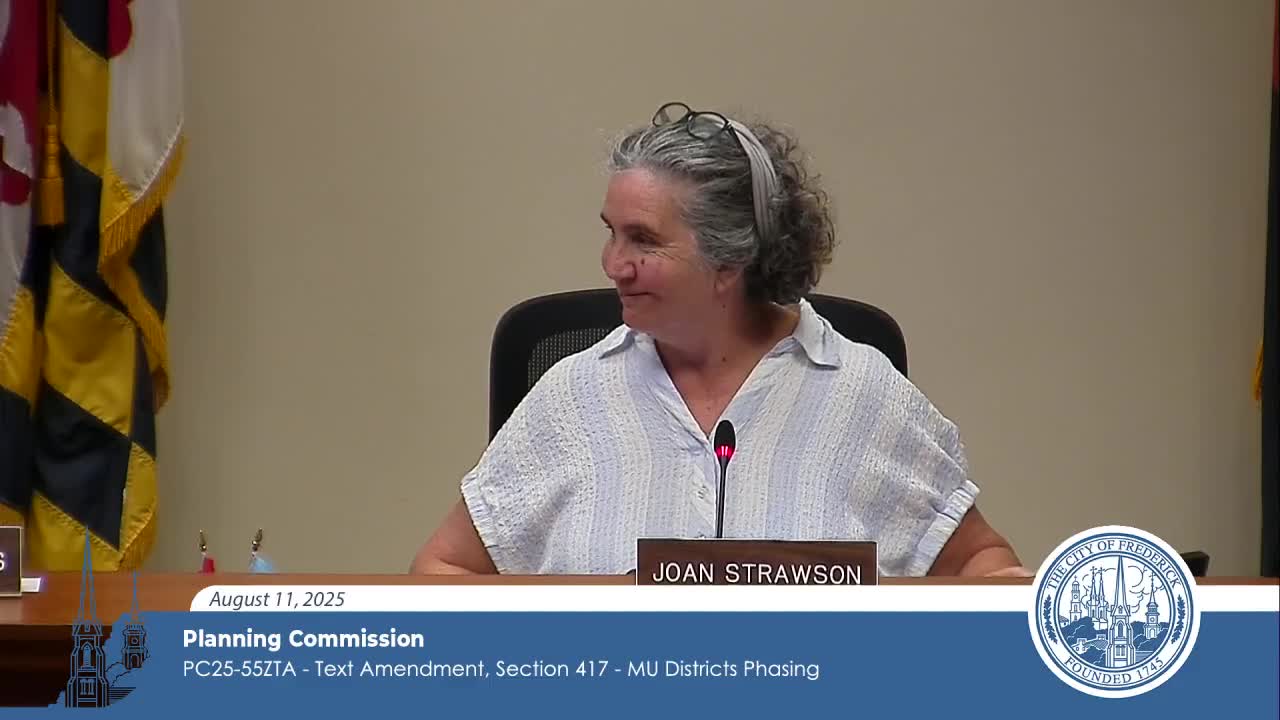
The Planning Commission on Aug. 11 continued a proposed zoning text amendment that would change how phasing changes for MU‑1 and MU‑2 mixed‑use master plans are reviewed, after extended testimony from developers and residents.
The Planning Commission on Aug. 11 voted to continue a proposed zoning text amendment (PC25‑55 ZTA) that would change how the city handles phasing of mixed‑use (MU‑1 and MU‑2) master plans. The commission delayed action to its Sept. 8 meeting while staff and commissioners collect suggested modifications and clarify public‑notice and review requirements.
What’s proposed: The amendment would add language to section 4‑17 of the Land Management Code governing the sequencing of residential and nonresidential construction in mixed‑use developments. Staff said the text is intended to allow administrative revisions in limited circumstances and to codify processes that reflect current practice for modest adjustments to phasing while leaving larger changes to the original reviewing authority. Under current LMC §3‑10 staff can approve a single revision to a master plan if density is not increased, land-use does not change and no section increases dwelling units by more than 10 percent. The amendment would remove duplicative wording and clarify what kinds of phasing changes can be handled administratively.
What commissioners and the public debated: A central divide at the public hearing was whether the citywide change should enable more staff-level approvals (faster but less public) or preserve planning‑commission oversight for phasing modifications impacting the mix of uses. Several residents and community speakers urged more public notice and commission review, saying phasing decisions affect delivery of promised retail, parks and amenities. Rob Thompson, a neighborhood resident, argued that “phasing matters just as much after approval as it does during initial review” and urged that significant phasing changes be subject to a public hearing before the Planning Commission.
Developers presented market data and argued that firms marketing retail for new mixed‑use centers evaluate precise trade areas and that an unwieldy re‑review could stall projects. Representatives from Matt & Company summarized Wren Quarter’s timeline, national retail brokers’ market feedback and the challenge of securing anchor tenants amid post‑pandemic market shifts; Brian Morris said several national prospects had evaluated the project but “we’re not there yet” and the amendment would help keep construction moving while protecting the required mix of uses.
Key concerns raised repeatedly during public comment and commissioner discussion included: - Public notice and the ability of neighbors to provide meaningful input if phasing revisions are handled administratively. - Whether staff-level approvals would weaken safeguards that ensure public facilities, connectivity and amenities are delivered as promised. - The need for clear evaluation criteria (market feasibility analyses, infrastructure capacity, detailed justification) before allowing administrative phasing changes.
Outcome: The commission voted to continue the item to Sept. 8 so commissioners can consolidate suggested criteria and notice language that staff can vet. Staff will compile commissioners’ recommended changes and post revised text ahead of the next hearing.
Why it matters: The amendment affects how mixed‑use projects adapt to changing market conditions. Supporters say streamlined administrative processes will reduce delays for development under construction; critics say reduced public review risks unfulfilled promises for parks, retail and other community amenities.