Get Full Government Meeting Transcripts, Videos, & Alerts Forever!
Get email alerts on the Infrastructure Dams topic
No spam. Unsubscribe anytime.
NEORSD presents revised recommendation for Lower Lake Dam: modeling, costs and options divide councils and public
Summary
The Northeast Ohio Regional Sewer District told joint councils from Shaker Heights and Cleveland Heights that updated modeling and predesign work changed its earlier assessment of the Lower Lake Dam and presented two costly options: full reconstruction to meet Ohio dam-safety standards or removal and stream restoration.
The Northeast Ohio Regional Sewer District (NEORSD) presented a revised recommendation to the Shaker Heights and Cleveland Heights councils about the Lower Lake Dam and the Doan Brook watershed, saying updated modeling and predesign work changed the earlier assessment and created two distinct pathways: reconstruct the dam to meet state dam-safety standards, or remove the dam and restore stream corridors. The presentation prompted extensive questions from both councils and a large public comment period.
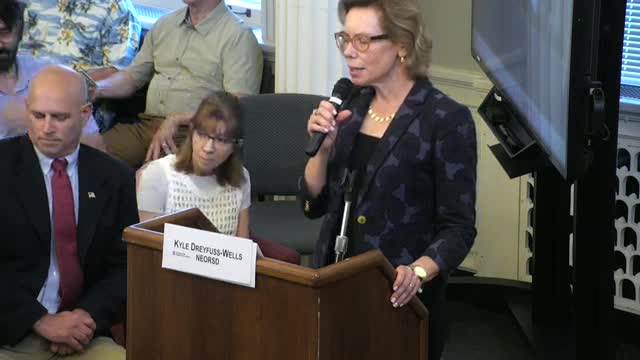
NEORSD CEO Kyle Dreyfus Wells opened the presentation saying, "We made the original recommendation in 2021 to remove Horseshoe Lake Dam, restore Doan Brook to current safety standards," and that new information and modeling gathered in 2024 and 2025 led the district to revise its recommendations for Lower Lake. Matt Sharver, NEORSD—s director of watershed programs, summarized the technical findings: the predesign showed that reconstructing Lower Lake Dam to meet Ohio Department of Natural Resources (ODNR) class 1 high-hazard standards would require major civil works, flood walls and an auxiliary spillway and was costly; by contrast, removing the dam and restoring the stream reduces public-safety risk and improves water quality and ecological function.
Key technical and cost points the district presented
- ODNR classification and probable maximum flood: NEORSD said the Lower Lake Dam is regulated as a class 1 high-hazard dam and must meet the probable maximum flood standard; Sharver said the probable maximum flood "is about 24 to 26 inches of rainfall in a 24 hour period." He also said, "Right now, Lower Lake Dam only provides 2% of conveyance for the probable maximum flood," a shortfall the predesign exercise examined.
- Modeling improvements: NEORSD said it moved from planning-level (one-dimensional) 2021 modeling to updated two-dimensional mesh modeling in 2024——2025 with more monitoring inputs. The updated modeling incorporated additional storm-sewer networks, sediment surveys and newly deployed monitors and altered the assessment of how much downstream flood benefit Lower Lake Dam provides.
- University Circle culvert feasibility and partnership: NEORSD reported a feasibility study and ongoing coordination with the Cleveland Museum of Art. The museum—s planned work on Wade Lagoon created a potential schedule and property alignment that would let NEORSD build a "sister" culvert in University Circle; that additional culvert, NEORSD said, materially improves flooding outcomes for University Circle regardless of the Lower Lake decision.
- Cost estimates (preliminary, predesign stage): NEORSD presented preliminary totals including roughly $44 million for dam reconstruction (predesign estimate), plus an additional $11 million—$12 million to remove ~140,000 cubic yards of sediment if a restored, high-quality lake were desired — producing a roughly $55 million figure for full reconstruction and comprehensive sediment remediation. NEORSD estimated dam removal and stream restoration at roughly $37 million (NEORSD—s earlier line-item) plus an additional $6—$7 million for culvert work downstream at Coventry and Fairhill, a combination NEORSD said brings removal-and-restoration totals to about $45 million depending on final scope. NEORSD also cited its contribution to the Horseshoe Lake restoration and related amenities (NEORSD contribution estimate about $24 million; local amenities estimate shown earlier as $7.2 million).
NEORSD—s proposed policy position and funding stance
NEORSD told the councils it could not justify using regional stormwater program funds to pay to reconstruct Lower Lake Dam because updated modeling showed the dam "no longer provides notable flood control" downstream. Sharver said that because the reconstructed dam would not materially reduce downstream flooding (with the sister culvert in place), the regional stormwater management program could not fund reconstruction or the full dredging of the lake. NEORSD said it would, however, fund removal of Lower Lake Dam and stream restoration under the regional program to address public-safety risks and water-quality objectives.
Council and public questions
Council members pressed NEORSD on several issues: whether both options (rebuild or remove) can satisfy public-safety concerns (NEORSD said both can if rebuilt to state standards or if removal and restoration include appropriate conveyance); whether sediment removal is legally required (NEORSD said there is no legal requirement to remove all 140,000 cubic yards of sediment to reconstruct the dam, but leaving the sediment would leave a low-quality lake); insurance and liability costs for owners of class 1 dams (NEORSD said downstream catastrophic failures in other jurisdictions have produced tens of millions in damages and that potential liabilities factor into decisions); and whether alternative designs (smaller offline ponds, partial amenities) could preserve a water feature while addressing safety and regulatory needs (NEORSD said it is open to exploring smaller or offline features but could not promise a specific design without further predesign work).
Public comment: scale and themes
The joint session then proceeded to an extended public-comment period. Dozens of residents and local advocates spoke for and against dam removal. Speakers for preservation and additional study emphasized the lakes— recreational, historic and community value, volunteer stewardship and skepticism about NEORSD—s change in position. John Barber, identifying himself as "cofounder and coleader of the Friends of Lower Lake," said the group had "contributed over 10,500 volunteer hours" stewarding Lower Lake. Others urged the councils to demand NEORSD—s modeling and assumptions, explore less-costly alternatives (smaller or offline ponds, lower dams that might reclassify the structure), or pursue grants and bonds to cover reconstruction costs. Several speakers questioned NEORSD—s consistency and local engagement, citing the earlier Horseshoe Lake process.
Next steps and schedule
NEORSD gave a tentative timeline: if the cities concur with removal, NEORSD said it would undertake a predesign process (about a year) followed by detailed design (about a year) and continued public involvement; construction would follow after permitting and design, meaning multi-year planning and delivery. NEORSD also announced three near-term public meetings for further information and comment: a virtual meeting on Tuesday, Aug. 19 (6—7 p.m.), and two in-person sessions on Wednesday, Aug. 20 (11 a.m.— p.m. and 5—— p.m.) at the Lee Road Library, 2345 Lee Road, Cleveland Heights.
What NEORSD did not decide or commit to
NEORSD did not ask councils to take an immediate vote at the session; it did not commit to reconstructing a new dam; it did not provide final design or permitting timelines beyond the planning estimates; and it said it would not fund dam reconstruction from the regional stormwater program given its revised analysis.
Speakers quoted in this article spoke during the joint session and public comment period, as recorded in the meeting transcript.