Get Full Government Meeting Transcripts, Videos, & Alerts Forever!
Get email alerts on the Utility Budget Rates topic
No spam. Unsubscribe anytime.
Austin Energy budget plan draws split vote after debate over raising monthly customer charge
Summary
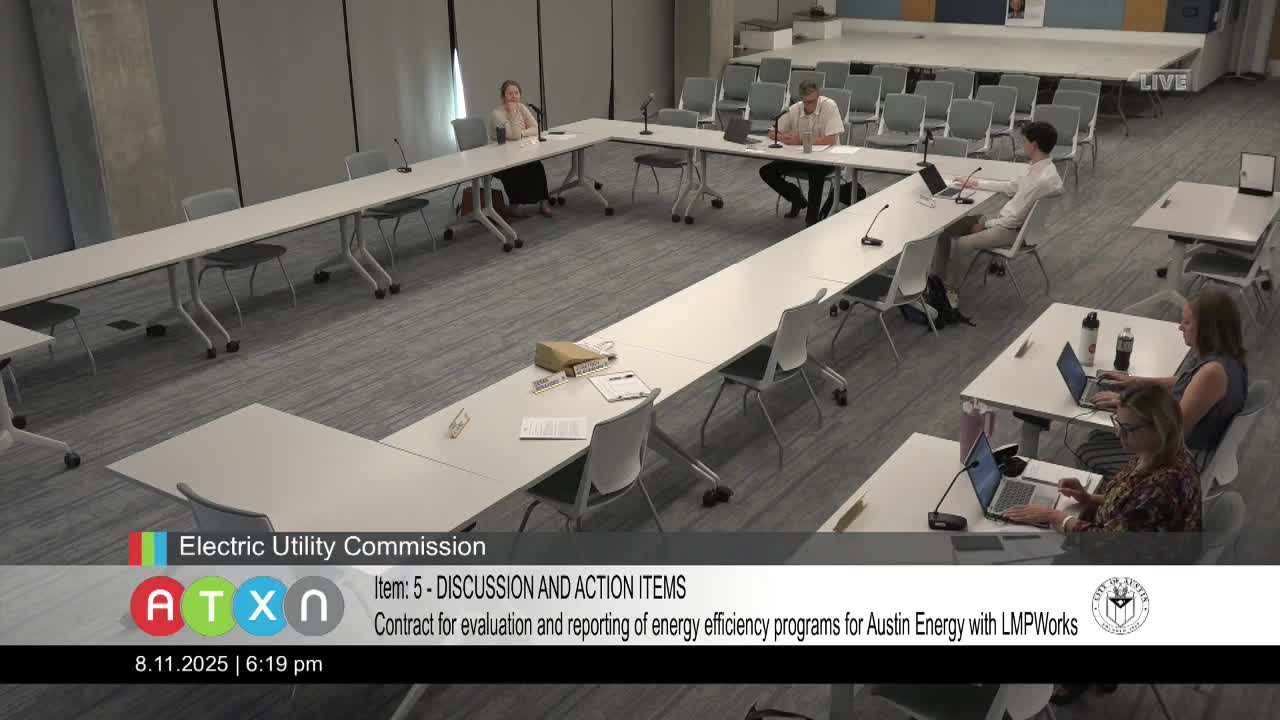
The Electric Utility Commission failed to adopt a recommendation to City Council that would have shifted part of Austin Energy’s requested increase into the fixed monthly customer charge, voting 3–7 on July 15, 2025, after a lengthy discussion of revenue stability and rate design.
The Electric Utility Commission failed to adopt a recommendation to City Council that would have shifted part of Austin Energy’s proposed 5% base-rate increase into a higher fixed monthly customer charge, voting 3–7 against the motion on July 15, 2025. The commission continued a broader review of the utility’s fiscal 2025–26 budget as Austin Energy staff described a shortfall and a multi-year recovery plan.
Austin Energy acting Deputy General Manager Rusty Manas told the commission the utility is proposing a $2 billion budget for fiscal 2026 that would include a 5% base-rate increase in 2026 and a proposal to repeat 5% increases each year for five years. Manas said the utility’s recommendation pairs that base-rate increase with a projected 23% reduction in the power supply adjustment (PSA), producing a net average residential-bill change of about −$4.89 per month compared with a year earlier. "Our five-year plan starts in '26, requests a 5% base rate increase… By 2027, we break even," Manas said.
Manas and finance staff described the drivers behind the request: a prolonged period of revenue shortfall beginning in 2020, inflation in capital and spare-part costs, and higher debt service and transfers to the city general fund. Manas said the utility projects it will remain approximately $43 million short of expenses in 2026 even after the proposed rate package and that recurring annual steps are intended to recover that deficit by 2028.
Commissioners debating the budget focused on rate design rather than the total amount requested. Commissioners Cyrus, Reid and Alvarez supported the commission motion — moved by Commissioner Reid and seconded by Commissioner White — asking City Council to obtain the same revenue through volumetric charges rather than raising the monthly customer charge. Proponents said moving funds into volumetric (per-kilowatt-hour) rates preserves conservation incentives and adheres to trade-offs made in the prior rate case. Commissioner Reid said the commission’s recommendation would deliver the same total revenue while keeping the fixed customer charge at prior levels.
Opponents, including Commissioners Rhodes, Braden, Blackburn and Bellamy, said raising the fixed charge provides revenue stability and better aligns cost recovery with the utility’s largely fixed obligations, such as debt service and certain contractual payments. Rusty Manas and other staff reiterated that many of Austin Energy’s largest costs do not vary with customers’ hourly usage and that a fixed charge raises that revenue predictably. "There are fixed costs — debt service, payroll, poles and wires — that don't change with kilowatt-hours used," Manas said.
The vote: Commissioners Alvarez, Reid and White voted in favor. Commissioners Rhodes, Braden, Blackburn and Bellamy voted against, joined by two other commissioners who identified themselves as Chris and Cyrus in the meeting record, producing a failed motion. The commission did not adopt a formal alternative rate design package; staff will proceed with budget materials for City Council review. Manas and staff said City Council could accept, reject or modify any recommendation.
Staff and commissioners also reviewed supporting materials presented earlier in the meeting. Stephanie Koudelka, director of finance, summarized third-quarter financial results and said a one-time $30 million reserve transfer tightened the utility’s operating position for the quarter but that the transfer is nonrecurring. Koudelka reported the utility was carrying about $109 million of power-supply over-recovery that will be returned to customers through the PSA and that days cash on hand, debt-service coverage and operating-margin metrics remain under scrutiny for a bond-rating objective.
Lisa Martin, chief operating officer, presented operations metrics, saying Q3 (April–June 2025) generation was 68% carbon-free and that distribution reliability remains better than Texas averages but showed pressure from increased storm restoration. Martin said planned generator outages had prepared units for summer demand and that staff is preparing a distribution resilience plan for later this year.
What the vote means: The commission’s rejection of the rate-design recommendation does not change Austin Energy’s budget request to City Council. It leaves the question of how to allocate any approved revenue increase — between fixed and volumetric charges — to be decided by council during its budget and rate-review process.
Next steps: Austin Energy staff said they will provide additional detail on the PSA components and volatility, a breakdown of plant dispatch economics on request, and follow-up analysis on how different customer classes may be affected by rate-design choices. The matter will move to City Council as part of the FY 2025–26 budget process; the EUC’s recommendation (which failed) will be included in the record of commission action sent to council.