Get Full Government Meeting Transcripts, Videos, & Alerts Forever!
Get email alerts on the Education Budget topic
No spam. Unsubscribe anytime.
After heated debate, Lakeville amends and approves school assessment; process to recertify triggered if towns differ
Summary
Town meeting repeatedly debated supplemental funding for the regional school assessment. Voters initially failed a two‑thirds vote on a larger transfer but later reconsidered and approved an amended increase funded partly from taxation and partly from a stabilization transfer.
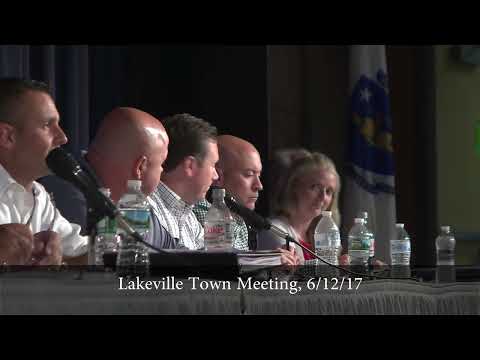
Lakeville’s annual town meeting spent much of the evening debating the Freetown‑Lakeville Regional School District assessment and ultimately approved an amended assessment after a procedural reconsideration and votes on funding sources.
The town initially considered an amendment that would have increased Lakeville’s school assessment by $459,810 and authorized using the town’s stabilization fund to pay a portion. That amendment failed to receive the two‑thirds supermajority required when first taken up. The failure left the town without an approved school assessment and triggered the process in Chapter 71, Section 16B of the Massachusetts General Laws that requires the regional school committee to recertify a budget and, if necessary, for the towns to hold additional town‑meetings.
After the initial vote, town meeting divided the warrant and continued with the remainder of the budget. Later in the evening voters moved to reconsider the defeated school item; by the required two‑thirds they voted to reopen the question. The town then amended the school assessment and approved the amendment by the required two‑thirds vote. The approved amendment combined $310,000 from the town’s taxation capacity (the annual levy limit funds) and $149,810 from stabilization to reach the amount requested in the amended motion.
Superintendent Richard Medeiros (spoke during debate) and Fred Baker, director of finance for the regional schools, addressed impacts tied to staffing and special‑education costs. The superintendent said failing to increase the assessment as requested would likely force staffing reductions that the district estimated could include five classroom teachers, six paraprofessionals, multiple clerical positions and four custodians; he described those cuts as “devastating” to instructional programs and supports. Baker and other school representatives said the district submitted its budget based on expected needs and the regional assessment formula.
Lakeville finance‑committee members and selectmen repeatedly cautioned voters about the town’s long‑term fiscal position, the limits of one‑time funds, and the risk of depleting the town’s stabilization and free‑cash reserves. Finance committee members said they preferred to avoid tapping stabilization unless necessary and urged structural fixes to the budget process to avoid repeating the cycle.
Several residents asked that disagreements between Lakeville and Freetown be resolved cooperatively; town counsel explained that if either town rejects a recertified budget a joint town meeting of both towns is required under state law to resolve the assessment.
After the final two‑thirds vote, the moderator and town accountant noted that the school committee would proceed with any certification steps required by statute and that the practical effect of the evening’s votes was to approve the operating budget as amended.