Get Full Government Meeting Transcripts, Videos, & Alerts Forever!
Get email alerts on the Municipal Budget topic
No spam. Unsubscribe anytime.
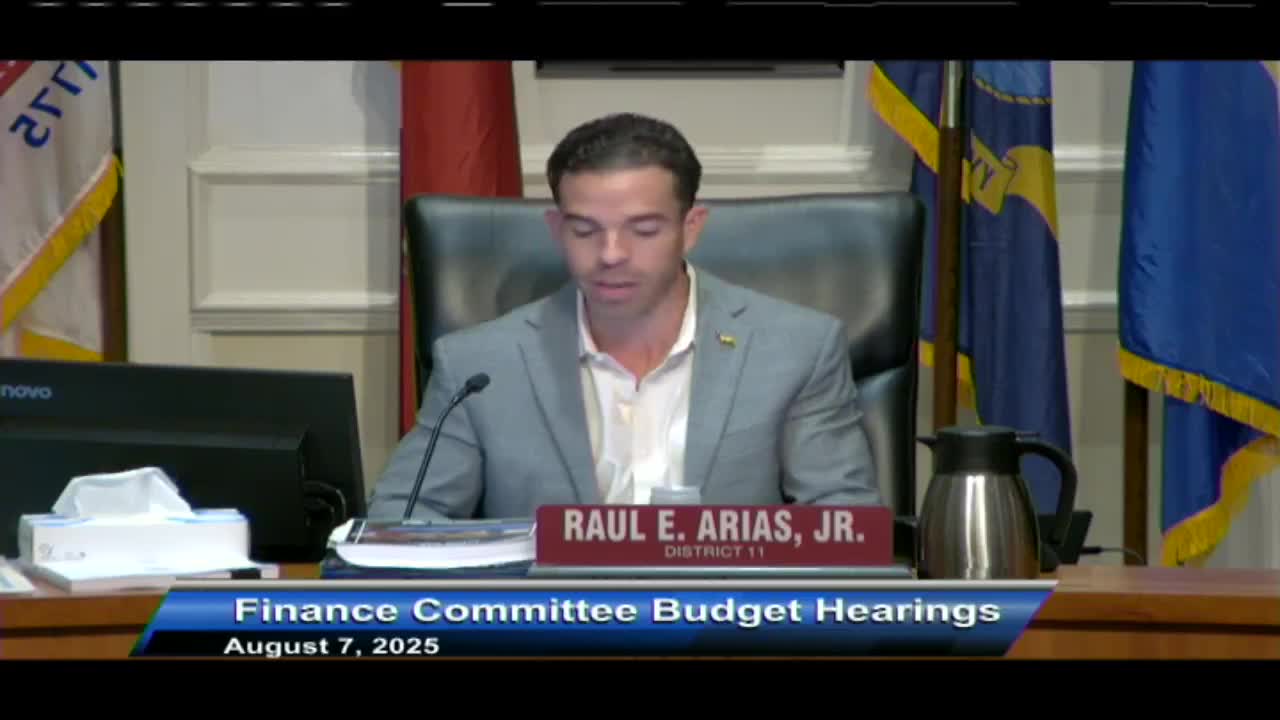
Finance committee cuts telehealth, shifts council CBA dollars, votes 1/8-mill property-tax rollback in first budget hearing
Summary
Jacksonville Finance Committee members opened the city’s 2025–26 budget hearings on Aug. 7 and approved a one‑eighth mill property‑tax rollback, moved district council CBA money from the CIP into the operating budget, deleted a proposed telehealth pilot and directed staff to rewrite financing rules for a $39 million downtown incentive.
Jacksonville Finance Committee members opened the city’s 2025–26 budget hearings on Aug. 7 with a series of policy and technical votes that trimmed one program, restored or reclassified several funding streams and set the tone for later deliberations.
The committee approved moving district council Community Benefits Agreement (CBA) funds out of the capital improvement program (CIP) and into the operating budget. Committee leaders said moving those dollars to operations will recognize them as immediately available to districts and will reduce reliance on debt (the motion was made and seconded on the floor and passed by voice vote). City auditors and staff warned the shift creates an initial $14 million operating shortfall that must be addressed elsewhere in the budget.
In the most visible fiscal change, the committee approved a rollback of ad valorem revenue of $13,478,133 — equivalent to a one‑eighth mill reduction — reducing the proposed millage and lowering the city’s tax take for 2025–26. Supporters said the move returns excess revenue to taxpayers after multiple years of revenue growth; opponents cautioned about sustaining services and preserving long‑term fiscal capacity. The motion passed on a recorded hands/voice vote.
The committee also removed $2.1 million proposed for a telehealth/Health Link JAX pilot from the budget. Supporters of the program argued it had already diverted patients from emergency departments and produced savings for local hospitals; opponents said the service should be funded by health systems or through other mechanisms rather than the general fund. The vote to delete the telehealth line item passed on the floor.
On economic development incentives, staff explained a $39 million proposed Downtown incentive was initially budgeted with debt and that the committee opposed debt‑funding upfront cash incentives. Auditors and budget staff presented an alternative — using available positive variances and escrow arrangements within the General Fund and Downtown Economic Development Fund — and committee members asked staff to prepare finance committee legislation to require pay‑as‑you‑go or escrowed cash rather than debt for that program. The body reached consensus to pursue that approach and asked staff to draft language for a finance committee bill.
Members also debated and acted on a set of smaller, recurring and one‑time items: the committee voted to eliminate the Northeast Florida Regional Council’s general funding allocation and to defer action on several small placeholder line items until staff can list and explain them (a motion to remove $1 placeholder line items was withdrawn pending an auditor-provided list). Other auditors’ technical recommendations and clarifications were approved.
The committee heard department budget presentations, including the Jacksonville Sheriff’s Office and Jacksonville Fire/Rescue. Staff and auditors noted personnel‑cost increases driven largely by recently ratified collective bargaining agreements and by planned equipment purchases. Several grants and capital carryforwards were presented and will be considered later in the cycle.
What comes next Committee members said they want to continue resolving the roughly $14 million structural change created by moving the CBA dollars, and to finish detailed line‑by‑line work later in the week during subsequent budget hearings. Direct contracts (program grants, cultural and public‑service grants, and other single‑vendor agreements) were deferred so the body can review them together at the start of the next meeting cycle.
Votes at a glance (selected actions recorded Aug. 7) - Move district council CBA funds from CIP to operating budget — motion made by Council Member (motion maker identified in hearing); seconded; passed (voice vote). Notes: staff said this creates an initial $14 million operating shortfall that must be offset elsewhere. - Reduce ad valorem (property tax) revenue by $13,478,133 (one‑eighth of a mill) — motion made by Council Member Arias; passed (hands/voice vote). - Remove telehealth/Health Link JAX line item (~$2.1M) from budget — motion passed (voice vote). Notes: proponents said the program diverted ~1,300 ER visits and served 3,100 patients; opponents said hospitals or state/federal sources should fund it. - Reject debt funding for a $39M downtown incentive; direct staff to prepare finance committee bill to require cash/escrow or other non‑debt funding — committee consensus; staff directed to draft legislation. - Delete Northeast Florida Regional Council line item (~$390,673) — motion passed. Notes: witnesses testified about grant work they run for the region; committee members concluded the city should not keep that recurring allocation. - Approve auditors’ technical recommendations (bookkeeping reclassifications, small program carryforwards and debt technical fixes) — motions passed.
What the committee heard from staff and witnesses - Budget staff (Kim Taylor, Council Auditor) presented high‑level numbers: staff noted roughly $87 million in new ad valorem growth for the coming year and repeated that the city’s reserves remain elevated — auditors reported roughly $369 million in operating reserves and $131 million in emergency reserves at the time of the hearing. - The mayor’s budget office (Mike Weinstein) and department leaders briefed the group on out‑year pressures, including collective bargaining and pension/benefit cost trends; staff repeatedly cautioned the committee to consider sustainability for recurring programs. - Public health and nonprofit providers briefed the committee on programs (infant mortality outreach, crisis counseling, eviction prevention and other safety‑net services); members debated which programs are appropriately funded by the city versus state/federal or private providers.
What the committee asked staff to do - Prepare finance committee legislation that prohibits debt‑funding upfront cash development incentives and that outlines a pay‑as‑you‑go / escrow alternative. - Produce a detailed list of placeholder line items (small $1 entries) in the general fund and identify where those appear and their intended use. - Provide updated projections of investment earnings and other revenues ahead of upcoming hearings and bring back firm numbers for Tax Increment Financing/Tax Increment District impacts.
Why it matters The Aug. 7 hearing set the committee’s early posture on tax relief and new spending. The one‑eighth‑mill rollback is a politically significant step toward returning revenue to property taxpayers in a year when the city is also absorbing several large recurring cost increases for public safety labor agreements. The hearing also signals the council’s inclination to constrain some new operating programs if funding sources are unclear (for example, removing the telehealth pilot) while preserving or reclassifying other streams (district CBA dollars).
Ending note The hearing continued a budget process that will include more detailed departmental presentations and a clustered review of direct contracts and grants. The committee recessed with staff directed to prepare proposed legislative language, revenue updates and lists of technical items for the next scheduled session.