Get Full Government Meeting Transcripts, Videos, & Alerts Forever!
Get email alerts on the Public Safety topic
No spam. Unsubscribe anytime.
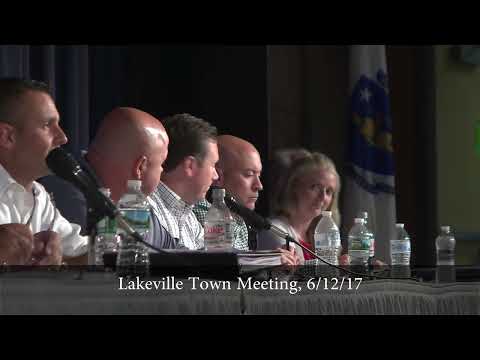
Lakeville voters approve $8 million to build new police station
Summary
Town meeting approved a debt-excluded $8 million borrowing authorization to design and build a new police station after the building committee and architect described a needs-driven design process.
Lakeville voters on June 12 approved $8 million to design and build a new police station, voting two-thirds in favor of a debt exclusion that will temporarily raise property taxes to repay the borrowing. The measure passed after architects and the police-station building committee presented a space-needs assessment supporting the size and design of the proposed facility.
The appropriation authorizes the town to borrow up to $8,000,000 to pay costs of “designing, constructing, originally equipping, and furnishing a new police station, including the payment of all costs incidental and relative thereto,” and allows the treasurer, with selectmen approval, to issue bonds or notes under Chapter 44, Section 7(1) of the Massachusetts General Laws. The borrowing will proceed only if the town later approves a debt-exclusion vote to exclude repayment from the Prop 2½ tax limit, as noted in the warrant language.
Aaron Burke, chairman of the police‑station building committee and a selectman, told voters the committee spent about two years evaluating options — purchasing and retrofitting an existing building, modular construction and a new building — and concluded retrofitting or modular solutions were not feasible. Burke said the committee developed a proposed design after a process that included a space‑needs assessment and site evaluation.
Brian Humes of Jokunsky Humes Architects, the firm selected through a request for proposals, described a four‑step process the firm led: space‑needs assessment, site evaluation, schematic design and professional cost estimating. Humes said the space‑needs assessment (completed February 2017) looked at population, calls for service, historical police data and projected growth; the proposed facility was designed to meet the town’s needs for at least 20 years and, by some metrics, could serve beyond 50 years.
Finance committee members recommended approval. After public questions about longevity, technology infrastructure and staffing assumptions, the moderators asked the tellers to count cards for a two‑thirds required vote. Counters reported results in multiple blocks; the moderator declared the motion passed by two‑thirds.
The vote clears the funding authorization; selectmen and other officials will take administrative steps to issue debt and finalize design and contracting. The warrant and motion language make clear any premium on bonds may reduce the amount authorized consistent with Chapter 44, Section 20 of the General Laws.
The building committee said it will return with more detailed design and schedule information as planning progresses.