Get Full Government Meeting Transcripts, Videos, & Alerts Forever!
Get email alerts on the Noise Ordinance Outdoor Entertainment topic
No spam. Unsubscribe anytime.
New Shoreham officials review noise measurements and propose ordinance changes for outdoor entertainment
Summary
Councilors and staff reviewed ambient and event noise readings, discussed measuring sound from licensees' property lines, removing a current exemption for outdoor entertainment license holders, and exploring C-weighted measurements to capture low-frequency bass. Staff was directed to draft ordinance language for public hearing.
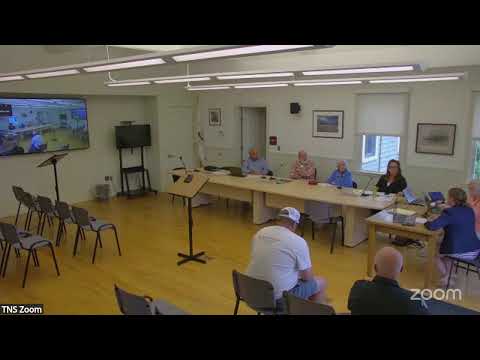
Officials meeting in New Shoreham reviewed municipal noise readings and discussed changes to the town's noise ordinance intended to improve enforcement of amplified outdoor music and address complaints about low-frequency bass.
The discussion centered on recent measurements staff provided showing ambient (neighborhood) sound levels and readings taken near licensed venues. Councilors and staff noted sidewalk readings near multiple locations ranged into the mid-60s to low-80s decibels, while ambient readings in quieter locations averaged about 55 dB. Participants said many disturbance measurements were only about 5–10 decibels above ambient, making it difficult to apply the ordinance as currently written.
Councilors and staff weighed three near-term amendment ideas: (1) measuring sound at the property line of the licensed source rather than at the receiving property, (2) removing a current exemption that excludes outdoor entertainment license holders from table 1 limits so a consistent standard applies to all properties, and (3) considering longer-term additions such as C-weighted measurements that better capture low-frequency bass.
Technical points raised included the difference between A-weighted and C-weighted measurements, a 2‑decibel instrument correction used by the town, and a separate 5‑decibel correction that applies only to “pure tonal” noise (for example, a constant transformer hum) and not to amplified music. Participants described that some other jurisdictions add a C-weighted adjustment (roughly +7 dB compared with A-weighting) to capture bass, and several residents and councilors argued that low-frequency vibration—not just A-weighted level—was a chief source of disturbance in homes.
Speakers identified examples where amplified sound from churches and commercial venues carried across town and where speaker orientation or placement affected impacts. Staff reported that holders of outdoor entertainment licenses have generally been responsive to requests to adjust levels. Councilors asked staff to include in license applications a description of on-site mitigation measures (speaker direction, baffling or barriers, curfews, equipment used) so applicants and neighbors have clearer expectations.
By consensus councilors directed town staff (Nick) to draft ordinance language reflecting the two near-term changes (measuring from the licensee’s property line and removing the outdoor-entertainment exemption from table 1) and return the draft for review and public hearing. Councilors also signaled interest in commissioning a sound engineer and in studying C-weighted metrics and source-management approaches as longer-term steps.