Get Full Government Meeting Transcripts, Videos, & Alerts Forever!
Get email alerts on the Infrastructure Freight topic
No spam. Unsubscribe anytime.
Gordie Howe International Bridge could redirect freight and spur regional warehousing, TMACOG director tells Toledo committee
Summary
Sandy Spank, executive director of the Toledo Metropolitan Area Council of Governments, told the Finance, Budget and Debt Committee that the Gordie Howe International Bridge is likely to shift freight routing and create opportunities for warehousing and related services in Northwest Ohio.
Sandy Spank, executive director of the Toledo Metropolitan Area Council of Governments, told the Finance, Budget and Debt Committee that the Gordie Howe International Bridge is likely to shift freight routing and create opportunities for warehousing and related services in Northwest Ohio.
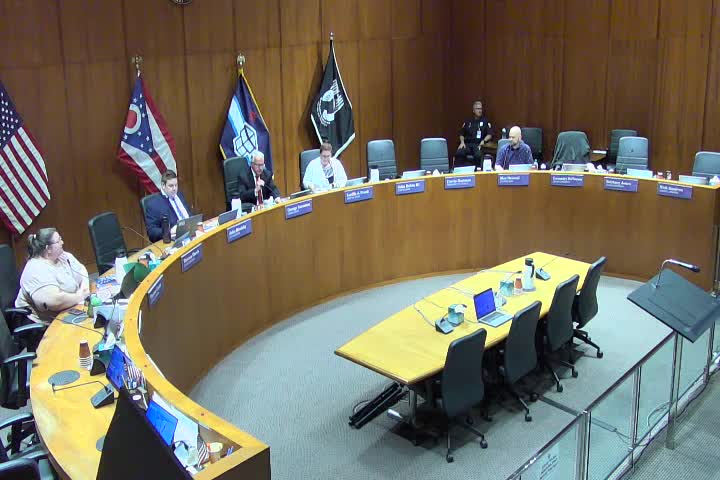
Spank spoke during the committee's regular meeting after the chair said she had asked her to present because the project “is going to be an economic engine that will benefit Toledo, Northwestern Ohio, and Southeastern Michigan.”
The bridge, Spank said, was designed with large customs and processing areas — about 167 acres on the U.S. side and more than 130 acres on the Canadian side — and separate lanes and inspection processing for commercial freight, passenger vehicles and people on foot or bicycle. "This is a game changer," she said, describing separate commercial lanes, a two-truck X‑ray inspection building and 36 main customs gates plus 26 secondary or specialty gates for hazardous materials, livestock and agricultural inspections.
Why it matters: Spank emphasized that current border capacity is concentrated at the privately owned Ambassador Bridge, where backups routinely force truckers to reroute through Port Huron or Buffalo. The Gordie Howe facility includes convertible lane controls and a full suite of on-site federal agencies, which Spank said should reduce processing time and rerouting. "Even if there wasn't an increase in trade, even if we didn't have more trade with Canada, I think we're still going to benefit," Spank told the committee, describing expected redistribution of traffic toward the new crossing.
Project details and features: Spank described the structure as a roughly 1.5-mile span — the largest free-span bridge in North America — with three traffic lanes plus an emergency lane in each direction (eight lanes total when configured for peak flows), a multiuse pedestrian and bicycle path with a separate customs lane, and on-site agency inspection facilities including USDA. She said tolling will be handled on the Canadian side, with rates based on vehicle class and axle count; payment options will include Canadian or U.S. dollars, card, cash and electronic prepaid/postpaid accounts. Spank also described community benefits contractors reported during construction: neighborhood infrastructure improvements, workforce development targeting nearby residents, public art and multiple sustainable design features such as green roofs, LED lighting and native plantings.
Construction and timeline: Spank said she has been told the project was near completion but that the final few percentage points are complicated by technology installations. "I've seen some, you know, there's 2% of the bridge left to finish. But they keep saying it's a very complicated 2%, because this is when the technology goes in," she said. She reported construction employment figures cited at a recent conference: roughly 10,890 jobs in Ontario and 12,670 in Michigan during the build phase.
Local questions and planning implications: Committee members asked about economic projections and traffic impacts. Vice Chair Driscoll asked for estimates of the bridge's economic impact on the region. Spank said outside economists declined to make firm predictions amid national and international trade uncertainty: "It's almost impossible to get anybody to give you any predictions," she said, noting most near-term forecasts did not incorporate the new crossing. Spank and members discussed likely near-term redistribution of traffic from other crossings and longer-term opportunities for warehousing, truck amenities and manufacturing.
On regional transportation planning, Spank said the bridge strengthens the case for a state-selected route for a proposed Columbus bypass and improved I‑75 connectivity. She told the committee Ohio Department of Transportation and regional planning partners attended the bridge tour and that a route selection for a bypass was expected by October, with engineering drawings within about a year; funding and tolling remain unresolved.
Cautions and next steps: Spank and committee members repeatedly framed benefits as contingent and gradual — trucking and private investment decisions will follow private-sector analysis of time savings and cost advantages. She urged local readiness in site preparation, brownfield cleanup and workforce development so Toledo can respond when private actors pursue investment. There was no committee action or vote on the presentation.
Spank closed by encouraging broader awareness of the bridge's features and timing and offered to share the conference presentation with council members.