Get Full Government Meeting Transcripts, Videos, & Alerts Forever!
Get email alerts on the Water Infrastructure topic
No spam. Unsubscribe anytime.
DeKalb County shifts to risk-based plan to replace small-diameter water lines
Summary
County engineers and outside consultants told commissioners they will move from a reactive repair program to a risk‑based, neighborhood-scale replacement program after thousands of breaks and years of recapitalization work.
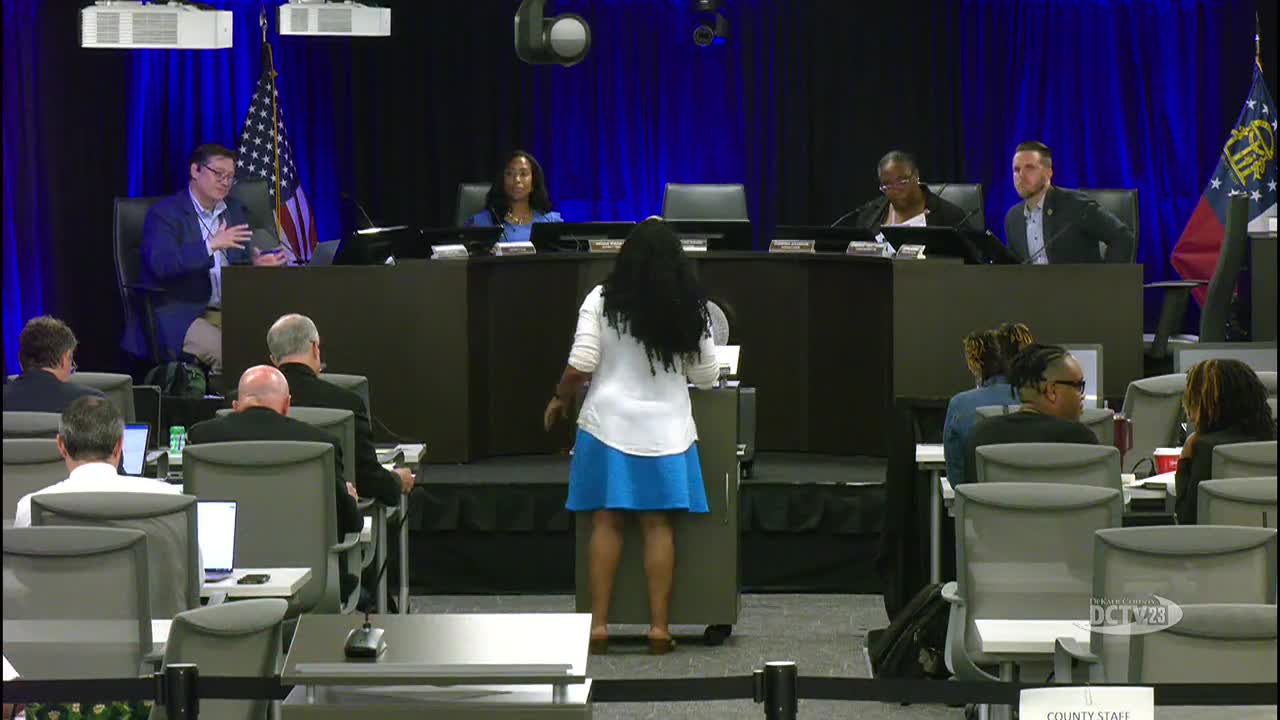
DeKalb County commissioners heard a briefing on a new, risk‑based strategy to replace small‑diameter water lines during a meeting of the Public Works and Information/Infrastructure (PWI) Committee.
County presenters said the county has recorded roughly 8,000 water main breaks over the past eight years — about three breaks per day — and has spent about $142 million on water system recapitalization in the last five years. The county and its engineering partners said the current approach will shift from reacting to individual breaks toward an asset‑management program that packages neighborhood or corridor projects and prioritizes work by likelihood and consequence of failure.
The shift follows guidance from industry standards, including the American Water Works Association (AWWA) M77 approach to condition assessment and risk analysis, presenters said. “The break rates and what we see and feel on a daily basis is only one of the many components that we have or considerations in respect of the master planning,” said Shane, a watershed staff presenter. He told commissioners the county’s technical teams combine pipe condition, age, material and historical break rates with consequences such as hydraulic impacts or disruptions to critical facilities when ranking projects.
Why it matters: Commissioners were told the county cannot take large portions of the system offline for repairs and must sequence projects to preserve system capacity and fire‑fighting hydraulics. Presenters said the new program packages work at a neighborhood or corridor scale so completed areas require less ongoing maintenance and cause fewer service interruptions.
Key details - Scope and costs: Presenters said the current capital improvement program (CIP) includes roughly $1 billion in water‑system renewal work over the coming decade; that list is updated annually and reprioritized every two years as part of the county’s CIP process. They also said the county has already packaged hundreds of projects for future delivery. - Asset assessment: Consultants recommended an objective, repeatable process that uses segment‑level condition assessment and consequence‑of‑failure scoring to create projects. Consultants named included AECOM (Greg Harrison) and Arcadis (Michael Diaz). Brad (engineering staff) and Shane were identified as county technical leads during the presentation. - Coordination constraints: Project timing must coordinate with other public works projects (for example, GDOT work on I‑285) and local city permitting so the county avoids repaving or reworking newly completed corridors. - Procurement and delivery: Commissioners discussed multiple procurement vehicles — design‑build, progressive design‑build and construction manager at risk (CMAR). County staff said many small‑diameter replacements can be delivered quickly with on‑call contractors and limited design (“cut and replace” work), while transmission mains and other large projects will require more formal procurement and design. - Operations and communications: Staff said the county is improving public notice for breaks, using email, recorded messages and press releases for longer incidents. On‑call contractor capacity and contractor availability remain constraints that may delay project starts despite funding availability.
Discussion highlights - Commissioner Terry asked about procurement options and whether alternative delivery methods (progressive design‑build or CMAR) should be used; staff said procurement choices will depend on project type and risk allocation. - Commissioner Massai pressed for clearer public notice when breaks occur; staff said they will improve notifications and use recorded messages and press releases for longer events. - Commissioners and staff discussed repaving approaches after trenching; staff said city permitting and local requirements can require full‑lane repaving in some jurisdictions while in others the county performs narrower trench restoration.
Technical and implementation notes - The consultants cautioned that break counts are an important, immediate signal but are only one input; likelihood (condition, age, material) and consequence (hydraulics, users affected, critical facilities) are weighed together. - Staff said the county maintains flexibility in its CIP, including an allocation (example cited: $30 million) for small‑diameter replacements that allows projects to be slotted more quickly when new breaks or emergencies arise.
Ending County leaders said the program is meant to move the county from ad hoc repairs to a repeatable, data‑driven replacement pipeline; staff will return with regular CIP updates and expects project lists to change annually as conditions, breaks and priorities evolve.